







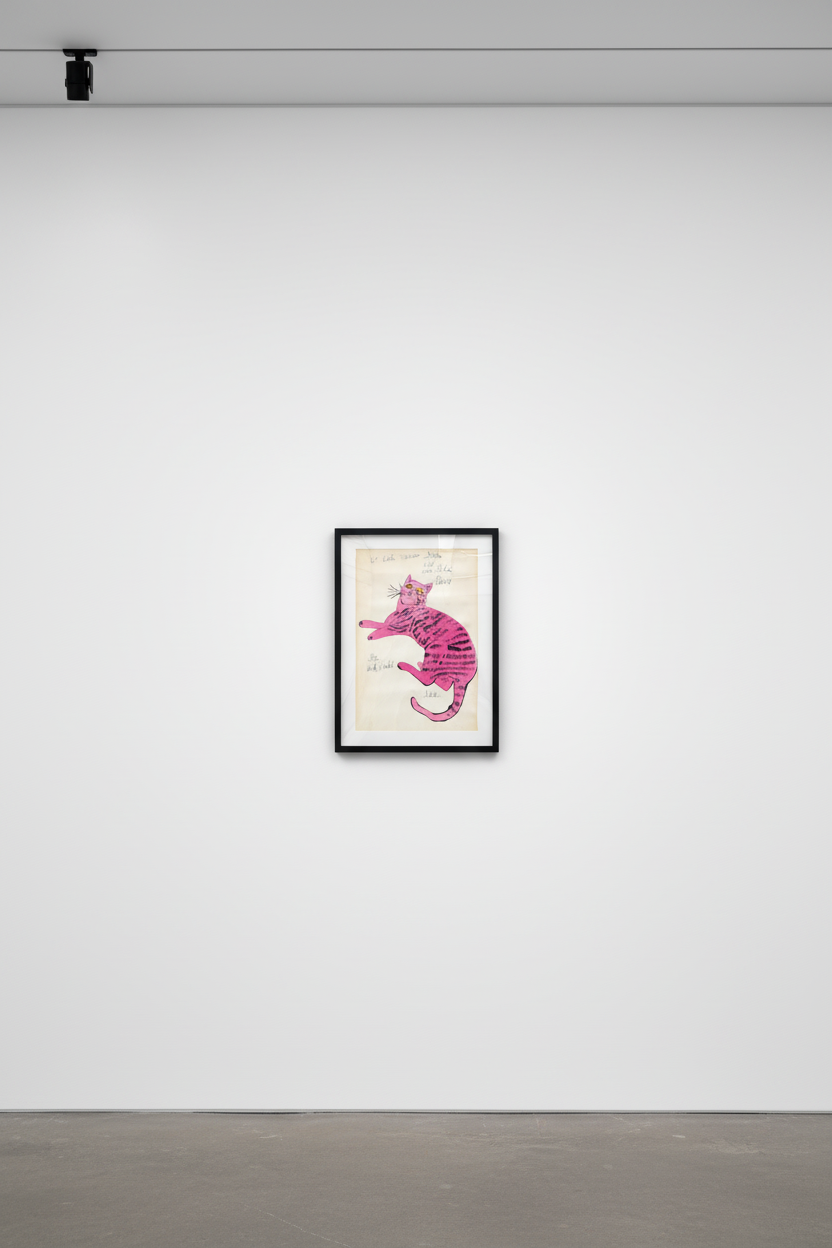
25 Cats Named Sam
20 works

The Flowers 1970 portfolio stands as one of the most actively traded and consistently appreciating series in Andy Warhol's print market, commanding prices that rival his political portraiture while offering broader accessibility than singular iconic subjects.
The Flowers portfolio attracts a distinctive collector profile: buyers seeking museum-quality Warhol exposure without the eight-figure entry point demanded by unique works or the Marilyn series. The Shot Sage Blue Marilyn's $195,040,000 result at Christie's in May 2022—the highest price ever recorded for a 20th-century artwork at auction—established Warhol as the definitive blue-chip standard. The Flowers series benefits directly from this market positioning, functioning as a gateway acquisition for collectors building toward comprehensive Warhol holdings.
Current pricing reflects strong fundamentals rather than speculative heat, a characteristic our advisory team views favorably for 2025-2026 acquisitions.
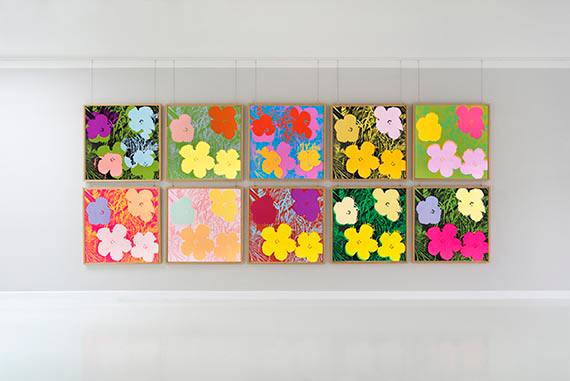
Published by Factory Additions, New York, the Flowers portfolio comprises ten screen prints executed in 1970, each measuring 36 x 36 inches. The edition size of 250 plus 26 artist's proofs established sufficient market liquidity while maintaining collectible scarcity—a balance Warhol calibrated deliberately for his major print projects.
The source imagery derives from a photograph by Patricia Caulfield, published in Modern Photography magazine, which Warhol appropriated and transformed through his signature flattening technique. This act of visual repurposing sparked copyright litigation that became inseparable from the series' conceptual framework, anticipating debates around appropriation art that would dominate critical discourse for decades.
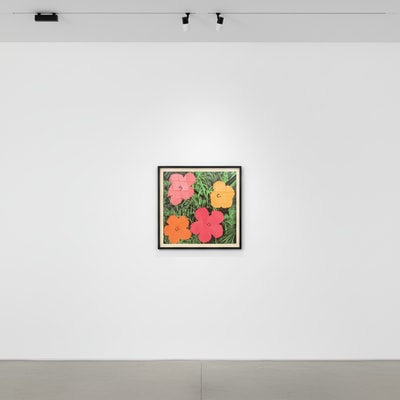
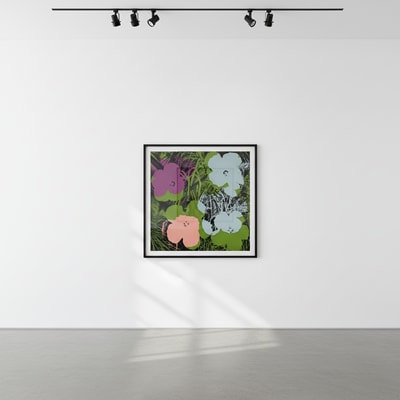
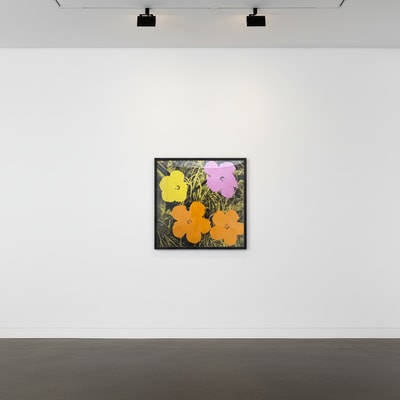
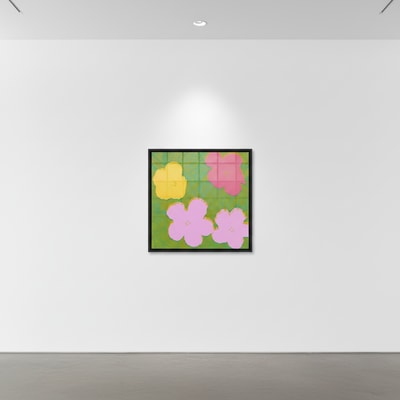
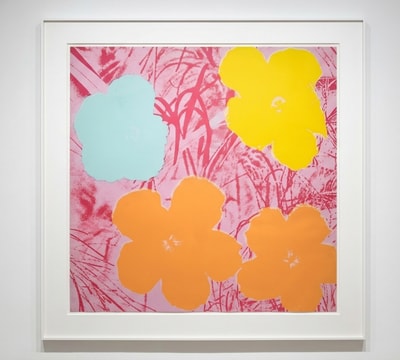
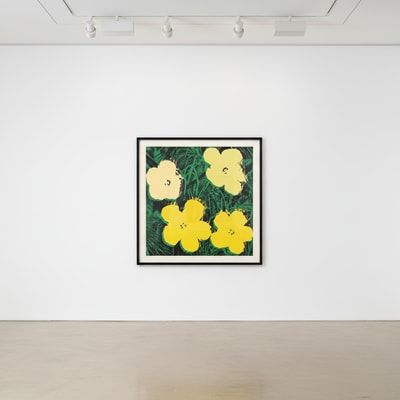
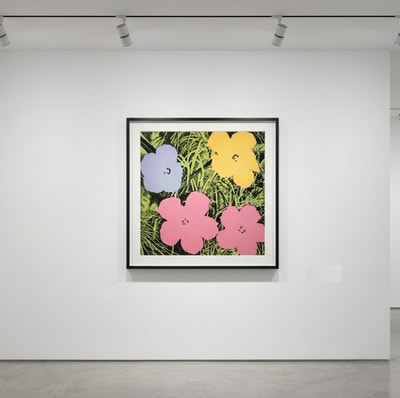
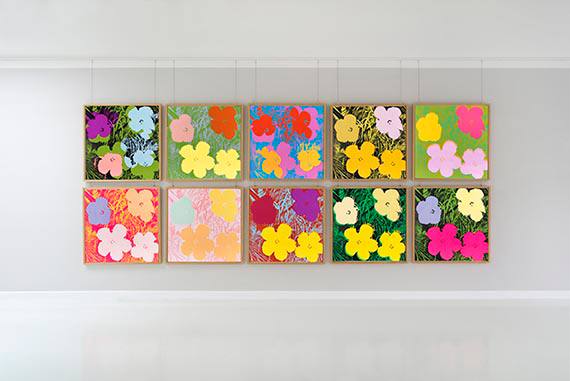
Warhol's color separations reduce botanical complexity to graphic immediacy: four hibiscus blooms rendered in saturated, artificial hues against dark foliage. The tension between organic subject matter and industrial production methodology remains central to the portfolio's art-historical significance. Each colorway—ranging from acidic yellows and pinks to cooler blues and magentas—demonstrates Warhol's understanding of how chromatic variation could generate distinct aesthetic experiences within a unified conceptual framework.
Within the ten-print portfolio, certain colorways consistently outperform others at auction and in private transactions. One colorway, with its striking orange and pink palette, generates the strongest collector response. These works balance visual impact with interior versatility—a practical consideration serious collectors acknowledge when building holdings intended for long-term display.
The complete ten-print set represents a distinct acquisition category. Full sets rarely surface, and when they do, pricing reflects the premium collectors assign to comprehensiveness. From a dealer perspective, complete portfolios appeal to collectors establishing legacy holdings or those with architectural contexts suited to sequential display.
One colorway delivers the saturated visual punch that reads effectively in contemporary interiors. Each colorway has its constituency; none should be dismissed as secondary within the portfolio structure.
Authentication for the Flowers 1970 series requires verification against the Feldman and Schellmann catalogue raisonné, the definitive scholarly reference for Warhol's prints. Legitimate impressions bear the Factory Additions blindstamp and are numbered and signed in pencil on the verso. Unsigned examples exist but trade at significant discounts and should be approached with appropriate documentation scrutiny.
Condition assessment focuses on several series-specific factors. The saturated inks Warhol employed are susceptible to light fading, particularly in the yellow and pink colorways. Collectors should request detailed condition reports noting any color shift, particularly along sheet edges where light exposure typically manifests first. Surface abrasions, handling creases, and foxing affect value materially—differences between fine and excellent condition can represent six-figure price differentials at this market level.
The Andy Warhol Foundation for the Visual Arts maintains authentication protocols that have evolved significantly since the Authentication Board's dissolution in 2011. Provenance documentation tracing ownership history remains the most reliable authentication pathway for secondary market acquisitions. Guy Hepner maintains rigorous verification standards, and our condition reports reflect physical examination by specialists with extensive Warhol print expertise.
Contact Guy Hepner in New York to discuss available Flowers 1970 works, acquisition strategy, or portfolio valuation. Our Warhol specialists offer private consultation for collectors at every stage of market engagement.
This series belongs to the vast and varied body of print and painted work Warhol produced across five decades, during which he moved fluidly between celebrity portraiture, consumer product imagery, historical appropriation, and personal or commissioned subject matter — all filtered through the same signature screenprint process that flattened the distinction between mechanical reproduction and fine art. Warhol's insistence on treating commercial printing techniques as a primary artistic medium, rather than a secondary reproductive tool, remains one of the most influential positions in postwar American art.
Warhol's work is held in the permanent collections of major museums worldwide, including the Museum of Modern Art, the Whitney Museum of American Art, Tate Modern, and the Andy Warhol Museum in Pittsburgh, which maintains the most complete public archive of his output across all periods and subjects.
13 works available
The Colourways
Warhol first appropriated the hibiscus image from a 1964 photography magazine; in 1970 he returned to it and formalised the motif into this ten-print portfolio, now one of his most widely exhibited images.
Other Flowers 1970 Works
Five Facts About Andy Warhol Flowers 1970
Flowers 1970 is a portfolio of ten screenprints published by Factory Additions, New York, in an edition of 250, plus 26 artist's proofs lettered A through Z.
The images are based on a photograph of hibiscus blossoms that Warhol first used for his painted Flowers series of 1964-65, revisited five years later in print form.
Each sheet measures approximately 36 x 36 inches, catalogued as Feldman and Schellmann II.64-73, printed by Aetna Silkscreen Products, Inc., New York.
The ten prints share the same underlying floral image but are differentiated by background and petal colour across the set.
Impressions from the portfolio are held in major museum collections, including the Museum of Modern Art in New York.
Market Data
See real auction history, estimate ranges and price benchmarks for individual Flowers 1970 prints, sourced from Christie's, Sotheby's and other major auction houses.
Frequently Asked Questions
Andy Warhol Flowers 1970 prints for sale are available at Guy Hepner Gallery, 177 Tenth Avenue, New York. We offer authenticated editions with full provenance documentation sourced from the secondary market and directly from publishers.
Andy Warhol Flowers 1970 works — 13 available — are typically produced as limited editions, individually signed and numbered by the artist. Contact Guy Hepner Gallery for edition details on specific works.
Pricing for Andy Warhol Flowers 1970 prints varies by edition size, date, and condition. Contact Guy Hepner Gallery for current market pricing and availability.
From the Journal
Watch
More Andy Warhol Series
View all Andy Warhol works →