727

May 23, 2026
Takashi Murakami stands as one of the most influential and commercially significant contemporary artists of the 21st century. His extraordinary ability to seamlessly blend traditional Japanese artistic techniques with contemporary pop culture has resulted in an instantly recognizable visual language that has captivated collectors, museums, and art enthusiasts across the globe. For those seeking to enter the vibrant market for Murakami prints - whether as seasoned collectors expanding their holdings or newcomers acquiring their first piece - understanding the artist's background, his print editions, and the current market dynamics is essential. This comprehensive guide covers everything you need to know about collecting Takashi Murakami prints.
Takashi Murakami was born in 1962 in Tokyo, Japan, and his artistic journey began within the rigorous traditions of Japanese art education. He studied traditional Nihonga painting at the Tokyo University of the Arts, ultimately earning a PhD in the discipline - a remarkable academic achievement that provided him with deep knowledge of classical Japanese artistic conventions. However, Murakami quickly became dissatisfied with what he perceived as the rigid and insular conventions of Nihonga, seeking a new direction that would allow him to engage with the broader contemporary world.
Influenced by both Western pop art - particularly the democratizing approach of artists like Andy Warhol - and Japanese otaku culture, Murakami began developing his own unique visual vocabulary that merged the boundaries between fine art and mass production. This synthesis would eventually crystallize into his groundbreaking Superflat theory, articulated in 2000, which posited that traditional Japanese art and contemporary anime and manga share a flattened aesthetic that distinguishes them from Western artistic traditions emphasizing perspective and depth.
In 1996, Murakami established the Hiropon Factory, which later evolved into Kaikai Kiki Co., Ltd. - a sophisticated studio that functions simultaneously as a commercial art production house and an incubator for emerging Japanese artists. This enterprise model, reminiscent of Warhol's Factory, has enabled Murakami to produce work at scale while maintaining exacting quality standards. Today, Kaikai Kiki employs hundreds of assistants and operates offices in Tokyo, New York, and Los Angeles, underscoring Murakami's position as both artistic visionary and entrepreneurial force.
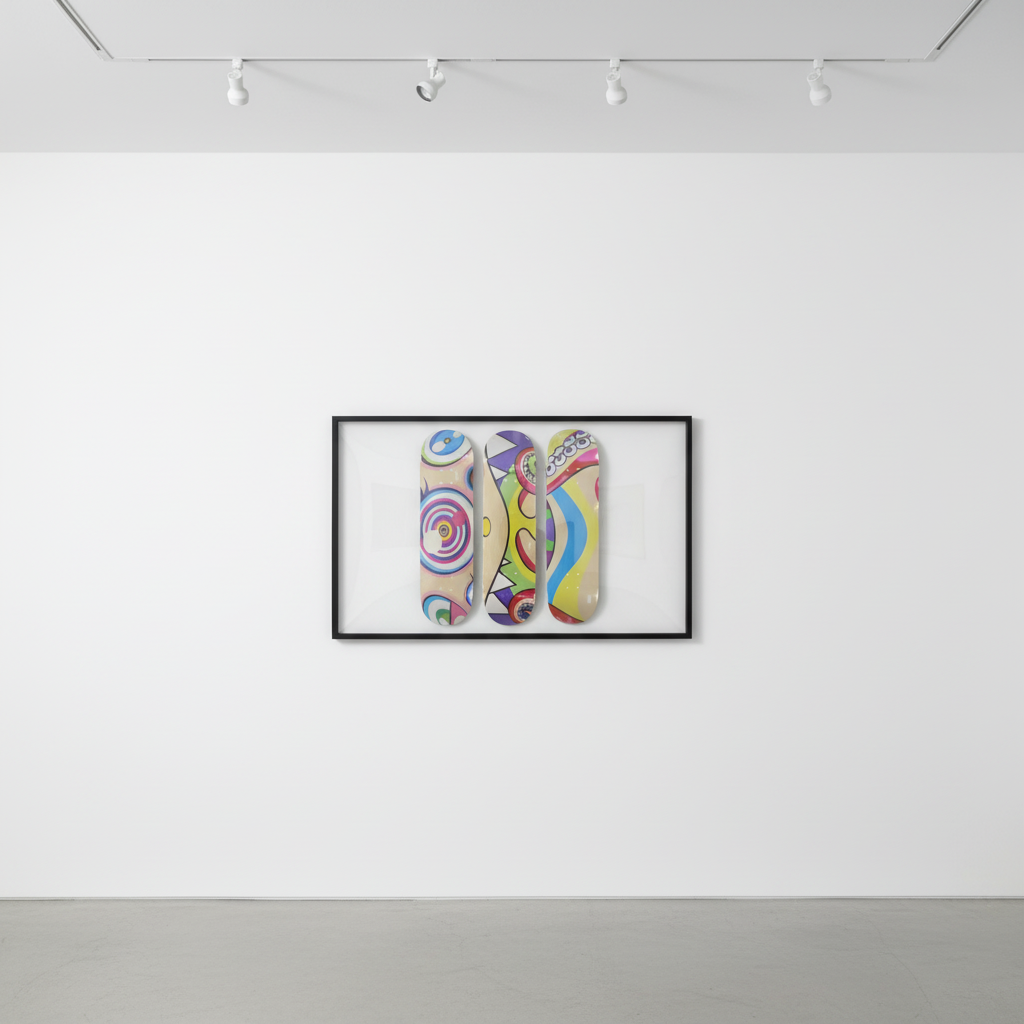
Flowers Set Of 3 Skateboard Decks — Takashi Murakami. Available at Guy Hepner, New York.
Takashi Murakami prints represent one of the most accessible entry points into collecting work by a major contemporary artist, while simultaneously offering significant examples of his artistic vision. His print editions - spanning screenprints, offset lithographs, and mixed-media works - feature the same iconic imagery that appears in his monumental paintings, including the beloved smiling flowers, the enigmatic Mr. Dob character, and his elaborate skull compositions.
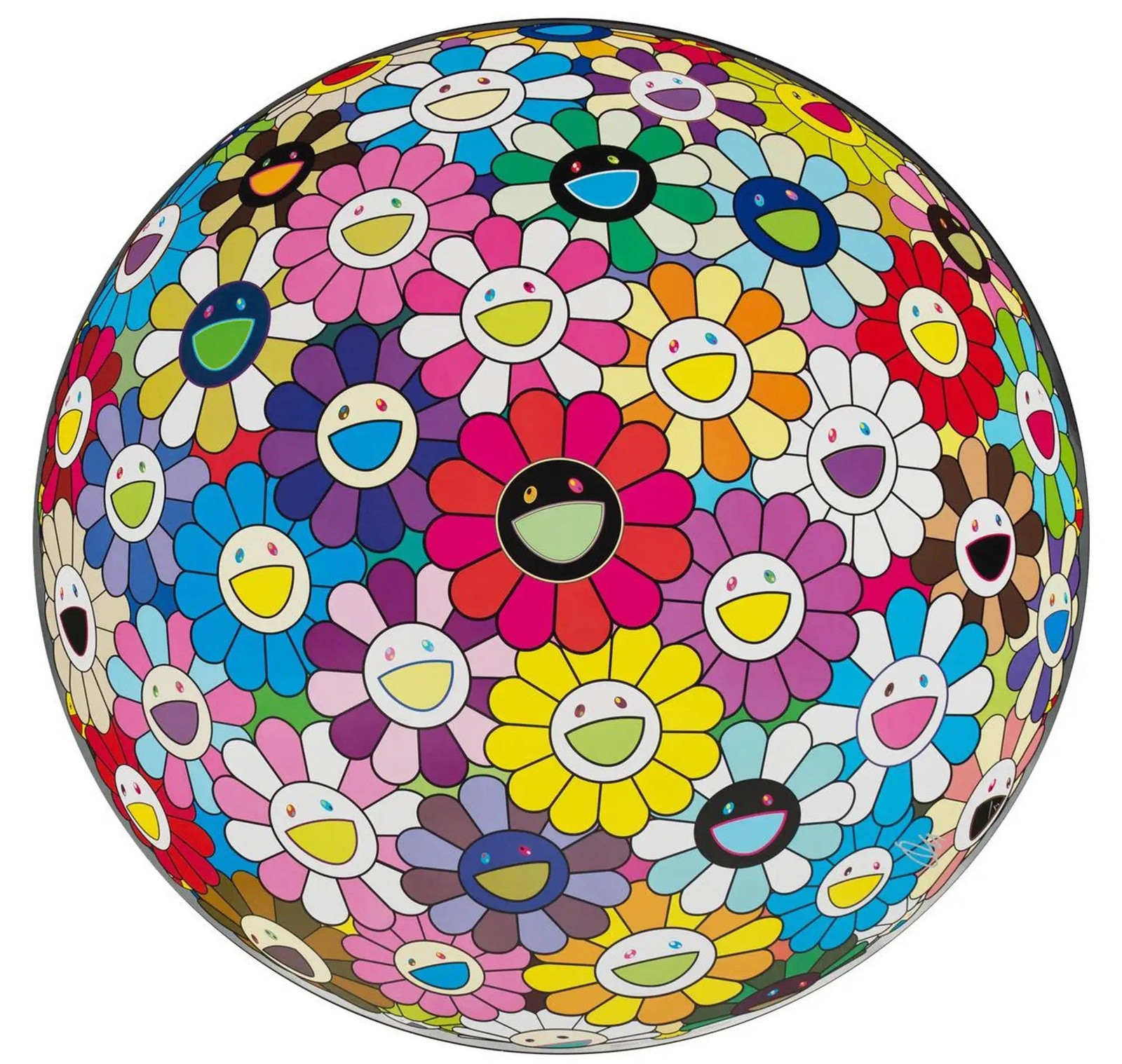
The flowers motif, in particular, has become synonymous with Murakami's practice and remains highly sought after by collectors worldwide. These cheerful, rainbow-hued blossoms with their cartoon-like smiling faces emerged in the early 2000s and have since appeared across countless print editions, each variation offering subtle differences in color palette, composition, and scale. According to market analysis from Sotheby's, Murakami flower prints consistently perform well at auction, demonstrating sustained collector interest across multiple market cycles.
Murakami's print editions also showcase his remarkable range of cultural references and collaborations. His homages to art historical masters - including works that reference Yves Klein's iconic blue and traditional Japanese painters like Ogata Korin - demonstrate the intellectual depth underlying his seemingly playful aesthetic. These art-historical dialogues make Murakami prints particularly appealing to collectors who appreciate conceptual sophistication alongside visual impact.
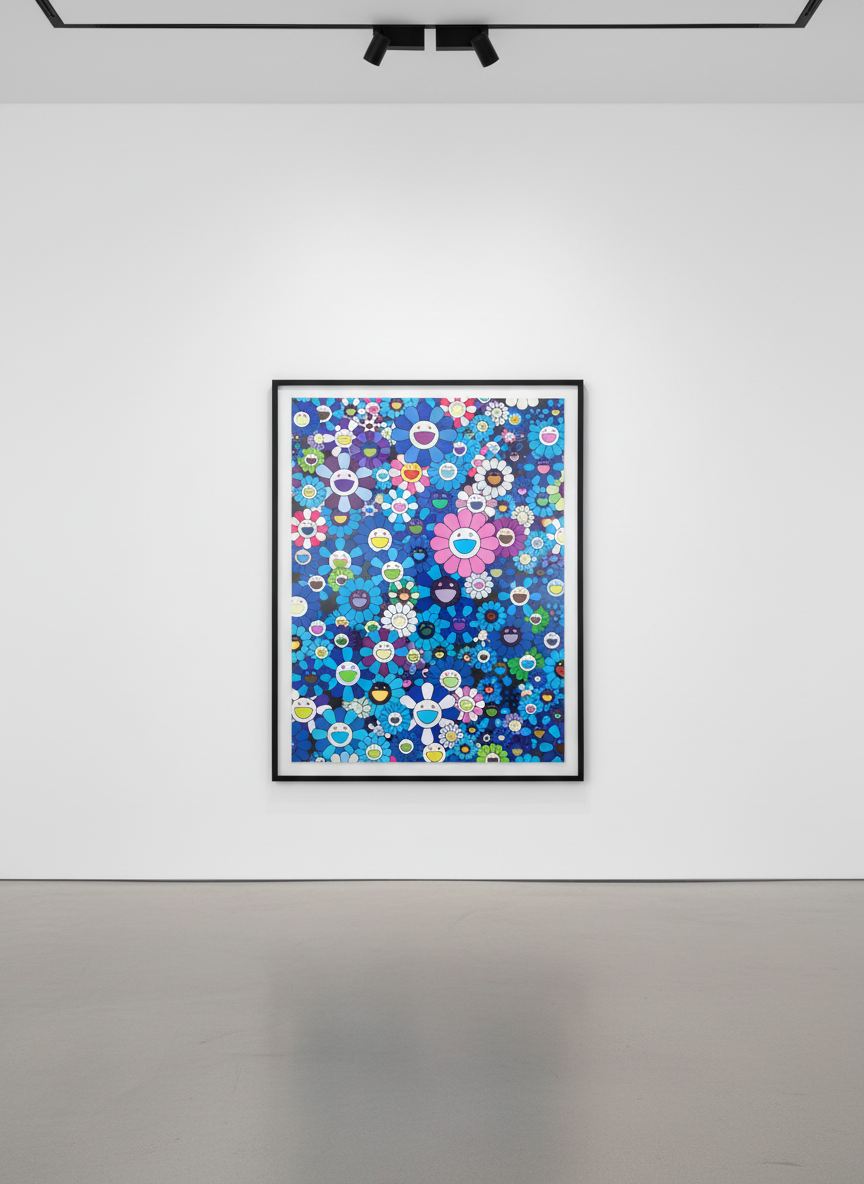
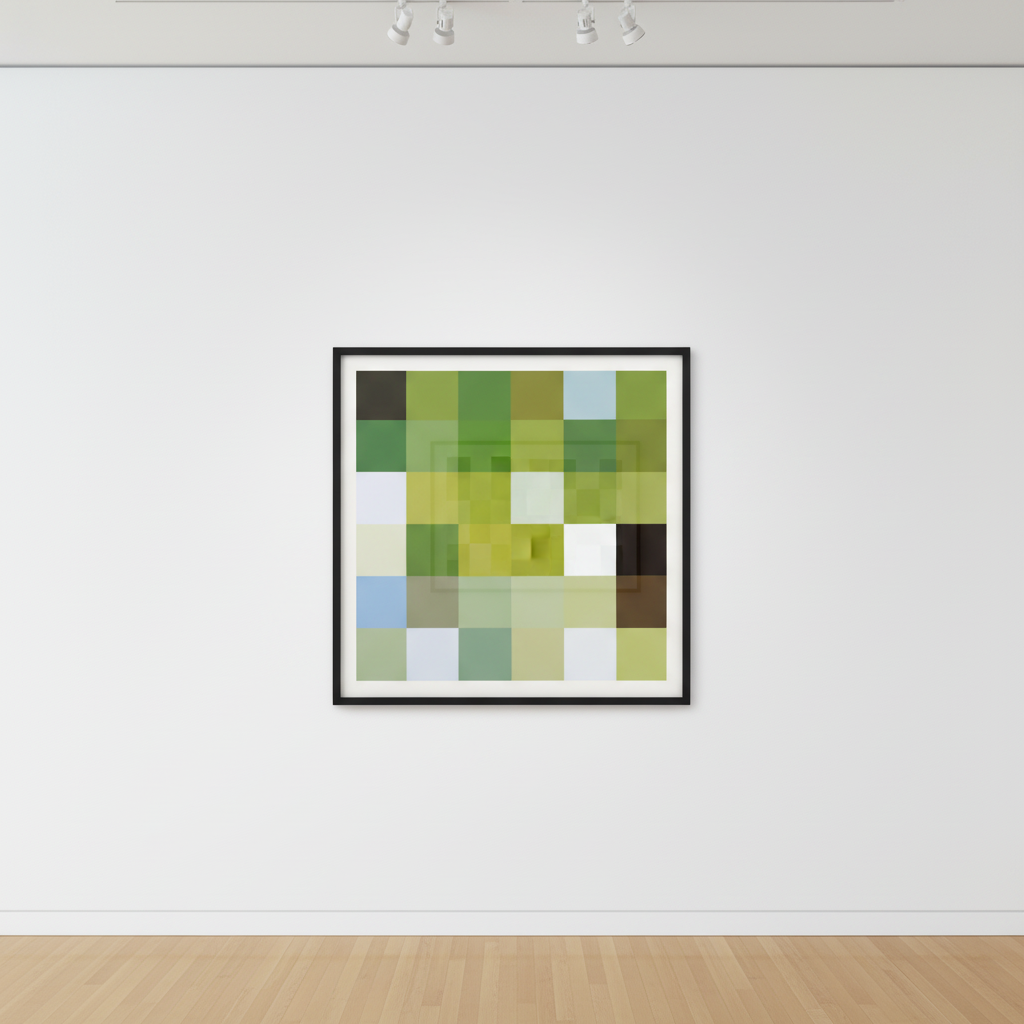
An Homage To Yves Klein Blue — Takashi Murakami. Available at Guy Hepner, New York.
The artist's collaborations have further elevated his profile and expanded his collector base. His partnerships with major fashion houses and musicians have introduced his work to audiences far beyond traditional art world boundaries, while his museum retrospectives at institutions including the Museum of Contemporary Art Los Angeles and the Palace of Versailles have cemented his art historical significance.
The market for Takashi Murakami prints has demonstrated remarkable resilience and growth over the past two decades. According to data from Christie's, Murakami ranks consistently among the top-selling contemporary artists at auction, with his print editions representing a significant portion of transaction volume. The Art Basel and UBS Global Art Market Report has noted the continued strength of the contemporary print market, with established artists like Murakami commanding particular collector attention.
When considering Takashi Murakami prints for acquisition, collectors should pay attention to several key factors. Edition size significantly impacts both availability and long-term value - smaller editions typically command premium prices and may appreciate more substantially over time. Condition remains paramount, as these works often feature vibrant colors and metallic elements that can be sensitive to light exposure and environmental factors. Provenance and authentication through Kaikai Kiki Co. provide essential assurance of legitimacy in a market where the artist's popularity has unfortunately attracted counterfeiters.
The range of price points available in Murakami prints makes the artist accessible to collectors at various levels of the market. Entry-level prints and multiples - including his acclaimed skateboard deck editions - offer opportunities for emerging collectors to acquire authentic Murakami works, while rare early editions and large-format prints appeal to established collectors seeking museum-quality pieces.
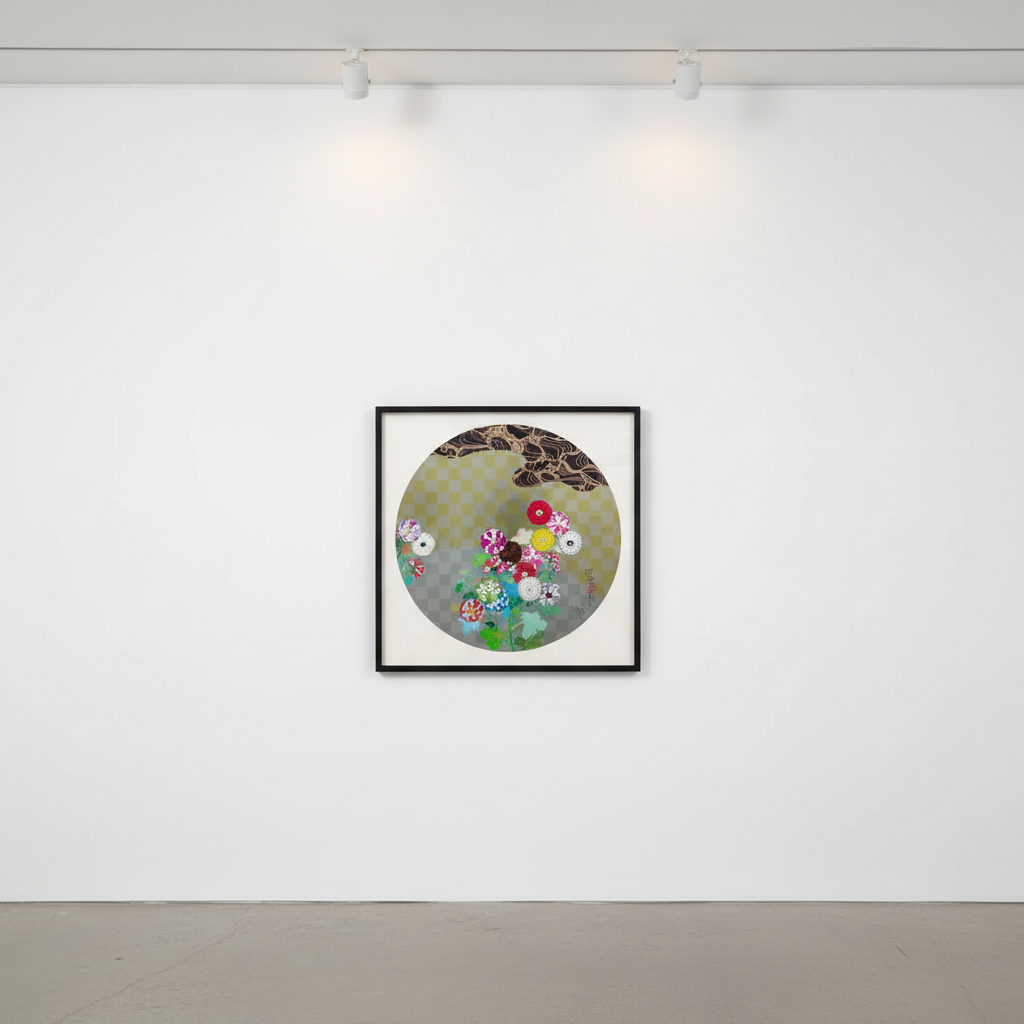
Korin Flowers and Water — Takashi Murakami. Available at Guy Hepner, New York.
The enduring appeal of Takashi Murakami prints stems from multiple factors that resonate with contemporary collectors. His work offers genuine artistic innovation - the Superflat movement he pioneered has influenced countless artists and reshaped conversations about the relationship between high and low culture. Simultaneously, his prints deliver immediate visual pleasure, their vibrant colors and playful imagery creating powerful aesthetic experiences that enhance any collection or living space.
Murakami's continued productivity and relevance further support collector confidence. Unlike artists whose practices have stagnated, Murakami continues to evolve, introducing new motifs, exploring fresh collaborations, and engaging with contemporary cultural moments. This ongoing vitality suggests sustained institutional and market interest for years to come.
Guy Hepner is proud to offer an exceptional selection of Takashi Murakami prints, including iconic flower editions, limited-edition multiples, and rare works that represent the full scope of the artist's remarkable vision. Our specialists provide personalized guidance to collectors at every level, ensuring informed acquisitions that align with individual aesthetic preferences and collecting goals. Contact Guy Hepner today to explore available Takashi Murakami prints and discover the perfect addition to your collection.
To understand Takashi Murakami's prints as art historical objects — rather than simply decorative works or commercial multiples — it is essential to engage seriously with the Superflat theory he articulated in his landmark manifesto of 2000. The concept is deceptively simple in its name and dizzyingly complex in its implications, and it underpins virtually everything Murakami has made since the mid-1990s. Superflat is not merely an aesthetic description; it is an argument about Japanese culture, colonialism, and the collapse of distinctions between historical eras and cultural registers.
The manifesto takes as its starting premise an observation about surface. Japanese art, Murakami argues — from the flat gold-ground compositions of Momoyama-period screen paintings through the woodblock ukiyo-e prints of Hokusai and Hiroshige, through wartime propaganda illustration, and into postwar manga and anime — has never fully adopted the Western tradition of perspectival depth. The pictorial space in Edo-period ukiyo-e prints is flat, layered, pattern-driven. Figures exist in relation to decorative fields, not in convincing three-dimensional space. This is not an absence of sophistication; it is a different set of conventions entirely, and Murakami argues it creates a visual continuity across five centuries of Japanese image-making that Western art history has consistently failed to recognize on its own terms.
The postwar dimension of the Superflat argument is where it becomes most provocative. Murakami contends that Japan's defeat in 1945 and the subsequent American occupation produced a cultural condition of radical infantilisation. Japan was, in his reading, forced to relinquish military and political agency and instead redirected its creative energies into the production and consumption of fantasy: anime, manga, video games, character merchandise. Otaku culture — the obsessive, insular fandom built around fictional Characters and fictional worlds — becomes, in Superflat, not a cultural pathology but a legible response to historical trauma. The flat, two-dimensional worlds of manga and anime are the direct descendants of Edo period woodblocks, both formally and psychologically.
The critical move Murakami makes is to refuse any hierarchy between these registers. The smiling flowers that appear in his screenprints are simultaneously high art and kawaii consumer goods, simultaneously referencing classical Japanese painting techniques and anime character design. The same image can appear as a gallery-exhibited silkscreen edition and as a plush toy. This is not a contradiction in Murakami's framework; it is the point. Superflat argues that the categories through which Western culture orders art — fine art versus commercial art, serious versus playful, museum-worthy versus mass-produced — are themselves ideological constructs that Murakami's work deliberately dismantles.
For the print collector, understanding Superflat transforms how the works read. When you acquire a Murakami flower print, you are not simply buying a bright, cheerful image. You are acquiring an object that embeds a sophisticated theoretical position about Japanese cultural history, about the relationship between traditional craft and contemporary consumer culture, and about what it means for an image to exist simultaneously in gallery space and in the broader visual economy. The prints are argument-objects. Their apparent accessibility is part of the argument, not an escape from it.

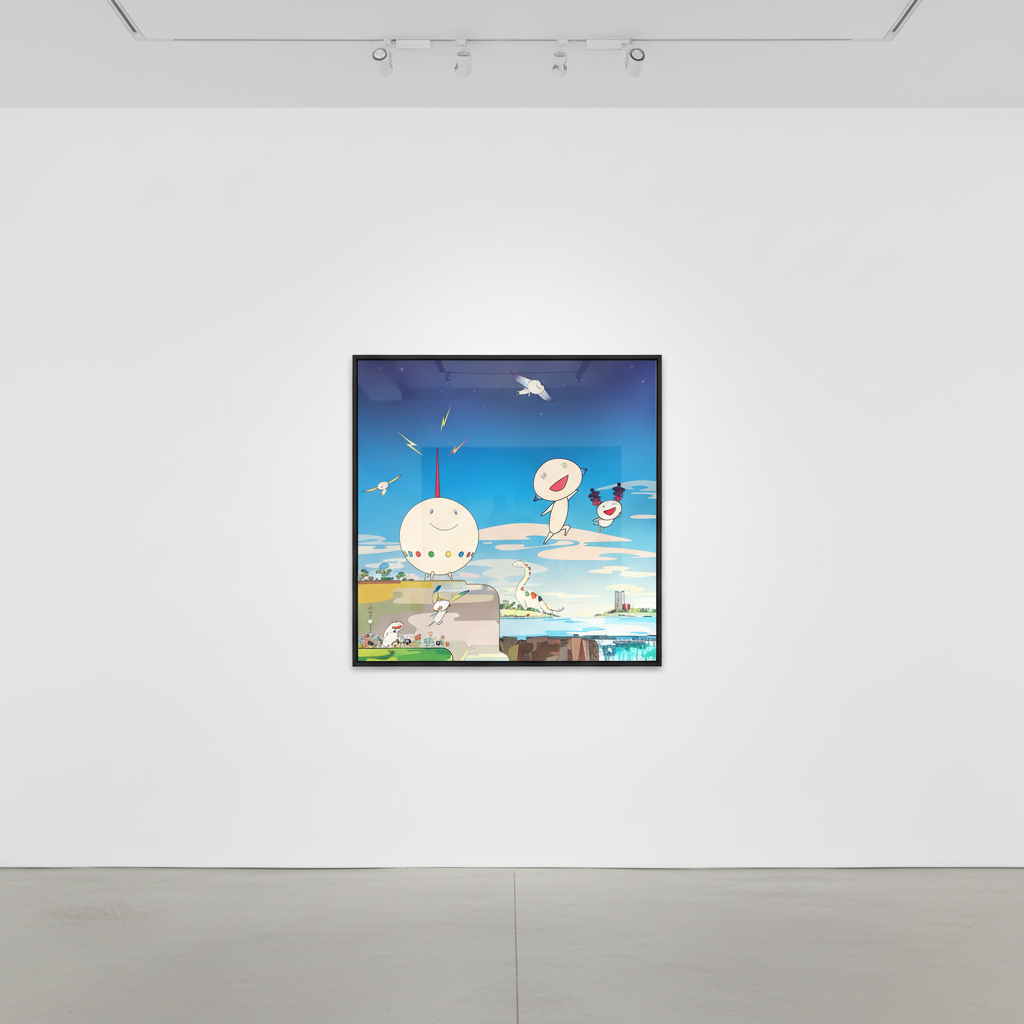
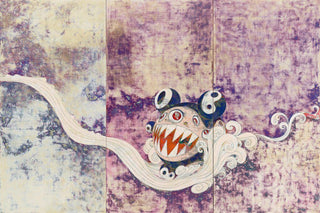
727 — Takashi Murakami. Available at Guy Hepner, New York.
Murakami has developed a body of print work across multiple distinct series over three decades, each with its own iconography, market dynamics, and collecting logic. Understanding the differences between these series is foundational to building a coherent collection and making informed acquisitions. What follows is a practical map of the major bodies of work and what collectors should know about each.
The smiling, multi-eyed flower motif is Murakami's most recognised and most widely collected image. First developed in the early 2000s, the flowers — with their circular, cartoon faces ringed by dozens of petals in graduated rainbow color fields — have appeared in hundreds of print editions across a vast range of scales, color palettes, and formats. Their immediate visual appeal, combined with their art-historical complexity (the flat petal arrangements deliberately invoke Rimpa school decorative painting), has made them the most actively traded works in the secondary market for Murakami prints.
Collector notes: Edition size varies considerably across flower print releases, from small editions of 50 to open editions running into the hundreds. Smaller editions, particularly those published directly through Kaikai Kiki or by Galerie Perrotin, typically command premium prices. The flowers also appear in multiples formats — framed print sets, shaped editions, and sculptural works — which function differently in terms of both collecting and care.
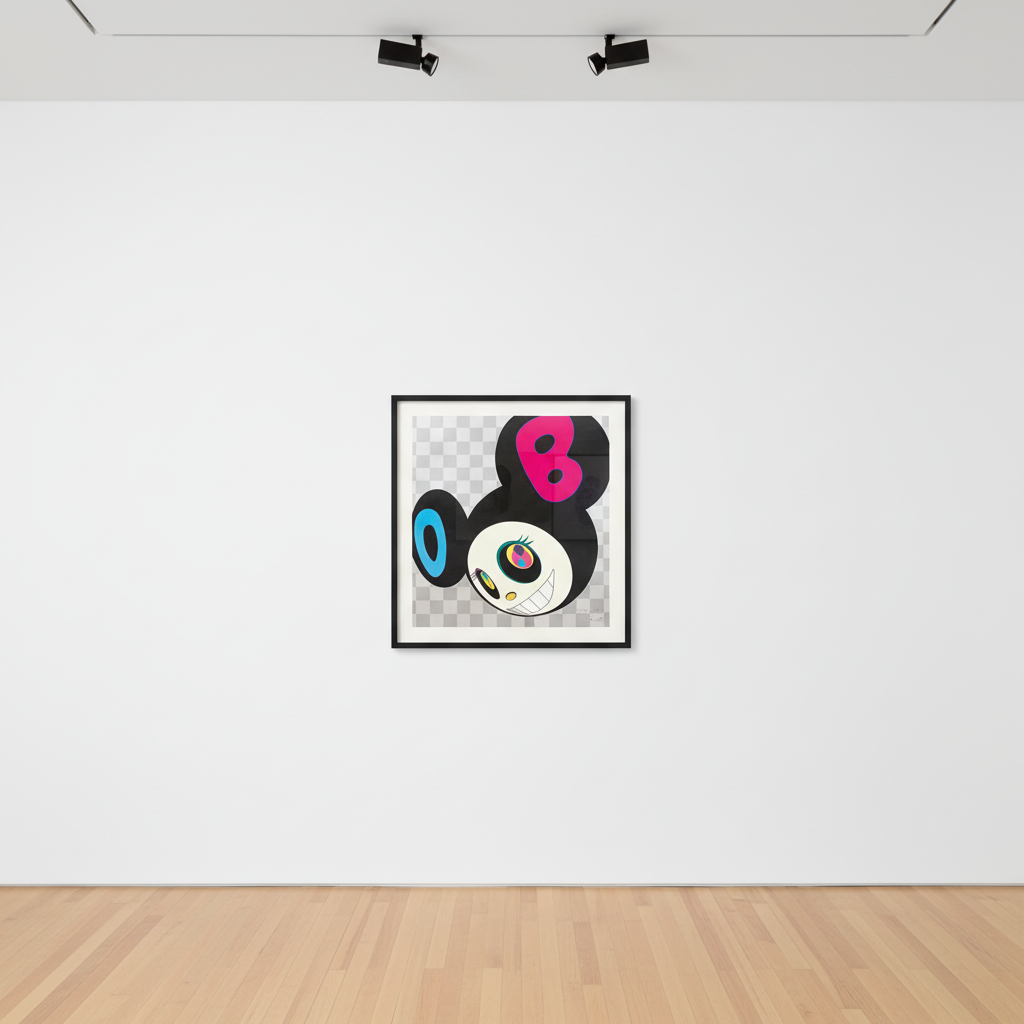
Mr. DOB — Murakami's alter-ego character, a smiling mouse-like creature whose features migrate between cartoon innocence and unsettling aggression — is among the artist's earliest and most conceptually charged motifs. The character's name derives from the Japanese slang phrase "dobojite" (why?), and his shifting physiognomy across different works allows Murakami to probe the contradictions within consumer culture: the cheerful exterior that conceals teeth. Mr. DOB works tend to appear in smaller print editions than the flowers, and early examples from the late 1990s and early 2000s are substantially rarer in fine art print form.
Collector notes: Mr. DOB prints represent early career works and carry a different market positioning from the flowers. They appeal to collectors with a more conceptually oriented interest in Murakami's practice, and they appear less frequently at open-market auction. Provenance documentation is particularly important for early DOB works given their relative scarcity.
The 727 series — named after the painting exhibited at the 1996 P.S.1 Contemporary Art Center show and subsequently restaged at multiple institutions — represents Murakami's most ambitious engagement with Japanese art historical tradition in his print work. The central image, a rolling dragon-cloud over churning waves, derives directly from classical Edo-period screen painting conventions but is rendered in Murakami's flat, graphic register. The series also includes the iconic "My Lonesome Cowboy" and related figure works that position anime aesthetics within the context of monumental painting.
Collector notes: 727-related print editions are among the most significant in terms of art historical weight, and they appeal to collectors building museum-quality holdings. Works from this series have performed strongly at major auction houses and represent a significant statement in any collection.
Murakami's skull imagery provides the counterpoint to his cheerful flower iconography: where the flowers celebrate surface and pleasure, the skulls engage with mortality, Buddhist impermanence, and the darker undercurrents of Japanese visual culture. The skull works draw on both Western vanitas traditions and Japanese Buddhist iconography around death and rebirth. In print form, skull editions have attracted strong collector interest, particularly from those who find the flowers too decorative and seek works with more explicit conceptual weight.
Collector notes: Skull print editions have shown consistent secondary market strength, and their more sombre palette makes them formally versatile in collection display contexts. They also pair well with Murakami's flowers in collections that seek to represent the full range of his thematic concerns.
Tan Tan Bo — the biomorphic, blob-like figure first developed around 2001 — represents one of Murakami's most formally adventurous and least commercially straightforward characters. The figure's amorphous, constantly mutating form refuses the legibility of the flowers or Mr. DOB and positions Murakami within a tradition of biomorphic abstraction that connects to European Surrealism while remaining distinctly Japanese in its execution. Tan Tan Bo prints are rarer than flower editions and appeal particularly to collectors interested in Murakami's more experimental output.
Collector notes: Tan Tan Bo editions are less frequently available at open market and tend to hold well in terms of secondary market positioning due to their relative scarcity. They represent an excellent option for collectors seeking works less widely seen in the market.
The KAIKAIKIKI mascot characters — Kaikai, a white bunny-like figure, and Kiki, an orange star-shaped sprite — appear across a range of editions, multiples, and merchandise-adjacent objects. These works occupy an interesting position in collecting terms: they are more accessible and more openly commercial than the major fine art print series, yet they are produced with the same exacting craft standards. Edition controls vary, and collectors should pay close attention to publisher information when considering KAIKAIKIKI character works.
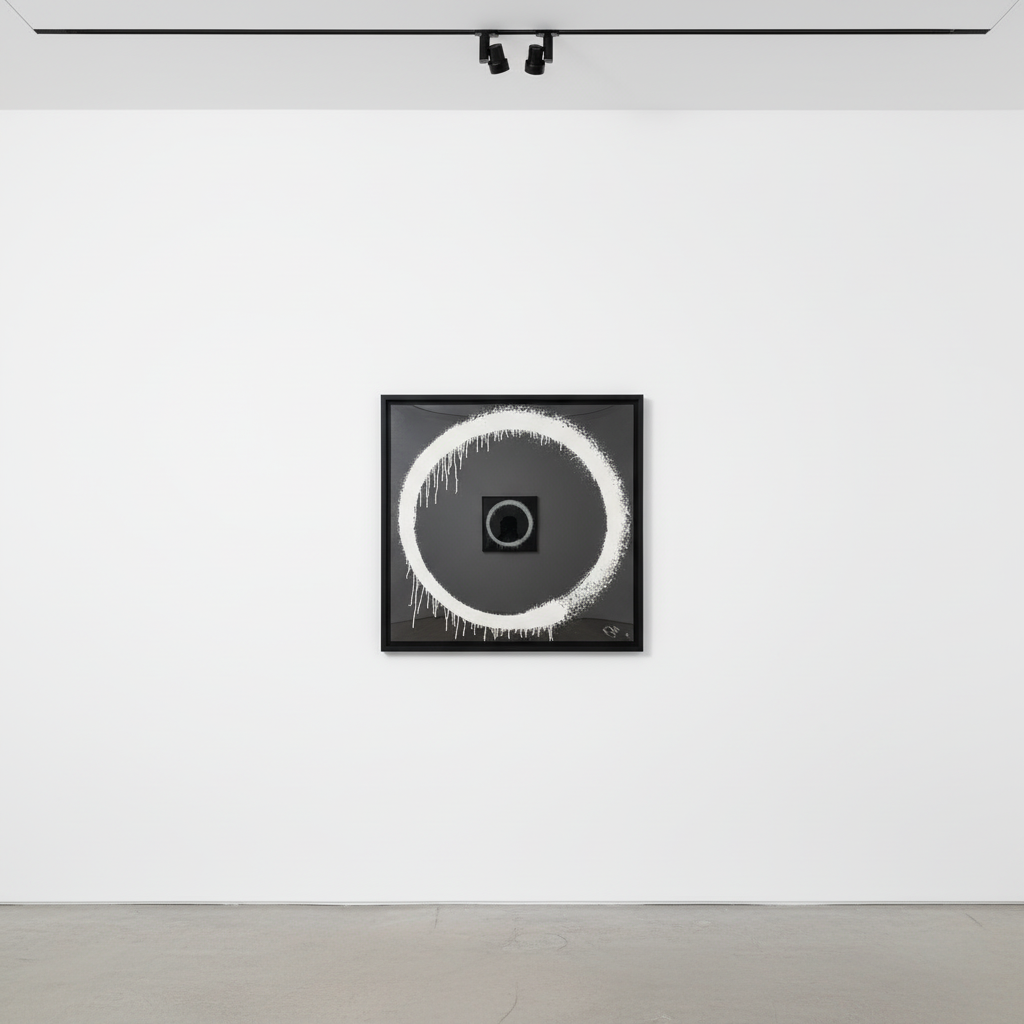
The Enso series — works featuring the Zen Buddhist circular brushstroke — represents Murakami's most explicitly abstract body of work, and arguably his most direct engagement with the Japanese fine art tradition. The enso is a centuries-old Zen practice: a single, spontaneous brushstroke completing a circle, expressing the moment of enlightenment or the imperfection of existence. Murakami's versions translate this gesture into his flat graphic language, rendering the circle in vibrant color fields against spare grounds. These works are less widely known than the flowers or skulls but are significant in terms of understanding the full scope of his practice.
Collector notes: Enso works appeal to collectors seeking Murakami works with direct lineage to the Japanese fine art tradition and are a meaningful complement to flower and skull holdings.
Murakami's homage works — including his tributes to Yves Klein, Ogata Korin, and other art historical figures — demonstrate the intellectual scaffolding of his practice most explicitly. The Yves Klein homage works directly invoke Klein's IKB blue and his "Anthropometries" performances, translated into Murakami's flat graphic language. The Korin-derived works reference the Rimpa school master whose folding screen compositions are among the most celebrated works in Japanese art history. These homage editions are particularly significant for collectors interested in the conceptual depth of Murakami's practice.

Red Crane — Takashi Murakami. Available at Guy Hepner, New York.
No aspect of Takashi Murakami's practice has shaped his market profile more dramatically than his collaborations — not because they represent the artistic core of his work, but because they redrew the boundaries of who knew his name and what his images signified. Each major collaboration introduced a new audience, generated a new class of collectible object, and posed fresh questions about the relationship between art, commerce, and cultural value.
The Louis Vuitton collaboration, initiated with then-Creative Director Marc Jacobs in 2003, remains the most consequential collaboration in Murakami's career and one of the most influential fashion-art partnerships of the twenty-first century. The project saw Murakami reimagine Louis Vuitton's iconic LV monogram in a spectrum of thirty-three colors, producing what became known as the Multicolor Monogram — instantly recognisable, widely imitated, and commercially extraordinary. The collaboration also produced a range of cherry blossom-motif bags that brought Murakami's flower aesthetic directly into luxury retail.
For collectors, the Louis Vuitton collaboration created several categories of valuable objects: fine art prints produced in conjunction with the collaboration and exhibited in gallery contexts; limited-edition accessories that straddle the line between fashion object and artwork; and a general elevation of Murakami's market profile that permanently shifted how the art market valued his editions. Collectors seeking to understand the post-2003 Murakami market cannot ignore the LV collaboration as the inflection point that changed everything.
Murakami's design of the cover artwork for Kanye West's Graduation album in 2007 introduced his work to an entirely new demographic — one that was young, culturally engaged, and not primarily oriented towards the art market. The smiling bear character Murakami developed for the cover, and the animated short film he produced for the album's release, created one of the most high-profile intersections of contemporary art and popular music in recent memory. The bear character subsequently appeared in several print editions and multiples, and works connected to the Graduation project carry a distinctive cultural cachet that extends well beyond traditional art collecting circles.
Collector notes: Works connected to the Kanye West collaboration appeal strongly to collectors from music and streetwear cultural backgrounds and have demonstrated significant secondary market interest, particularly among younger collectors.
The Supreme skateboard deck collaborations represent one of the most accessible Murakami collectibles in terms of price point, and simultaneously some of the most culturally loaded. Supreme's skateboard decks have functioned as collectible objects within streetwear culture for decades, and the Murakami versions — featuring flower imagery, DOB characters, and skull motifs translated into the long-format deck shape — exist at the intersection of skateboarding culture, streetwear collecting, and fine art. Edition sizes for Supreme collaborations tend to be larger than fine art print editions, but the cultural premium associated with Supreme products creates sustained secondary market demand.
Murakami's engagement with Virgil Abloh and Off-White extended the conversation between his practice and fashion culture into a new generation. Abloh — who died in 2021 and whose cultural influence across fashion, architecture, and art continues to grow posthumously — shared with Murakami a deep interest in the permeability of high and low culture and in the appropriation and transformation of existing visual languages. Works produced in or around their collaboration are of increasing significance to collectors tracking the intersection of contemporary art and fashion culture.
The 2020 collaboration with Billie Eilish — during a period when live entertainment had halted globally and cultural experience had shifted online — demonstrated Murakami's continued relevance to the youngest generation of cultural consumers. The collaboration produced visuals for Eilish's music and introduced Murakami's aesthetic to an audience of millions of young people who had not previously engaged with the fine art print market. The cultural crossover effect has been measurable: gallery interest in Murakami editions from collectors under 35 has grown since 2020.
A common question among collectors is whether Murakami's commercial collaborations raise or lower the value of his fine art editions. The evidence suggests they have, on balance, significantly raised his market profile and the prices achieved for fine art editions, while creating a parallel market for collaboration-specific objects that functions somewhat independently. The risk — that commercial ubiquity dilutes the perceived exclusivity of fine art works — has been managed through Murakami's careful maintenance of distinct edition hierarchies: fine art screenprints published by Kaikai Kiki or Gagosian occupy a clearly different register from merchandise collaborations, and the market has broadly respected that distinction.

Skulls — Takashi Murakami. Available at Guy Hepner, New York.
Murakami's print editions span a range of technical processes, and understanding the differences between them has direct implications for both the collecting and care of these works. The technique used to produce a print affects its visual character, its longevity, its relationship to the artist's hand, and its market positioning.
Screenprinting — also called silkscreening — involves pushing ink through a mesh screen onto the print surface, with a separate screen for each color. Murakami's screenprints are produced to extremely high technical standards, often involving dozens of separate color passes to achieve the saturation and subtlety of tone his compositions require. The physical properties of screenprinting allow for thick, opaque ink deposits that give Murakami's prints their characteristic visual weight and brilliance. Fine art screenprints represent the upper tier of the Murakami print market and are the editions most closely associated with his gallery and auction presence.
Offset lithography produces prints via a photomechanical process in which an image is transferred from a plate to a rubber blanket and then onto the print surface. The technique allows for high-volume production and precise color reproduction but produces a visually thinner result than screenprinting — the ink deposits are finer, the surface texture less pronounced. Offset lithographs are often used for larger-edition works and can represent excellent value for collectors who are focused on the image rather than the technical craft of the edition. When evaluating a Murakami edition, checking the colophon for the printing method is straightforward and worth doing.
Giclée is a high-quality inkjet printing process that uses archival-grade pigment inks on fine art paper or canvas. Giclée editions are common in the Murakami market, particularly for works published through third-party publishers or as editions accompanying institutional exhibitions. They can achieve excellent color fidelity and, when produced on archival substrates with proper inks, have strong longevity. However, they occupy a lower position in the edition hierarchy than screenprints, and this difference is reflected in secondary market pricing. The distinction between a screenprint and a giclée is not always obvious from images alone; physical inspection or documentation from the publisher is the reliable way to determine which you are looking at.
A distinctive feature of many Murakami screenprint editions is the use of metallic inks — gold, silver, and iridescent variants — that give his works their characteristic luminosity. These inks behave differently from standard printing inks in terms of care requirements: they are more sensitive to UV light and humidity, and can oxidise or shift in color if improperly stored. UV-reactive elements, which glow under ultraviolet light and are present in some editions, add another dimension of care complexity. Collectors acquiring works with metallic or UV-reactive elements should factor specialist framing with UV-protective glazing into their acquisition costs from the outset.
Murakami typically signs fine art editions in pencil below the image in the lower margin, with the edition number (e.g., 12/50) on the left and the signature on the right. Some editions are signed in marker or other media. Signed editions command a significant premium over unsigned or unsigned and unnumbered variants of the same work — the premium for a signature can be substantial, often representing a meaningful percentage of the total price. Collectors should note that the Kaikai Kiki authentication system provides verification that extends beyond the presence of a signature, and the two should be considered together rather than treating the signature alone as sufficient authentication.
The publisher of a Murakami edition is a meaningful data point for collectors. Editions published directly by Kaikai Kiki Co., Ltd. sit at the top of the edition hierarchy in terms of studio control and authentication confidence. Works published by major international galleries — Gagosian, Galerie Perrotin, Blum & Poe — carry strong institutional provenance. Third-party publishers occupy a broader range, and collectors should research unfamiliar publisher names before acquisition. The colophon — the technical information typically printed on the reverse of the sheet or in an accompanying booklet — should list the publisher, printer, edition size, and date of publication.

Enso Red — Takashi Murakami. Available at Guy Hepner, New York.
The popularity of Takashi Murakami's work has, inevitably, created a market for forgeries and misattributed works. Understanding the authentication landscape is not optional for collectors — it is a prerequisite for any serious acquisition, particularly at the secondary market level where works change hands without the chain of institutional provenance that a primary gallery sale provides.
Kaikai Kiki Co., Ltd. is the definitive authority on the authenticity of Murakami's works. The company maintains records of all editions produced under studio supervision and can, in principle, confirm or deny the legitimacy of works submitted for authentication. The process involves physical examination of the work, comparison with studio production records, and assessment of all accompanying documentation. Collectors should factor the time and cost of authentication into the acquisition process for any significant secondary market purchase.
It is worth noting that Kaikai Kiki authentication is most straightforward for works produced under direct studio supervision and distributed through established gallery channels. Works from collaborations — particularly those produced at volume, such as the Louis Vuitton accessories or Supreme skateboard decks — may have different authentication pathways and documentation standards.
A legitimate fine art Murakami print edition should come with a Certificate of Authenticity (COA) that includes: the title and date of the work; the edition number and total edition size; the printing method and materials; the publisher; and, where applicable, confirmation of the artist's signature. The COA should be produced on quality paper with clear publisher letterhead and should reference the specific work by its edition number rather than being a generic document. Collectors should be cautious of COAs that are clearly photocopied, lack edition-specific information, or reference publishers that are difficult to verify.
The most common Murakami forgeries in circulation exploit the visual familiarity of his flower motif — the image is sufficiently simple that it can be reproduced digitally and printed at scale without specialist printmaking expertise. Red flags include: color profiles that appear slightly off when compared to documented editions; printing that lacks the visual weight and ink density of genuine screenprints; margins and paper quality inconsistent with fine art print standards; edition numbers that cannot be cross-referenced with publisher records; and signatures that appear hesitant, inconsistent in letterform, or positioned unusually on the sheet.
Online marketplaces — including certain lower-tier auction platforms — have at various points listed Murakami flower prints at prices well below market, sometimes accompanied by COAs from unknown or fabricated publishers. Price points dramatically below established secondary market ranges for comparable editions are themselves a significant warning signal.
The specialist print and multiple departments at major auction houses — Christie's, Sotheby's, Phillips, Bonhams — maintain internal expertise in Murakami editions and conduct their own condition and authenticity checks before accepting works for sale. Purchasing through established auction houses provides a meaningful layer of authentication assurance, though it does not entirely eliminate risk. Auction house specialists can also provide pre-sale estimates and condition reports that serve as useful benchmarks for private market transactions.
Established galleries specialising in contemporary prints and multiples, including Guy Hepner, maintain specialist knowledge of Murakami editions and can provide authentication guidance as part of the acquisition process. Gallery authentication support is particularly valuable for collectors who do not have direct relationships with auction house specialists or who are acquiring works in formats — multiples, skateboard decks, collaboration objects — that fall outside the standard fine art print category.
Understanding the price landscape for Murakami prints requires distinguishing between the different categories of edition and their respective market positions. What follows is a guide to observed price ranges across the major categories, based on secondary market evidence. Individual works may fall outside these ranges depending on condition, provenance, edition size, and the specific moment of sale.
The flower series spans the widest price range of any Murakami print category, reflecting the enormous variation in edition type, size, and format within the series. Small open-edition flower prints — produced at volume for retail distribution — have been available for as little as $3,000 to $8,000. Mid-range flower screenprint editions of 50 to 100 typically achieve $15,000 to $80,000 at auction depending on scale and color variant. Major signed screenprints, particularly large-format works from small editions produced in conjunction with major gallery exhibitions, have achieved $300,000 to $500,000 or above at the top auction houses. The range reflects the fact that "a Murakami flower print" encompasses objects as different in character and rarity as an entry-level multiple and a museum-quality edition.
Mr. DOB print editions, particularly those from the late 1990s and early 2000s when the character was central to Murakami's practice, occupy a price range of approximately $30,000 to $300,000 depending on medium, date, format, and condition. The relative scarcity of early DOB prints in the secondary market means that when they appear, they attract strong bidding from collectors specifically seeking early career works.
Skull editions have a secondary market range of approximately $10,000 to $150,000, with the upper end of the range representing large-format, small-edition screenprints with strong provenance. The skull works have shown consistent secondary market demand and represent a reliable area of the Murakami print market for collectors seeking works with both conceptual weight and sustained collector interest.
Skateboard decks and small multiples represent the most accessible price point in the Murakami collectibles market, with individual decks and small-format multiples ranging from approximately $500 to $5,000 depending on the collaboration, condition, and whether the deck is accompanied by its original packaging and documentation. Supreme skateboard decks in excellent condition with original packaging consistently achieve the upper end of this range. These objects offer a genuine entry point into collecting Murakami for those who are building their practice and developing their eye before committing to larger expenditure.
While prints rather than paintings are the focus of this guide, understanding where major Murakami canvases position in the market provides essential context for assessing print values. Major Murakami paintings — large-scale flower canvases, monumental Mr. DOB compositions, and major series works — have achieved between $1 million and $15 million or above at top auction houses, with particularly significant works exceeding these ranges. The painting market establishes the ceiling against which print prices are calibrated: as paintings remain inaccessible for most collectors, exceptional prints absorb some of the collector demand for major Murakami works at price points that remain within reach.
As a general principle, edition size is inversely related to price per work: an edition of 50 will typically command a higher price per work than an edition of 300 for ostensibly similar prints. In practice, the premium for smaller editions varies considerably. The rule of thumb is useful, but condition, provenance, and the specific cultural significance of the work in question will often outweigh edition size in determining secondary market performance. A large-edition work with exceptional cultural significance — the Graduation-era Kanye West bear, for example — can achieve prices that exceed works from smaller editions of less culturally loaded images.

Tan Tan Bo — Takashi Murakami. Available at Guy Hepner, New York.
Fine art prints are among the more demanding collecting categories in terms of conservation requirements, and Murakami's editions — with their metallic inks, UV-reactive elements, and vibrantly saturated color fields — require particular care. The following guidance reflects best practice for maintaining these works in optimal condition over the long term.
Light is the primary enemy of Murakami prints. Ultraviolet radiation — present in both daylight and most artificial lighting — causes fading and color shift in printing inks, and the metallic inks common in Murakami editions are particularly vulnerable to UV exposure. Conservation-standard framing for a Murakami print should always incorporate UV-filtering glass or acrylic glazing. Museum-grade conservation glazing, while more expensive than standard options, provides significantly better UV filtering — blocking 97 to 99 percent of UV radiation versus the 70 to 80 percent typical of standard UV glass. Works should not be displayed in direct sunlight or in spaces where strong indirect sunlight falls on the work for extended periods.
Paper-based prints are sensitive to fluctuations in relative humidity and temperature. The optimal environment for storing and displaying Murakami prints is 45 to 55 percent relative humidity and 65 to 70 degrees Fahrenheit (18 to 21 degrees Celsius). Environments that are too dry risk embrittlement and cracking of the paper support; environments that are too humid risk mould growth and cockling. Significant or rapid fluctuations in either temperature or humidity are more damaging than a stable environment that sits slightly outside the ideal range. Rooms with exterior walls, central heating directly below the artwork, or proximity to kitchens and bathrooms present conservation challenges that collectors should address before installation.
Conservation-standard framing for Murakami prints should incorporate acid-free matting around the perimeter of the work — the mat creates both an aesthetic border and a physical separation between the print surface and the glazing, preventing the condensation or direct contact that can cause damage. The backing board behind the print should be archival-quality acid-free board, not the standard cardboard used in commercial framing. The frame itself should create a sealed environment at the back to reduce dust and insect infiltration. For large-format prints, the weight of appropriate conservation materials increases significantly, and it is worth engaging a specialist art framer with experience in contemporary prints rather than a general commercial framing service.
Prints should be handled as infrequently as possible, and when handling is necessary, cotton gloves should be worn to avoid skin oils transferring to the paper surface. Murakami prints should never be folded or rolled — particularly those that have been produced flat — as creasing causes permanent damage to the paper support and ink layer. When moving works, they should be carried face-up and supported from below; propping against walls or carrying by the frame alone risks damage to both the frame and the work.
Works not on display should be stored flat in acid-free folders or solander boxes, with interleaving tissue between individual prints to prevent surface abrasion. Storage in tubes — while space-efficient — is not recommended for Murakami editions that have been produced flat and stored flat since production. Climate-controlled storage at the humidity and temperature ranges described above is ideal; general domestic storage in attics, basements, or garages is not recommended due to the temperature and humidity fluctuations common in those spaces.
Specialist art insurance — from providers such as Chubb, AXA Art, or Berkley One — provides coverage for fine art that differs materially from standard home contents insurance, which typically undervalues art, imposes per-item limits, and does not provide worldwide transit coverage. When acquiring a Murakami print of significant value, obtaining a specialist art insurance policy or rider is strongly advisable. Documentation of condition at the point of acquisition — ideally a written condition report from the gallery or auction house — provides the baseline evidence needed to support any future insurance claim.
Institutional presence is one of the most reliable long-term validators of an artist's market. When major museums acquire an artist's work, add them to permanent collection displays, and devote monographic retrospectives to their practice, the market for that artist's editions typically responds with sustained and strengthened collector interest. Murakami's institutional presence is exceptional in scope and geographic spread.
The Museum of Modern Art in New York holds significant Murakami works and has been an important institutional context for his practice in the United States. MOCA Los Angeles — the Museum of Contemporary Art — mounted one of the most significant Murakami retrospectives, "©Murakami," in 2007 and 2008, which subsequently travelled to the Brooklyn Museum of Art and the Museum of Fine Arts, Boston. The retrospective scale and the seriousness with which major American institutions engaged with his practice in the mid-2000s were foundational to the sustained American collector base for his prints.
The 2010 exhibition at the Palace of Versailles — which placed Murakami's monumental sculptures and installations in dialogue with the extraordinary baroque excess of the Galerie des Glaces and the palace gardens — was a defining cultural moment. The juxtaposition of Murakami's flat, cartoon-derived imagery with the high ceremonial spaces of French royal architecture produced readings that resonated with his Superflat argument about hierarchies of culture: the supposedly popular and the supposedly elevated, placed in direct and productive confrontation. The Versailles exhibition significantly raised Murakami's European profile and accelerated European collector interest in his editions.
The Louis Vuitton Foundation in Paris — the Frank Gehry-designed museum opened in 2014 — has a deep institutional relationship with Murakami that extends from the commercial collaboration with the Louis Vuitton brand into the museum's collecting and exhibition activities. The Foundation's holdings and its programming position Murakami within the broader context of the LVMH cultural enterprise, and its international profile ensures continued European visibility for his practice.
Major European institutions including the Guggenheim Bilbao, the Centre Georges Pompidou in Paris, and Tate Modern in London have all exhibited Murakami's work, and several hold significant examples in their permanent collections. European institutional presence is meaningful for collectors based outside the United States: it signals that Murakami's significance is not simply an American or East Asian phenomenon but genuinely global in institutional terms. The breadth of geographic institutional support — spanning North America, Europe, Japan, and beyond — is one of the most compelling arguments for the long-term durability of his market.
Museum acquisition validates an artist's place in art history in a way that no amount of commercial success alone can achieve. When a major institution acquires a work for its permanent collection, it is making an argument that the work belongs in the canonical record of art — that future generations of students, scholars, and the general public should encounter it as part of the story of art. For print collectors, institutional presence matters because it sustains the curatorial attention, scholarly literature, and general cultural awareness that keep an artist's name and work legible over time. An artist whose work is in major museum collections is an artist whose prints will continue to be relevant to future collectors.
The Flowers series remains the most widely collected and actively traded body of Murakami print work, combining immediate visual appeal with deep art historical resonance and a sustained secondary market with consistent liquidity. That said, "most collectible" depends on your collecting priorities: if you are interested in early career works and conceptual depth, Mr. DOB editions offer something distinct; if you seek works with Buddhist and philosophical weight, the Skulls or Enso series may be more compelling. The most collectible print for any individual collector is the one that aligns most precisely with their aesthetic and intellectual interests, acquired in the best available edition quality.
Authentication of Murakami prints rests on several pillars: documentation from the publisher (Certificate of Authenticity, colophon information); physical examination of the work itself (printing quality, paper, ink density, signature examination); provenance — a clear and documented chain of ownership from the original publisher or gallery to the current owner; and, for significant works, submission to Kaikai Kiki Co., Ltd. for formal authentication. Red flags for potential forgeries include COAs from unknown publishers, prices significantly below secondary market rates for comparable editions, and printing quality that does not match documented examples. If you have any doubt, consult a specialist at an established gallery or major auction house before completing an acquisition.
Murakami prints have demonstrated strong performance in the secondary market over the past two decades, with major editions showing meaningful appreciation and the broader market maintaining liquidity even during periods of general art market softness. However, fine art should be understood as a long-term asset class with meaningful risk: not every Murakami edition will appreciate, condition and provenance have material effects on value, and the art market is subject to taste cycles and broader economic pressures. The most reliable collecting strategy is to acquire works you would be content to live with regardless of market performance, focusing on significant editions with strong documentation and provenance. This approach both minimises the risk of significant loss and ensures that the collecting experience is satisfying independent of financial outcomes.
A screenprint is produced by pushing ink through a mesh screen onto the print surface, one color at a time. The result is characterised by thick, opaque ink deposits, vibrant color saturation, and a tactile surface quality that is visible and perceptible to the touch. An offset lithograph is produced photomechanically, with the image transferred from a plate to a rubber blanket and then to the print surface. The ink deposits are finer and the surface texture less pronounced than in a screenprint. Both can achieve high-quality results, but screenprints represent the more craft-intensive and typically more valuable format in the Murakami print market. The distinction can usually be confirmed by examining the print under magnification — the dot pattern of offset lithography is generally visible at moderate magnification, while a screenprint shows a more continuous ink deposit.
The most reliable sources for Murakami prints are: established galleries with a specialism in contemporary prints and multiples, including those with a direct relationship with Kaikai Kiki Co., Ltd.; the specialist print departments of major auction houses (Christie's, Sotheby's, Phillips, Bonhams); and the primary market through Murakami's representing galleries (Gagosian, Galerie Perrotin, Blum & Poe). Online marketplaces and platforms should be approached with significant caution unless the seller is a verifiable established gallery or auction house. The price premium paid when acquiring through an established gallery or major auction house typically reflects genuine value added through authentication, condition assessment, and provenance documentation — not simply a mark-up.
Superflat is the theoretical framework and aesthetic movement articulated by Takashi Murakami in his 2000 manifesto of the same name. It argues that a continuous aesthetic tradition of surface flatness connects Edo period Japanese painting and woodblock prints with postwar manga, anime, and contemporary consumer culture; that this flatness reflects both a distinct visual convention and a cultural response to Japan's postwar condition; and that the hierarchical distinctions between high and low culture — between art and commerce, between the museum and the marketplace — are ideological constructs that Murakami's practice deliberately challenges. Superflat has been enormously influential in contemporary art discourse and is foundational to understanding Murakami's print work as art historical objects rather than simply decorative items.
Browse Takashi Murakami prints available at Guy Hepner
Sell your Takashi Murakami — free valuation
Explore Takashi Murakami prints for sale at Guy Hepner: Acupuncture, And Then and Then and Then and Then and Then, Characters, Doraemon, Enso.
Related Series