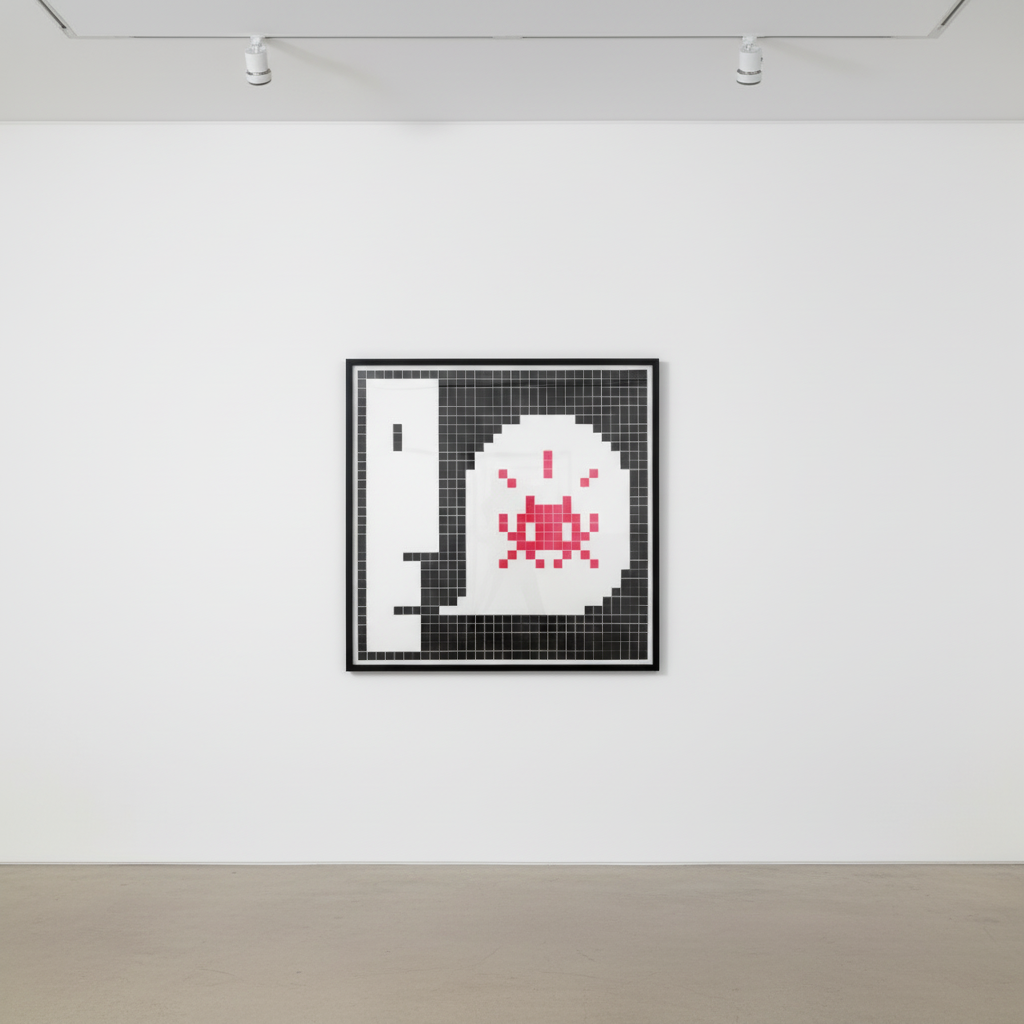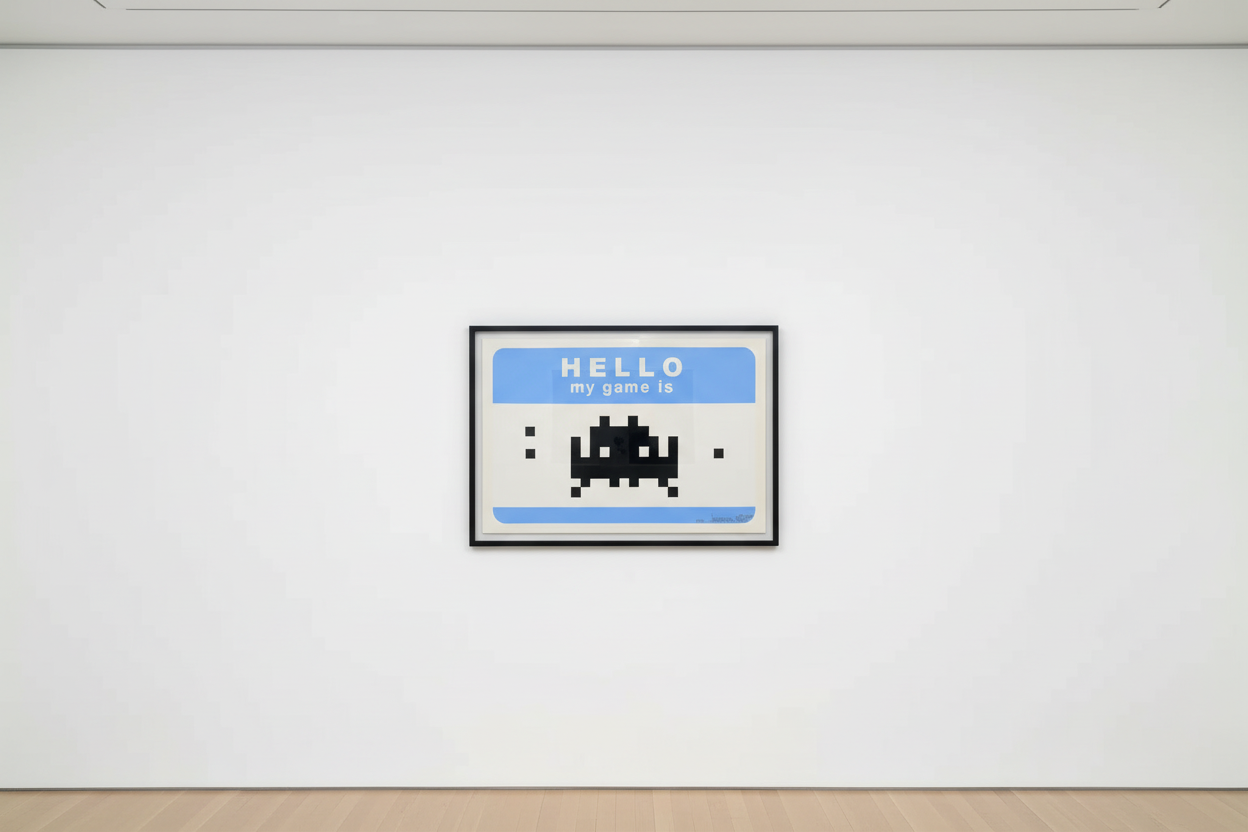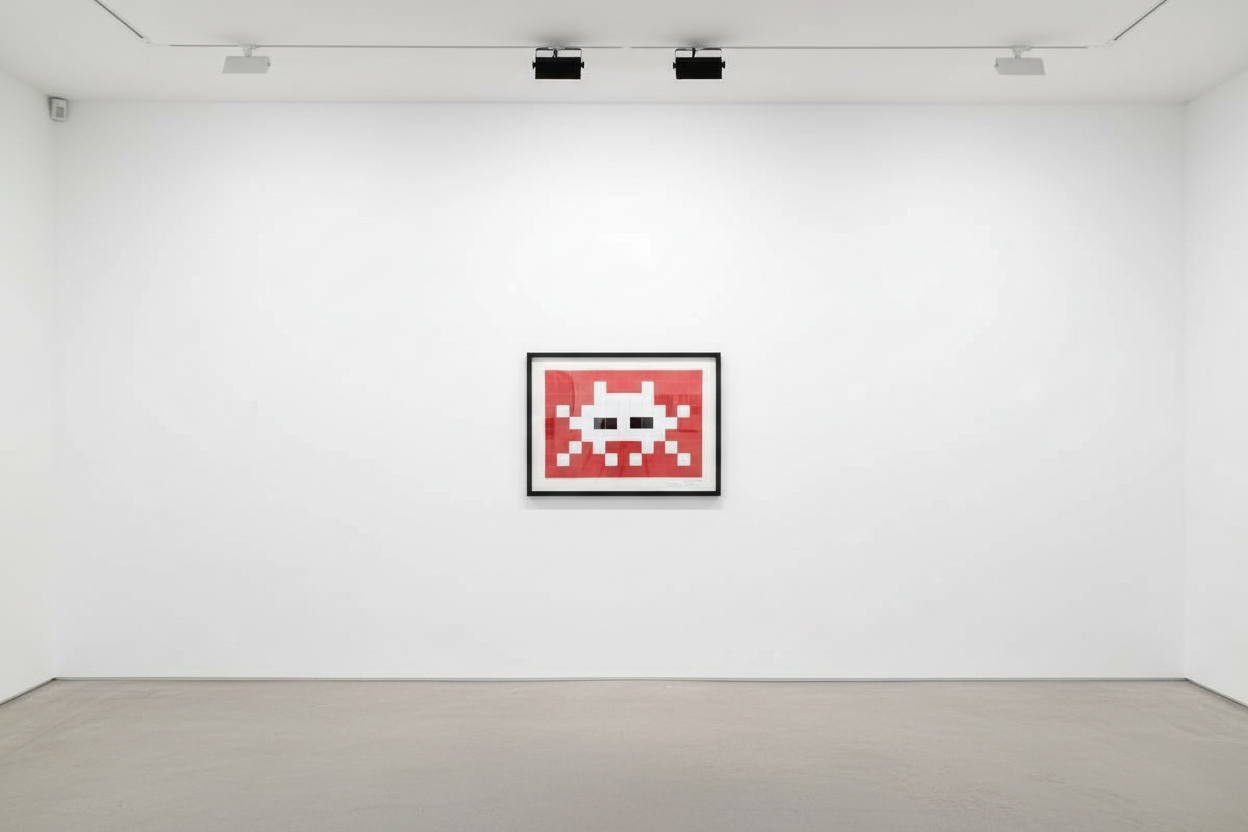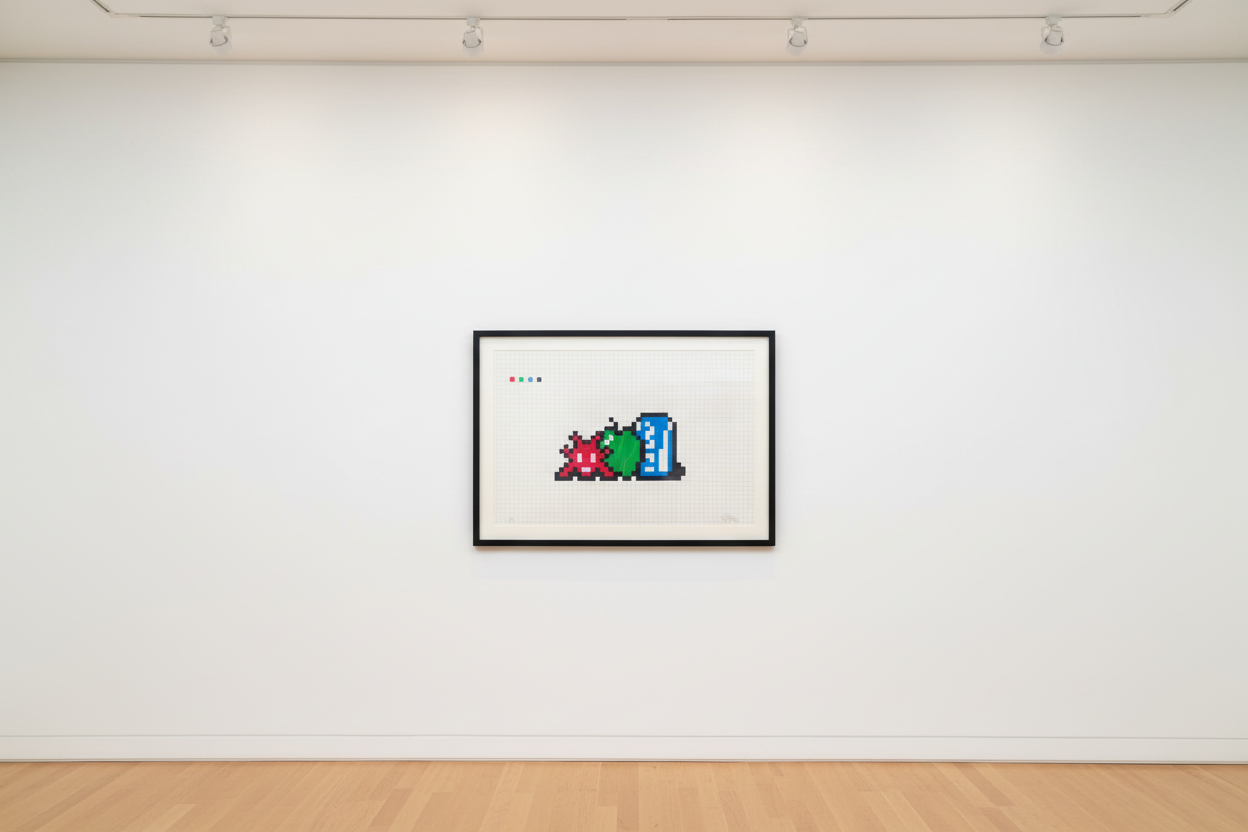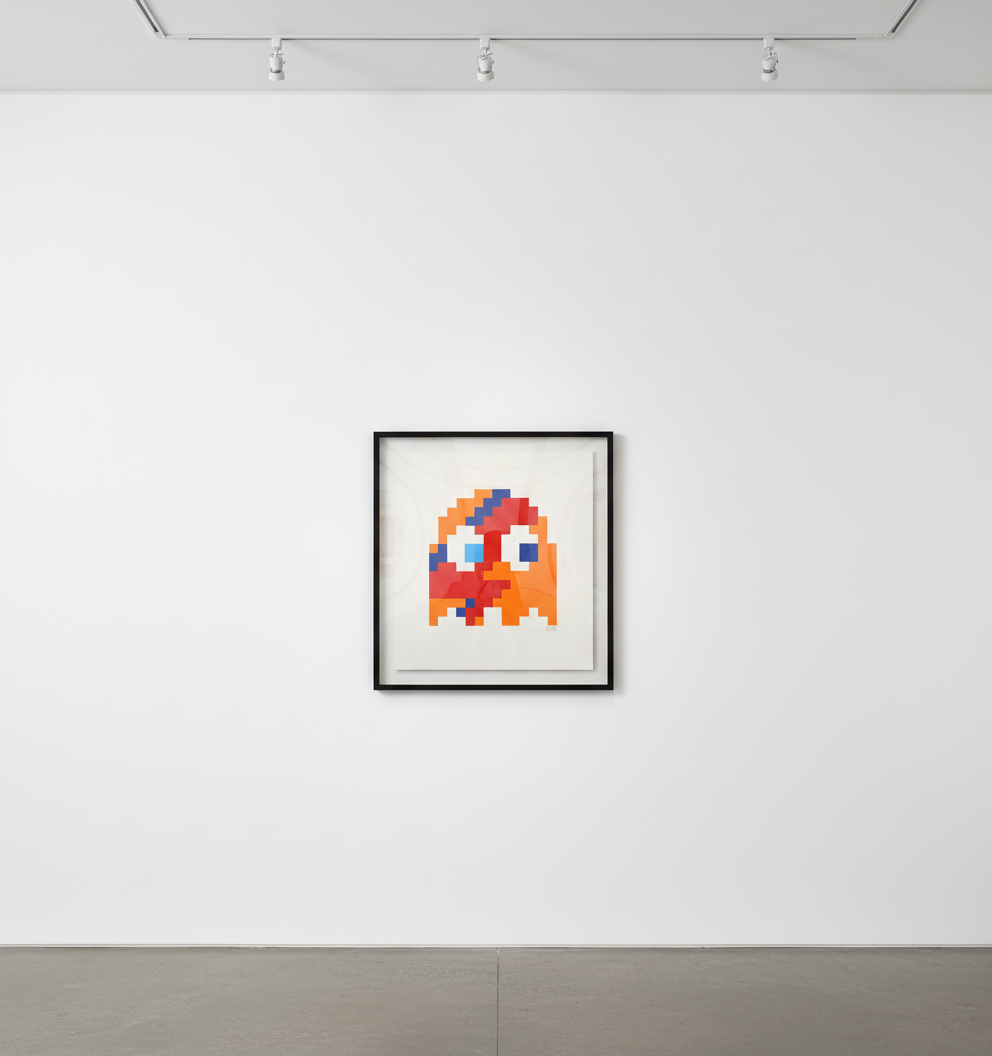
Aladdin Sane
7 works

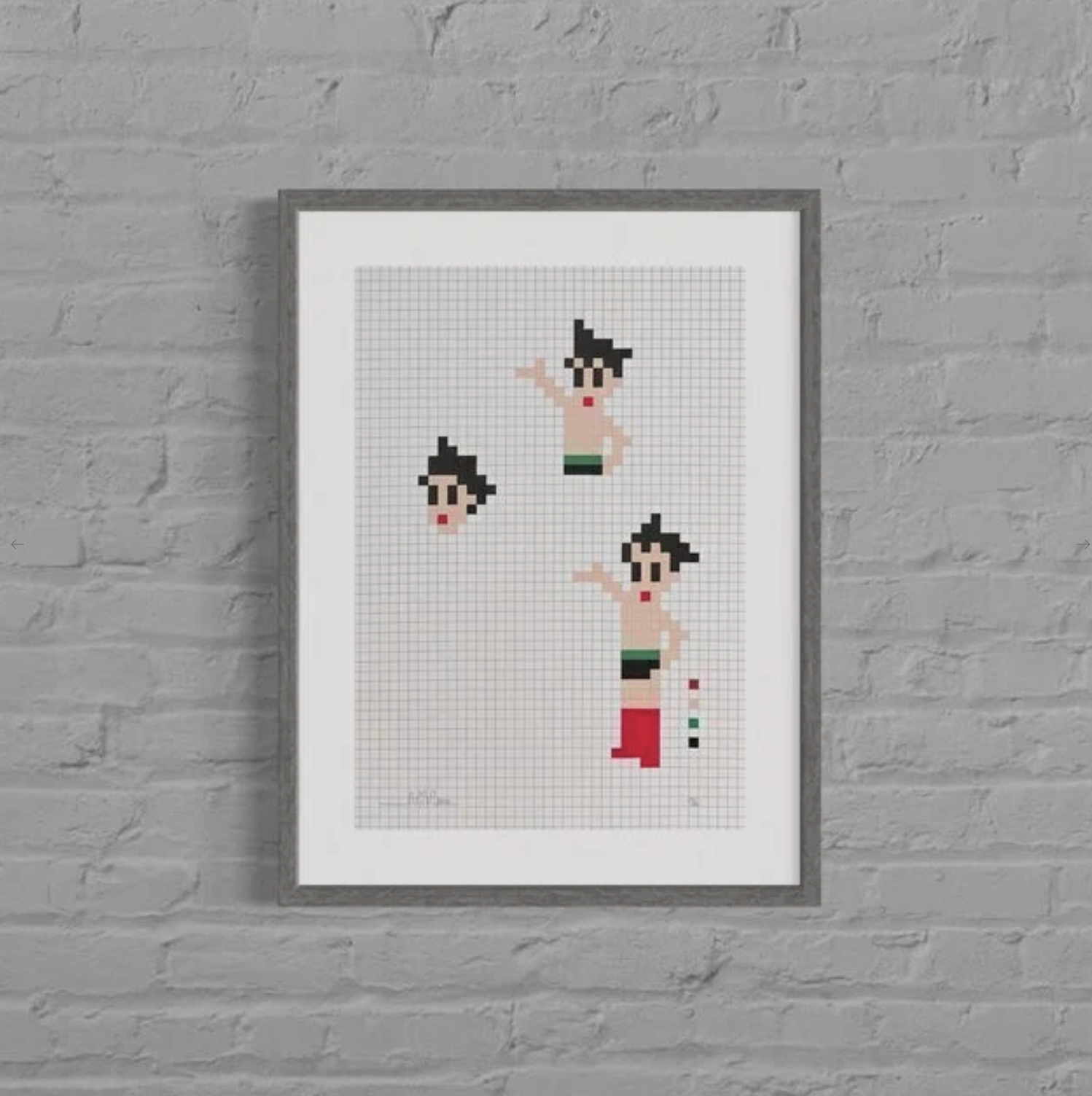
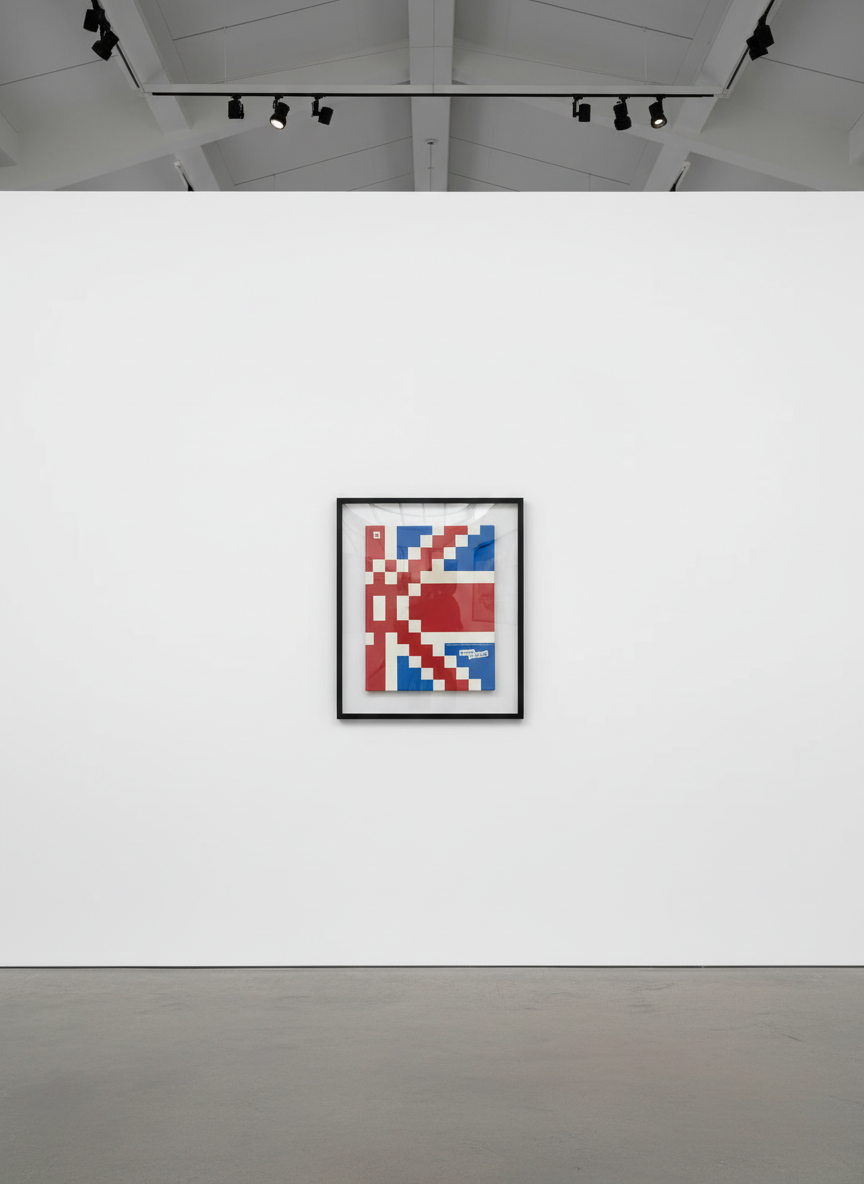
Astroboys, 2014
Screen print in colors on graph paper.
26 1/2 × 20 1/2 × 9/10 in | 67.2 × 52 × 2.3 cm with frame included
Invader stands as one of the most influential figures to emerge from the street art movement, having built an international reputation through his distinctive tile-based interventions that now populate cities across six continents. His work commands significant attention at auction and through private sales, with collectors recognizing both the cultural importance and investment potential of pieces by this elusive French artist. Astroboys exemplifies Invader's singular approach to image-making, translating the nostalgic visual language of early video games and Japanese animation into a refined gallery context. The work presents a grid of pixelated figures rendered in screen print on graph paper, a substrate choice that reinforces the mathematical precision underlying the artist's practice. Each character appears constructed from the same elemental building blocks that define Invader's celebrated mosaic installations, yet here they exist in vibrant color combinations that pulse with kinetic energy. The graph paper ground provides both a conceptual framework and an aesthetic texture, its printed lines echoing the digital matrices from which these forms originate. This edition of fifty represents a carefully controlled release, ensuring relative scarcity within the artist's print output. The work measures 26 1/2 by 20 1/2 inches framed, presenting at a scale that allows for intimate engagement with the intricate detailing of each pixelated form while maintaining visual impact suitable for prominent display. As demand for Invader's work continues to strengthen across primary and secondary markets, opportunities to acquire significant prints from limited editions become increasingly rare. Guy Hepner welcomes inquiries from collectors seeking to add this distinguished work to their holdings.
Invader is a French anonymous artist who has, since 1998, systematically invaded the urban fabric of cities on six continents with small mosaics constructed from ceramic tiles in the pixelated visual language of the 1978 Space Invaders arcade game. His identity remains rigorously concealed — the anonymity is not incidental but structural, an integral part of the work's meaning and its market mystique. Named after the Taito Corporation's iconic game, Invader treats the world's cities as a single global canvas, each installation a tile-based creature adhered to a building facade, a bridge, an underpass, a museum exterior — anywhere the public gaze might fall, and many places it is unlikely to.
The scope of the project is genuinely remarkable. Invader has completed invasions in more than eighty cities across more than thirty countries, installing over four thousand individual works in locations from Paris, London, New York, Tokyo, and Los Angeles to Kathmandu, Hong Kong, and beyond. Each city invasion is documented in a limited-edition artist book — the Invasion Guides — which function simultaneously as artworks, catalogues, and maps. The Flash Invaders mobile application allows enthusiasts to locate and photograph his works in the field, converting the invasion into a participatory urban game. This ecosystem of books, maps, and digital tools has built an unusually engaged and knowledgeable collector community around his practice.
The range of Invader's output includes ceramic tile mosaics installed in situ (photographed and sometimes deaccessioned), canvas mosaics produced for the gallery market, prints, and multiples. His work has appeared at Christie's, Sotheby's, Phillips, and Bonhams, where canvas mosaics and major works command five-figure and above results. His print editions and multiples — often created in small, controlled runs — are actively traded by collectors who engage with the full breadth of his output. Series include Space Invaders, Aladdin Sane, the Alert System, and Rubik Cube works deploying the pixelated aesthetic of the source game across an expanding range of subjects and references. His anonymity sustains a market dynamic in which scarcity and mystique compound one another: there is no studio to visit, no social media presence, no commercial gallery partner. What exists is the work itself, the documentation, and the global community of those who seek it out.
Invader has exhibited at the Musée d'Art Moderne de la Ville de Paris and MOCA Los Angeles, receiving institutional recognition that underscores the seriousness with which the art world regards his project beyond its street-art origins.
Guy Hepner represents Invader editions and multiples from our gallery at 177 Tenth Avenue, New York. We offer collectors authenticated works with full documentation, expert guidance on valuation, and access to a broad network of buyers and sellers active in this market. For those wishing to buy or sell Invader works, or seeking a free valuation of works in their collection, we are well placed to assist.