Pools

June 15, 2026
David Hockney's swimming pool prints occupy a singular position in postwar printmaking: they are at once technically ambitious, culturally loaded, and commercially enduring. Whether you are a first-time buyer drawn to a small aquatint or a seasoned collector considering a major signed lithograph from the Pools series, understanding the full arc of Hockney's engagement with water — from Bradford bathrooms to Beverly Hills backyards — is essential context for navigating the market. Pool-related works have accounted for some of the most significant sales in the history of living-artist auctions, culminating in Christie's November 2018 sale of Portrait of an Artist (Pool with Two Figures) (1972) for $90.3 million, a record for a living artist at that time. That painting's gravitational pull extends directly into the print market, where pool-theme editions continue to outperform at every tier of auction.
Inquire About Available David Hockney Pool Prints
Browse current Pool editions available through Guy Hepner, 177 Tenth Avenue, New York.
Hockney was born in Bradford, Yorkshire, in 1937, the fourth of five children in a working-class family on Steadman Terrace. Bradford in the late 1940s and 1950s was a wool-trade city, its skyline defined by factory chimneys, its light habitually filtered through industrial haze. There were no private swimming Pools in Bradford. Water, when it appeared at all as a visual motif, came in the form of canal reservoirs and the municipal baths on Morley Street. The idea of a body of water shimmering under unobstructed sunshine — a private pool visible from every room of the house — was not part of Hockney's visual grammar.
He studied at Bradford College of Art from 1953 to 1957, then completed National Service, then enrolled at the Royal College of Art in London, graduating in 1962. His early print work emerged from this period — technically meticulous, already showing the interest in flat planes of colour and line that would define his mature style. But it was in January 1964, when Hockney landed in Los Angeles on money earned from an etching sale, that the decisive visual rupture happened. He had been drawn partly by an issue of Physique Pictorial, an American magazine whose Los Angeles pool photography had lodged in his imagination. Within days of arriving, he rented a car, drove through Beverly Hills and Bel Air, and understood that he had found his subject.
California was the inversion of Bradford in every perceivable way: the light flat and hard where Bradford's was grey and directional, the houses spread horizontally where Bradford's were terraced vertically, water visible and decorative where Yorkshire's was industrial and practical. Hockney began painting pools almost immediately. He has said that he was struck by the fact that nobody in California seemed to find pools remarkable — that a feature which struck him as extraordinary had become the most ordinary thing in the world to his neighbours. That gap between the native and the arriving eye is the animating energy of the pool works.
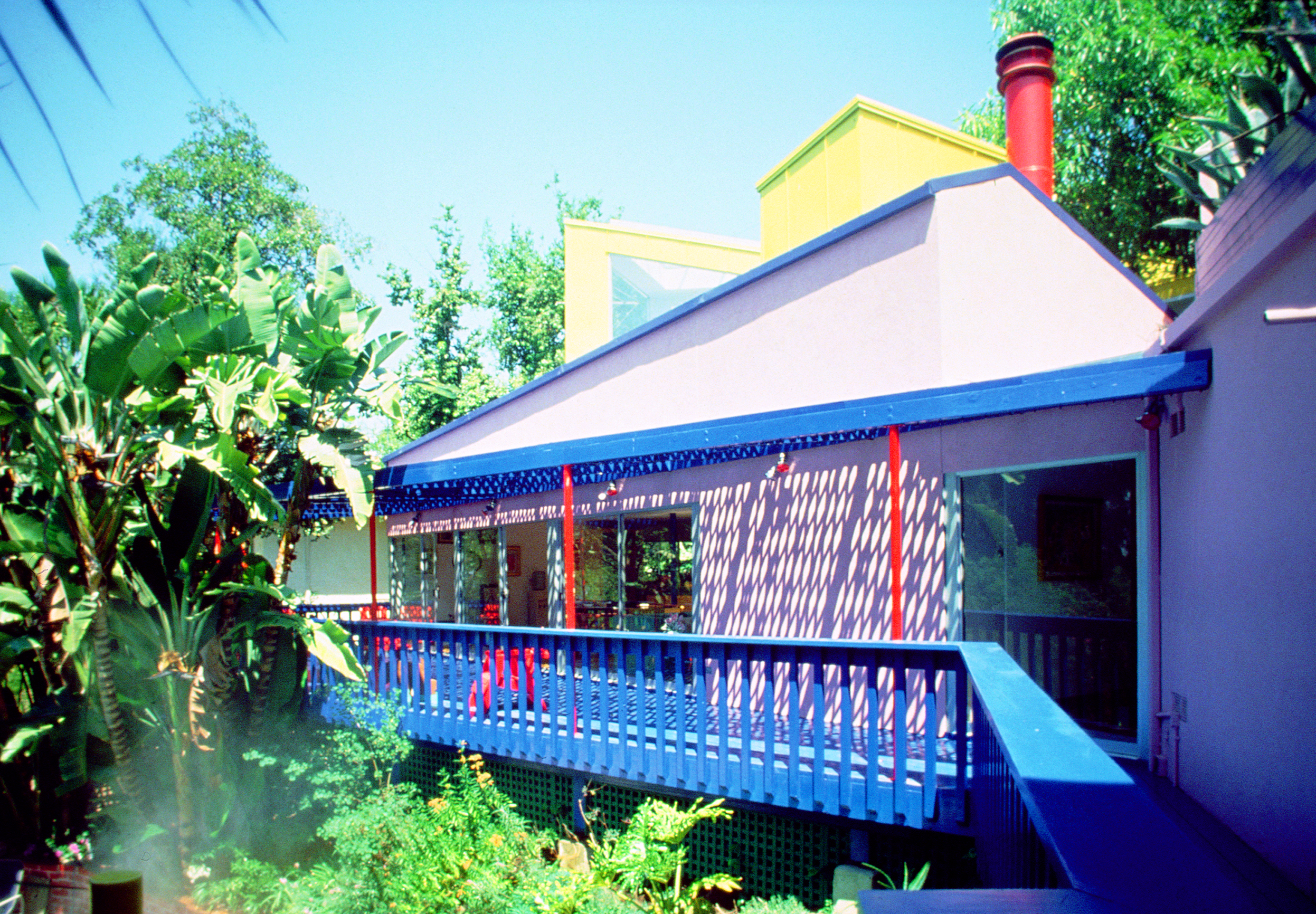
David Hockney's Los Angeles residence — his California base and the visual world that gave rise to the pool series. Photo: Jeffrey Daniels (CC BY-SA 4.0)
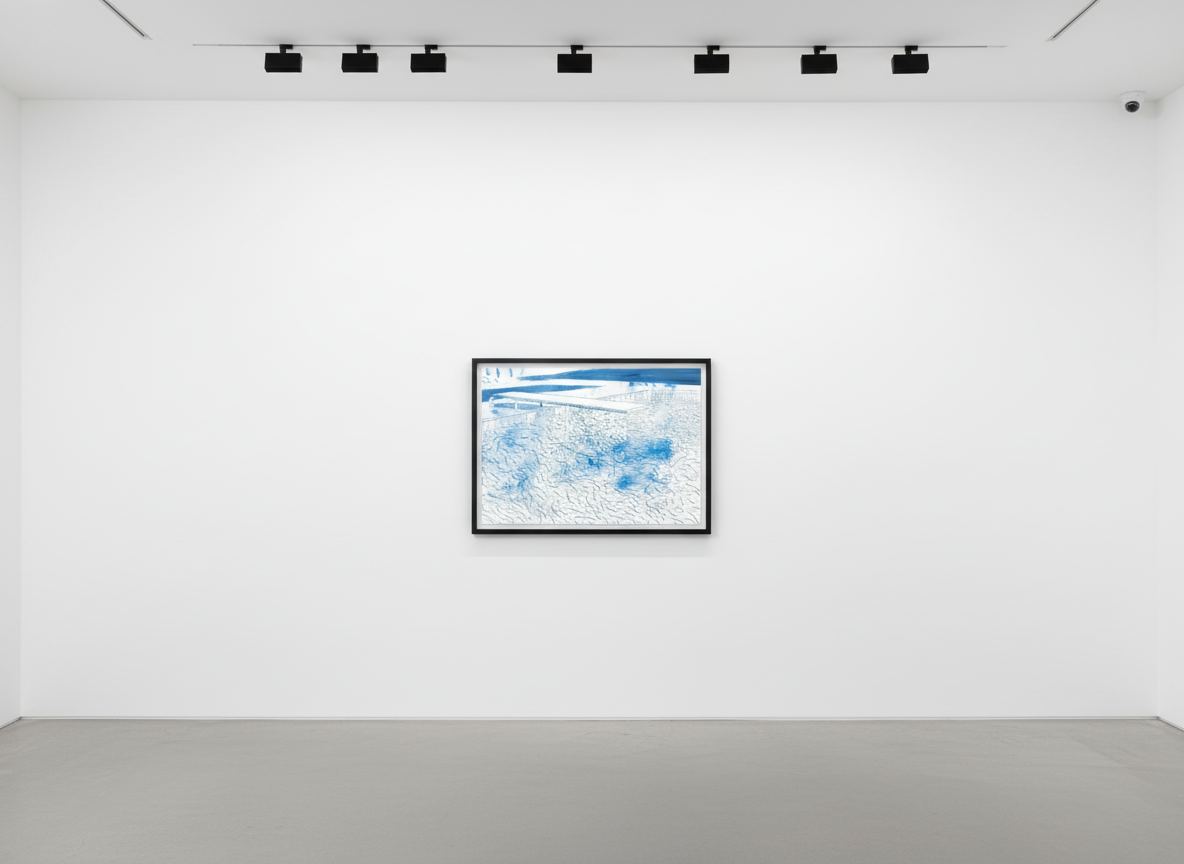
David Hockney, Lithograph of Water Made Of Lines, Blue Wash, 1978. Lithograph. Available at Guy Hepner, 177 Tenth Avenue, New York. Browse David Hockney Pool Prints →
The painted works are inseparable from the prints in public understanding, and any collector needs to know both. Hockney's most famous pool painting, A Bigger Splash (1967, acrylic on canvas, 96 × 96 inches, Tate collection), depicts a Beverly Hills pool at the precise moment a diver has entered the water — represented by a white explosion of spray — while the surface around it remains perfectly undisturbed. The spatial paradox is deliberate: a violent event frozen in time within an image that otherwise conveys absolute stillness. The painting took Hockney two weeks to complete but the splash itself — painted with brushes and small stiff hog-hair tools — took several days alone.
The logic of the pool as a compositional device was not accidental. Pools provided Hockney with flat, bounded planes of colour that he could subdivide, reflect, and distort. They were also explicitly modern — products of engineering and municipal planning, cultural objects as much as physical ones. To paint a pool in California was to comment on leisure, on the organisation of space, on the relationship between bodies and water, on the specific quality of light that bounced off chlorinated blue surfaces under a vertical sun. The pool was simultaneously domestic and exotic, familiar to millions through cinema and television, yet rendered strange by Hockney's Bradford-trained eye.
The painted works — The Splash (1966), A Bigger Splash (1967), Pool and Steps, Le Nid du Duc (1971), Portrait of an Artist (Pool with Two Figures) (1972) — have largely left the market. Most are in museum collections or permanent private holdings. This is exactly why the prints matter commercially: they represent the accessible tier of Hockney's pool vocabulary, the entry point into a body of work whose painted peaks are now beyond all but the most capitalised buyers.
The relationship between Hockney's paintings and his prints is not straightforwardly reproductive. He did not, as many artists do, make prints as afterthoughts to paintings. His printmaking developed in parallel with and often in advance of his painted work, and the technical constraints of etching and lithography pushed him toward solutions that fed back into the paintings.
The key distinction collectors need to understand is between the Pools series etchings (1965), which were made before the most famous painted works, and the later lithographs and screenprints which engage with the same subject from different technical angles. The 1965 etchings — published by Editions Alecto in London — are among the most technically refined prints Hockney had produced to that point. They use aquatint extensively to build tonal depth, and they represent the pool not as a single spectacular image but as a domestic presence, observed from pool-side and from above, at rest and in motion.
Later lithographic works engage more directly with the surface of water as a problem of representation. In Lithograph of Water Made of Lines and the related studies, Hockney worked through a series of mark-making approaches to a single question: how do you represent something that is defined by movement, by refraction, and by the light it reflects, using a medium that is essentially static? The answer he arrived at — a vocabulary of curved parallel lines that convey both the grid-like structure of water surface and its continuous movement — is one of the most elegant solutions in twentieth-century printmaking.
Collectors should also be aware of the Moving Focus prints series, which dates from the early 1980s and engages with related themes of water, reflection, and landscape from a very different technical and conceptual perspective. The Moving Focus works are technically complex lithographs that use multiple stones and up to sixteen colours.
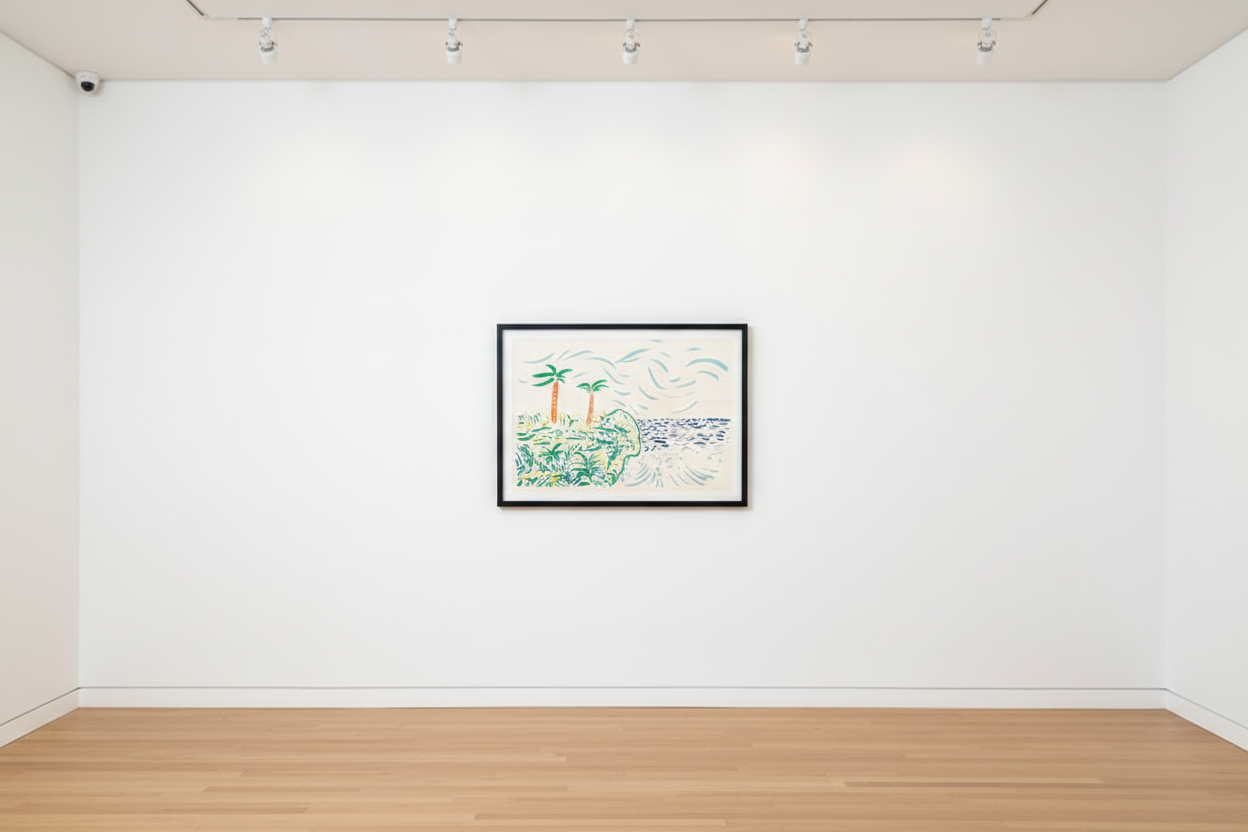
David Hockney, Bora Bora, 1971. Etching with aquatint. Available at Guy Hepner, 177 Tenth Avenue, New York. Browse David Hockney Pool Prints →
The following works represent the key reference points for any serious collector of Hockney pool-related prints:
Two Boys in a Pool, Hollywood (1965) — Etching and aquatint, published by Editions Alecto, London. Edition of 75 (plus artist's proofs). Sheet size approximately 30 × 40 cm. One of the earliest and most technically ambitious of the pool prints, depicting two figures in a sun-dappled residential pool. The aquatint groundwork for the water surface marks a direct response to the problem of representing the shimmering quality of California pool water. Signed examples in good condition appear at auction in the range of £15,000–40,000 depending on condition and provenance; artist's proofs command a premium.
A Lawn Being Sprinkled (1967) — Colour lithograph, published by Gemini G.E.L., Los Angeles. A composition in three horizontal zones — lawn, house, sky — bisected by the arc of a sprinkler. The image is less overtly about the pool than about the maintenance systems that sustain the Californian garden, but it is iconographically adjacent to the pool series and is often grouped with it in the market. Signed and numbered examples typically trade in the range of £20,000–55,000.
Lithograph of Water Made of Lines (1978–80) — One of a series of studies in which Hockney tested different formal vocabularies for representing water. These works are smaller in scale than the Gemini G.E.L. productions but technically remarkable. They sit at the intersection of the pools series and the later Moving Focus works. The edition sizes are typically small, and they appear at auction less frequently than the earlier etchings or the 1967 lithographs. Auction records suggest a range of £8,000–25,000 for signed examples.
Paper Pools (1978) — Technically distinct from the prints above, these works were made in collaboration with Ken Tyler at Tyler Graphics, using freshly formed, hand-cast paper pulp coloured with pigment. They are not prints in the conventional sense — they are works on paper constructed through a direct process — but they are grouped with the prints market and are among the most sought-after of all pool-related works. The Paper Pools suite of 29 works is held almost exclusively in museum collections; individual works from the series that do appear at auction can command prices well above £100,000.
Hockney's technical command of printmaking is unusual among artists of his generation in that it extends across multiple disciplines. He has worked in etching, aquatint, drypoint, soft-ground etching, lithography, screenprint, and, in later years, digital printing. Each medium offered a different set of constraints and possibilities for the pool theme.
The 1965 etchings use aquatint — a process in which rosin dust is dusted onto a copper plate and heated until it adheres, then etched with acid to produce a tonal range — with exceptional control. Aquatint naturally produces granular textures that are well-suited to representing the broken surface of water in sunlight. Hockney exploited this by building multiple layers of aquatint, stopping out different areas of the plate between each etch to produce the stepped tonal gradations visible in the pool surface.
The lithographic works of the late 1960s and 1970s required a different approach. Lithography is a planographic process — the image is drawn on a flat stone or plate with a greasy medium, then printed by exploiting the chemical incompatibility of grease and water. It produces smooth, continuous tones more naturally than aquatint, and Hockney used it for the broader, more abstract water surfaces of the later works. The curved parallel lines that appear in the Lithograph of Water Made of Lines series are drawn directly on the stone with lithographic crayon — a physically demanding process that requires considerable technical skill to produce the consistent pressure and spacing visible in the finished prints.
The Gemini G.E.L. collaboration, which produced many of the most important pool-related lithographs, was itself a significant factor in the technical quality of the work. Gemini, founded in Los Angeles in 1966, was at the leading edge of fine art printing technology, and Hockney's relationship with master printers there — particularly in the early 1970s — produced some of the most technically refined prints of his career. Collectors should note that Gemini prints carry their own documentation and blind stamps, and these can be verified against the workshop's published archives.
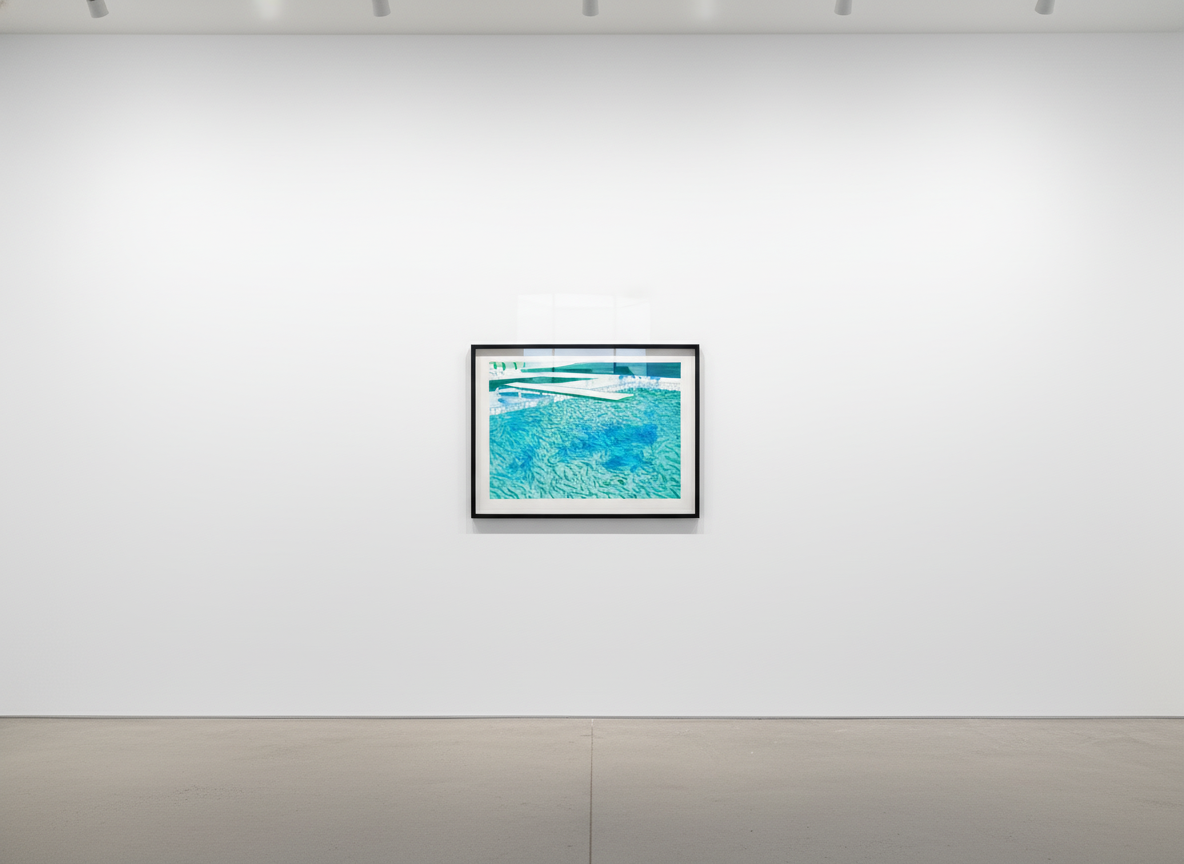
David Hockney, Lithograph of Water Made Of Lines With A Light Blue and Light Green Wash, 1978. Lithograph. Available at Guy Hepner, 177 Tenth Avenue, New York. Browse David Hockney Pool Prints →
One of the persistent challenges that Hockney confronted in the pool works was the specific quality of California light. Bradford light, when it appeared at all, came from a low angle and produced long shadows and muted tones. California light, particularly in summer, comes from directly overhead, eliminates shadows, and produces flat, saturated surfaces. This is fundamentally different from the European visual tradition in which Hockney had been trained — a tradition that derived much of its tonal sophistication from managing the directional drama of northern light.
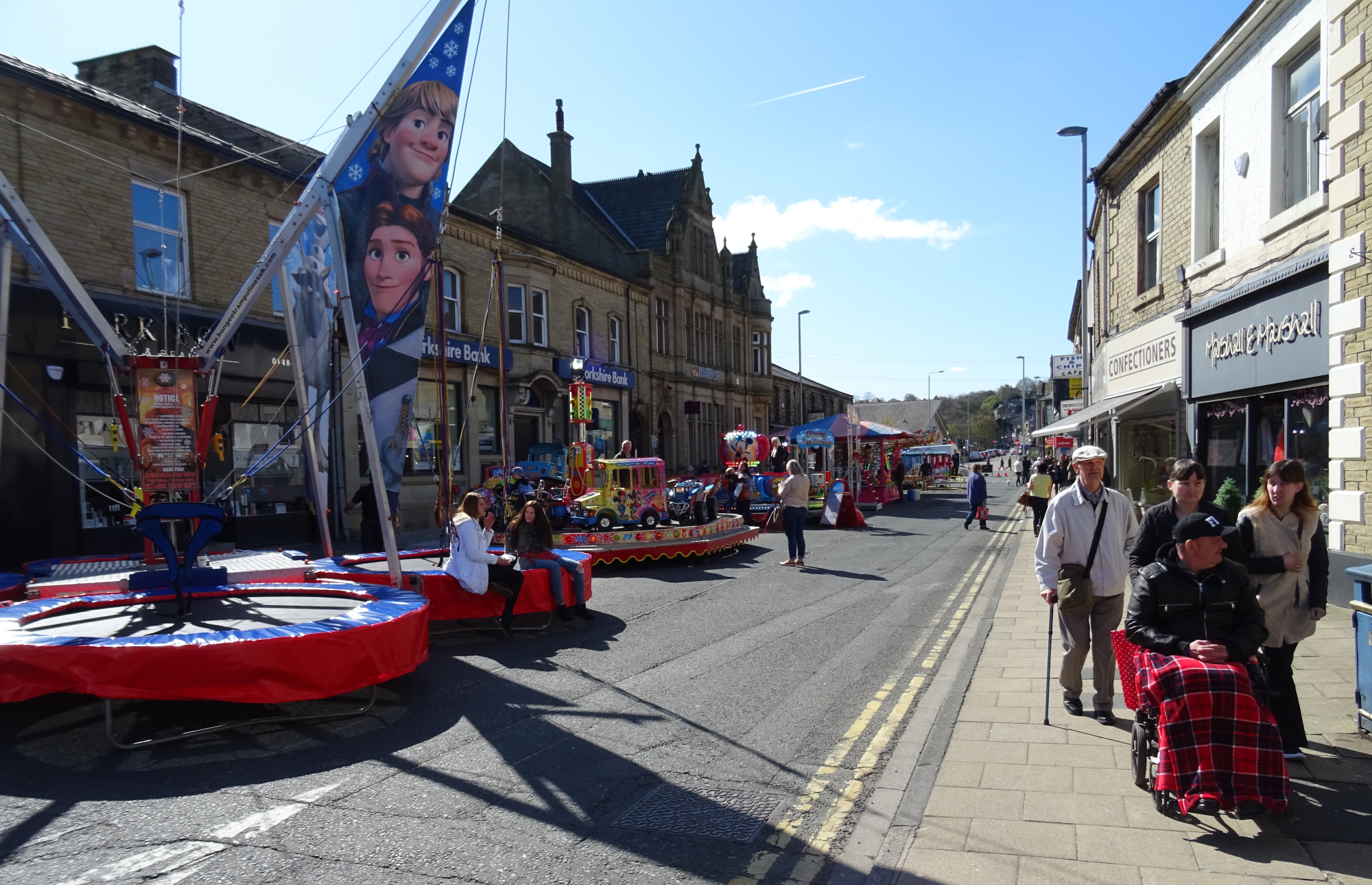
Bradford Road, Brighouse, West Yorkshire — the northern English world Hockney left behind in 1964 for the perpetual sun of Los Angeles. Photo: habiloid (CC BY-SA 2.0, via Wikimedia Commons)
Hockney's solution, arrived at gradually across the pool works, was to abandon the convention of tonal modelling entirely and work instead with flat, unmodulated planes of colour juxtaposed against each other. The pool blue — a specific synthetic, chlorinated blue that reads as simultaneously artificial and luminous — appears in the prints as a flat field, undifferentiated in tone but animated by the linear marks that Hockney deployed to suggest movement. The surrounding pale stone, the white walls of pool-edge architecture, the acid yellow of California lawns in summer: each element is given in its local colour without the atmospheric modification that European painting typically applies.
This chromatic strategy is visible across all the pool prints, from the early etchings (where the colour range is necessarily more restricted by the medium) through the full-colour lithographs. It gives the works their characteristic quality of heightened reality — more saturated than a photograph, more still than the actual subject warrants — that has made them so commercially durable. The colour palette of the pool prints sits easily in contemporary interiors, which is part of their sustained collector appeal, but it is also genuinely avant-garde: Hockney was solving a real formal problem, not simply producing attractive pictures.
Collectors interested in the full range of Hockney's engagement with light and colour should also consider the Blue Guitar series (1977), which takes a different subject but deploys many of the same chromatic strategies developed in the pool works.
The market for David Hockney pool prints is well established, with active participation from Christie's, Sotheby's, and Phillips across their London, New York, and Hong Kong sale rooms. The following provides a framework for understanding current market dynamics.
The macro context: The $90.3 million sale of Portrait of an Artist (Pool with Two Figures) at Christie's New York in November 2018 transformed Hockney's market. It did not simply set a record for a living artist; it recalibrated buyers' understanding of where Hockney's work sits in the hierarchy of postwar and contemporary art. The prints market absorbed this shift with a lag of roughly twelve to eighteen months, after which pool-related prints — particularly signed works from the major series — moved decisively into a higher price bracket at all auction tiers.
Benchmark prices (recent auction results): Pool-related etchings from the 1965 Editions Alecto series in good condition, signed and numbered, have been trading in the range of £12,000–45,000 at London sales. Major colour lithographs from the Gemini G.E.L. partnership have a wider range — smaller works and lesser-known compositions from £18,000; principal compositions including A Lawn Being Sprinkled and other key images pushing toward £50,000–70,000 for exceptional examples. The Paper Pools series, when it appears, typically opens at £80,000 and can exceed £200,000 for strong examples with clean provenance.
The provenance premium: Hockney prints with documented provenance — sales receipts from established galleries, inclusion in exhibition catalogues, or prior ownership by named collectors — command meaningful premiums at auction. This reflects the complexity of the authentication landscape: while Hockney's major series are well documented and fakes are rare, the market prices provenance highly as insurance.
Condition sensitivity: Pool prints, particularly the large-format lithographs, are susceptible to fading if stored or displayed without UV protection. Condition is a significant value driver in this market: prints with fresh colour and no fading, foxing, or surface damage command strong premiums over equivalent examples with even minor condition issues. Buyers should request condition reports and, for significant purchases, independent examination before bidding.
For a collector approaching the David Hockney pool prints market for the first time, the following considerations are essential:
Edition types: Hockney's major print series are published in lettered and numbered editions, typically with additional artist's proofs (A.P.) and, for some series, printer's proofs (P.P.) and hors de commerce (H.C.) examples. The standard hierarchy in terms of collectability runs: artist's proofs > low-number signed examples from the main edition > higher-number signed examples > unsigned examples. For Hockney specifically, the artist's proofs are particularly sought after because his involvement in the printing process was unusually direct — A.P.s often represent the print as Hockney himself approved it at the proofing stage.
Signed vs unsigned: All prints from the major series should be hand-signed in pencil by Hockney, typically in the lower right margin. Unsigned examples from otherwise complete series do exist — they surface occasionally at estate sales — but they are worth materially less than signed equivalents and should be priced accordingly. Be cautious of prints with signatures that appear too uniform or too consistent in ink tone across the signature and the print itself.
Paper condition: The primary support for Hockney's lithographs and etchings is typically acid-free archival paper, often handmade, and this should show its age gracefully. Look for even, creamy tone across the sheet; any brown spotting (foxing), staining from previous mounts, or cracking in the paper fibres are significant negative indicators. Hockney prints that have been stored in light — particularly close to windows — frequently show fading in the blue fields, which is extremely difficult and expensive to remediate.
Publisher documentation: For Gemini G.E.L. prints, the workshop's blind stamp should be present in the lower margin. For Editions Alecto prints, a chop mark or embossed seal may be present. These publisher marks are not guarantees of authenticity on their own, but their absence from a work that should carry them is a red flag.
The text editions: Several of Hockney's print series exist in versions with and without accompanying text — particularly the series published in connection with artist's book projects. The text versions are typically complete as issued; the prints-only versions are later extractions. Both are authentic, but they serve different collecting purposes, and the text versions sometimes carry additional collector interest as complete bibliographic objects.
Framing history: Many pool prints have spent decades in direct-glaze frames without UV filtering. When purchasing, it is worth asking for the piece to be removed from its frame and examined under controlled lighting to assess whether any fading or foxing is concealed by the frame's margins.
For collectors considering entry into this market, the Guy Hepner Pools series inventory offers a curated selection of authenticated editions with full provenance documentation. The gallery's specialist knowledge of the pool works extends across all major series and publication contexts. Alongside the pools, collectors with broader interest in Hockney's print output should also consider the iPad Drawings editions — the most technically divergent chapter of his printmaking career — and the Blue Guitar series for a complete picture of his graphic work.
The sustained demand for David Hockney swimming pool prints — from the 1965 Editions Alecto etchings through the Gemini lithographs and the Paper Pools — reflects a body of work that has lost none of its formal intelligence or market depth in sixty years. For the collector who approaches these works with the right technical and historical knowledge, they remain one of the most coherent and rewarding areas of the postwar prints market.
Explore David Hockney prints for sale at Guy Hepner: Pools, 20 Flowers, A Bigger Book & My Window, Celia, Computer Drawings.
Related Series