Homemade Prints

When people think of David Hockney as an innovator, they often jump straight to the Ipad Drawings, the multi-camera films, or the vast Yorkshire landscapes that have defined his later career. Yet one of the most conceptually important bridges between Hockney the traditional printmaker and Hockney the technological pioneer sits in a deceptively modest body of work from 1986: the Home Made Prints. Created using an office photocopier, these works are not prints in the conventional sense—images transferred from a plate or stone by a professional press. Instead, they are constructed layer by layer by Hockney himself, using the copier as both tool and collaborator. In doing so, he reframed what printmaking could be: immediate, experimental, intimate, and surprisingly painterly.
The Home Made Prints series emerges at a pivotal moment in Hockney's practice. The early to mid-1980s saw him intensely engaged with questions about how images are built and perceived. His photographic joiners had already fractured conventional perspective, assembling multiple views into composite images that felt closer to lived vision than to single-lens photography. The photocopier experiments follow naturally from this line of inquiry. Instead of asking a master printer to translate his vision through traditional techniques, Hockney took complete control of the process, feeding paper through the machine multiple times, adjusting colours, and building compositions through accumulation rather than subtraction.
What makes these prints so radical is their rejection of the distance typically inherent in printmaking. Traditional methods—etching, lithography, screenprinting—require planning, expertise, and often the mediation of skilled technicians. The photocopier eliminated these barriers. Hockney could work directly, making decisions in real time, responding to accidents and discoveries as they occurred. The result is a body of work that feels remarkably fresh and unguarded, capturing the artist's sensibility without the formality that sometimes accompanies editioned prints.
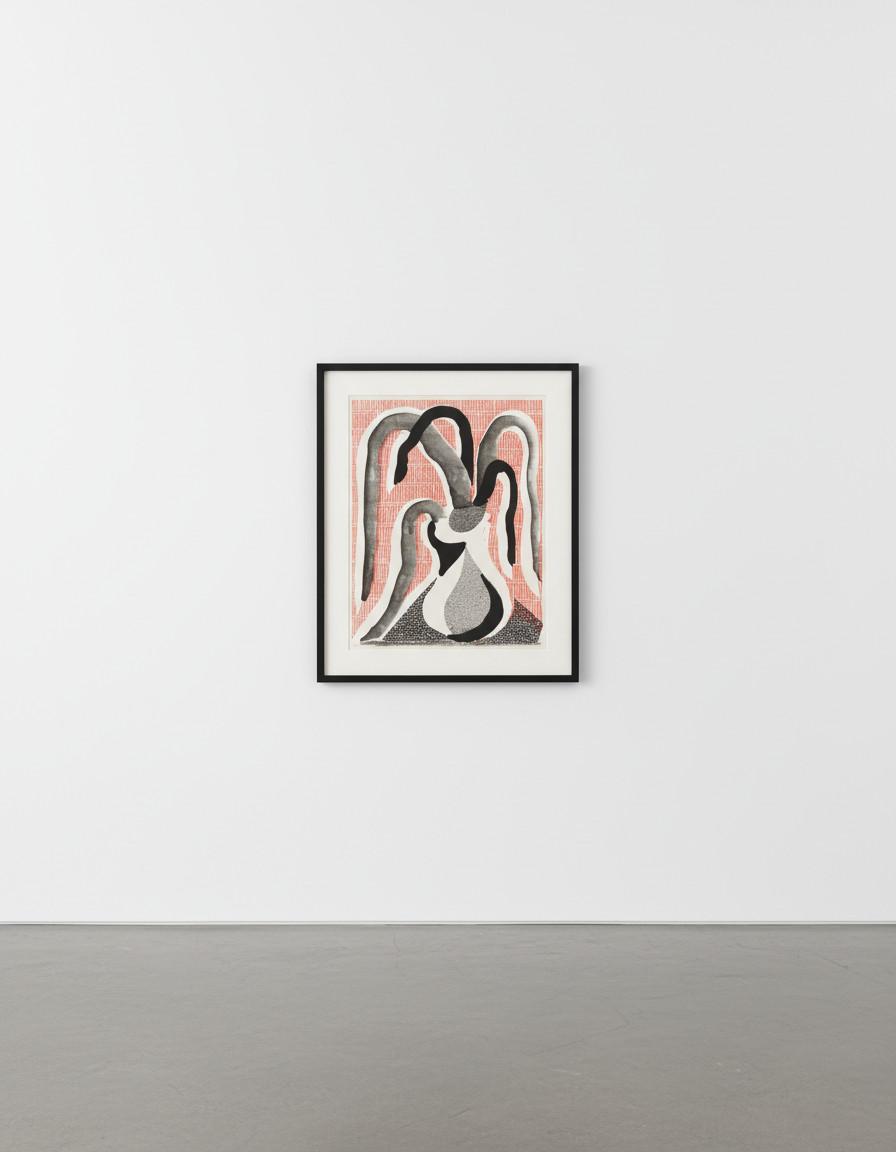
Drooping Plant, June 1986 — David Hockney. Available at Guy Hepner, New York.
Works like Drooping Plant, June 1986 exemplify this approach. The image possesses an almost tender quality, with the plant rendered through overlapping colour passes that create unexpected depth and luminosity. There is nothing mechanical about the final result despite the mechanical means of its production. Hockney transformed an office machine into an extension of his artistic hand, proving that innovation in art often comes not from the newest technology but from the creative misuse of existing tools.
The subjects Hockney chose for these prints reinforce their experimental nature. Rather than grand landscapes or portraits of famous sitters, he turned his attention to the immediate and the everyday: plants in his studio, fruit arranged on tables, his beloved dachshunds. This domestic focus gives the Home Made Prints a quality of private exploration, as if we are witnessing the artist thinking through problems in visual language without concern for public reception.
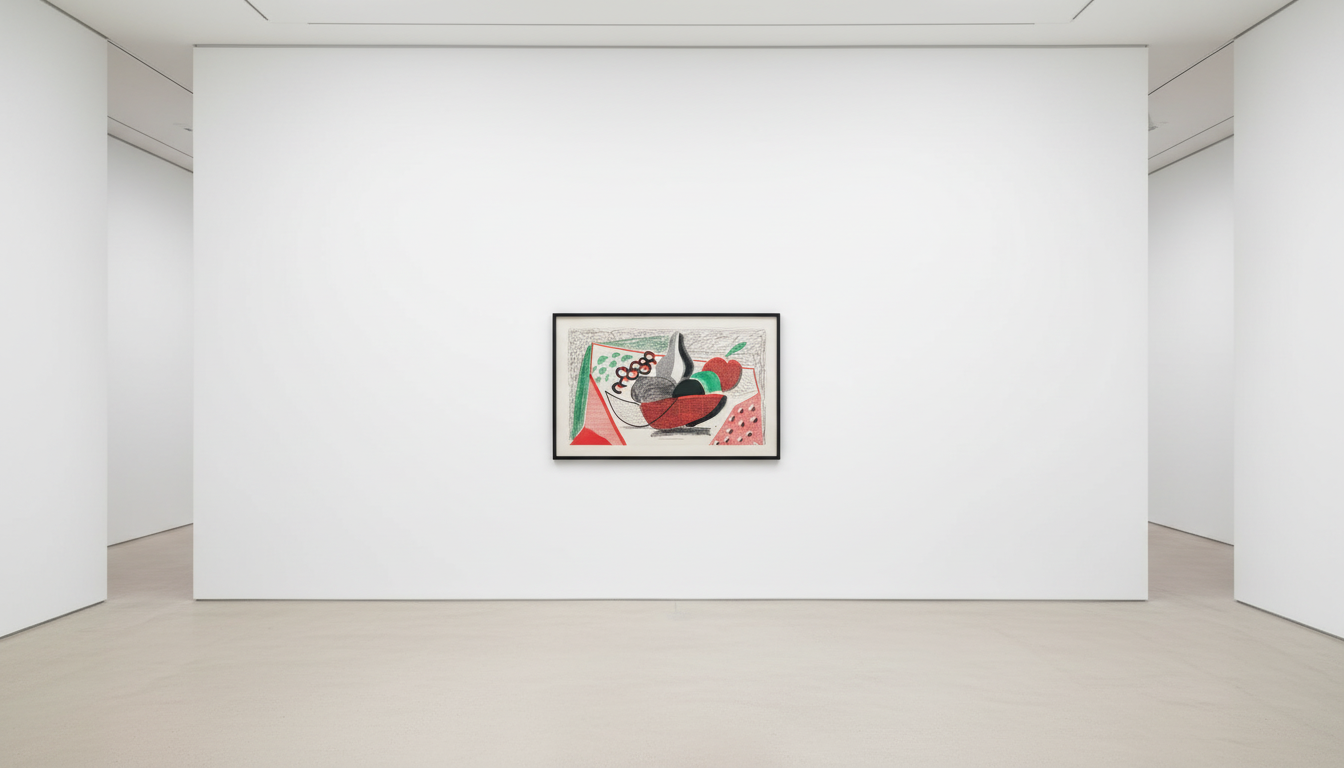
The still life compositions in particular reveal Hockney's ongoing dialogue with art history. Works depicting apples, pears, and bowls of fruit connect him to a lineage stretching from Cézanne through the Cubists—artists who similarly used humble subjects to interrogate fundamental questions about representation. Yet Hockney's approach remains distinctly his own. The colours are saturated and slightly artificial, the outlines bold and graphic. These are not attempts at optical truth but rather celebrations of the constructed nature of all images.
Apples Pears & Grapes — David Hockney. Available at Guy Hepner, New York.
His animal portraits from this period, including studies of his dogs, demonstrate how the photocopier's limitations became advantages. The slight registration shifts between colour passes, the grain inherent in the copying process, the way edges blur and overlap—these qualities that a perfectionist might consider flaws instead lend the works a vitality and warmth that polished prints often lack. The technology's imperfections humanised the images, making them feel more alive than technically superior alternatives might have.
David Hockney's position in the contemporary art market requires little introduction. According to data from the Art Basel and UBS Global Art Market Report, Hockney consistently ranks among the highest-selling living artists worldwide. Major auction results at Christie's and Sotheby's have established benchmark prices across all periods of his career, from the swimming pool paintings to the recent digital works. Within this broader market context, the Home Made Prints occupy a particularly compelling position for discerning collectors.
These works represent a critical transitional moment in Hockney's oeuvre—the point at which his interest in technology shifted from documentation to creation. Without the Home Made Prints, the logical progression to fax art in the late 1980s and ultimately to the celebrated iPad drawings becomes harder to trace. Collectors who understand this trajectory recognise these prints not as minor experiments but as essential documents in the evolution of one of the twentieth and twenty-first centuries' most significant artists.
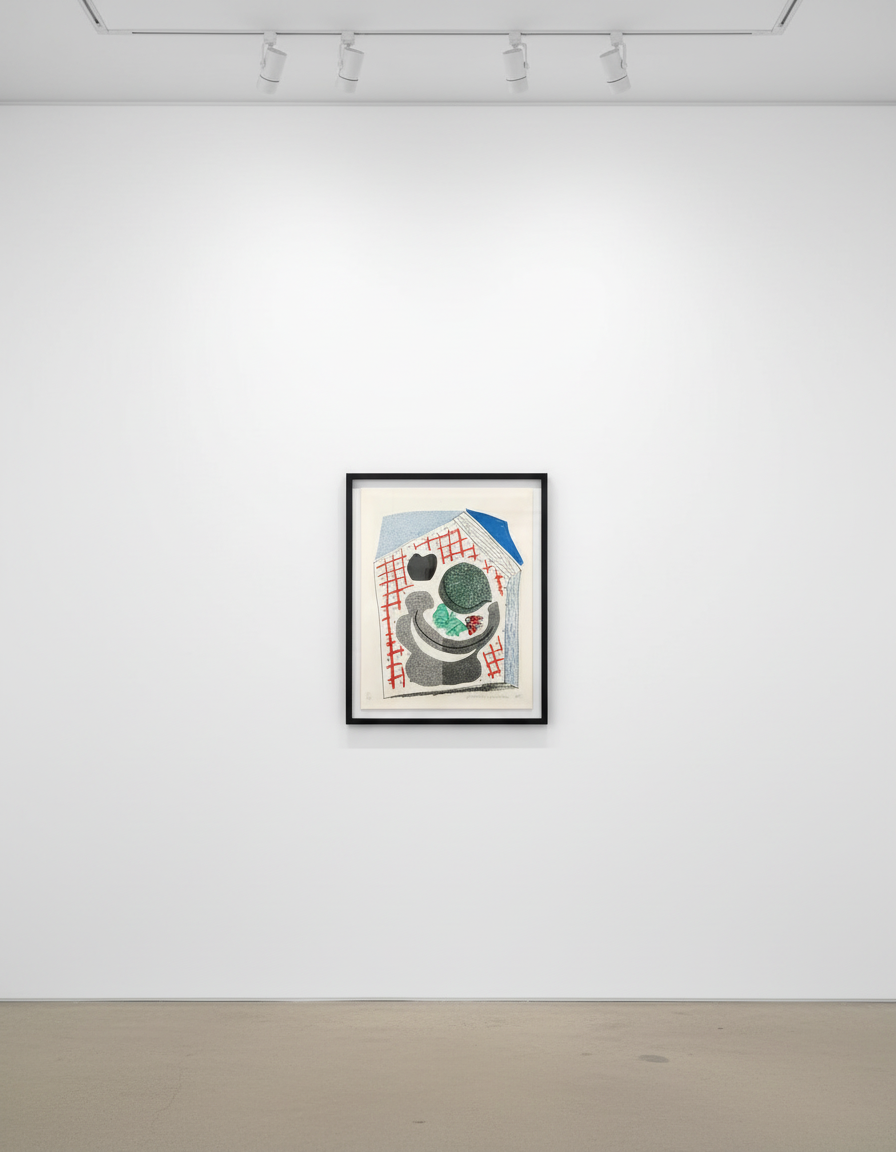
Bowl of Fruit — David Hockney. Available at Guy Hepner, New York.
The relative accessibility of these works compared to Hockney's paintings makes them attractive entry points for collectors building serious holdings in post-war and contemporary British art. Yet their conceptual importance ensures they are far more than stepping stones. Museums and private collections increasingly seek to represent the full scope of Hockney's technological investigations, and the Home Made Prints provide irreplaceable evidence of his early experiments with machine-assisted image-making. As scholarly attention to this period of his career continues to grow, these prints are likely to appreciate not only in monetary value but in art-historical significance.
Guy Hepner gallery is proud to offer select works from David Hockney's Home Made Prints series to collectors seeking museum-quality examples of this pivotal body of work. Our team provides comprehensive guidance on provenance, condition, and art-historical context, ensuring that each acquisition meets the highest standards of connoisseurship. Whether you are an established collector deepening your holdings in British contemporary art or a new collector drawn to Hockney's innovative spirit, Guy Hepner offers the expertise and access to help you acquire works of lasting significance. Contact us today to discuss available pieces and explore how these remarkable prints might enhance your collection.
--- **Browse David Hockney prints** at Guy Hepner: [David Hockney art for sale](/david-hockney) | [Sell your Hockney](/sell/david-hockney)Explore David Hockney prints for sale at Guy Hepner: Homemade Prints, 20 Flowers, A Bigger Book & My Window, Celia, Computer Drawings.
Related Series