Yoshitomo Nara: Child's Play
Yoshitomo Nara: Child's Play
Yoshitomo Nara has emerged as one of the most influential and immediately recognizable artists of his generation, commanding a devoted global following that spans serious collectors, cultural institutions, and a broader audience captivated by his deceptively simple yet profoundly resonant imagery. His work occupies a unique position at the intersection of fine art, Japanese pop culture, and deeply personal psychological exploration. The children and animals that populate his canvases have become iconic figures in contemporary art - their oversized heads, piercing gazes, and ambiguous expressions speaking to universal experiences of solitude, defiance, and the complex emotional landscape of youth. For collectors seeking works that combine immediate visual impact with substantial conceptual depth, Nara represents an essential figure whose market presence continues to strengthen alongside his cultural significance.
The Signature World of Yoshitomo Nara
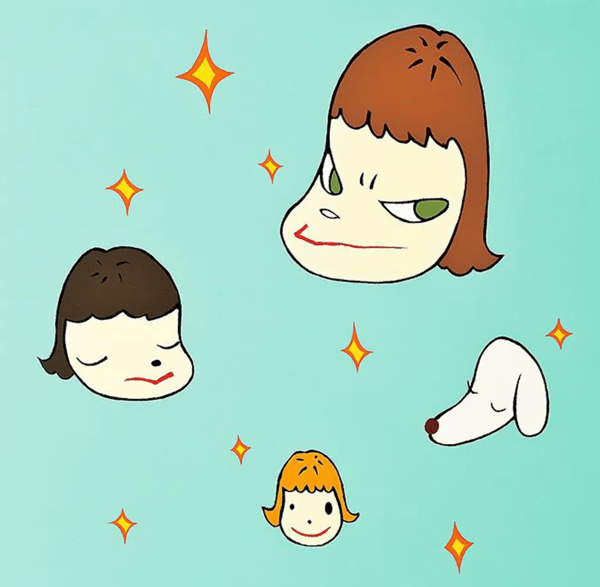
Yoshitomo Nara's artistic vocabulary is instantly identifiable, built upon a cast of characters that have remained remarkably consistent throughout his career while continuously revealing new emotional dimensions. His paintings and drawings frequently feature young children rendered with exaggerated proportions - large heads atop small bodies, sharp gazes that seem to penetrate directly through the canvas, and subtly expressive faces that oscillate between innocence and something far more complex. These figures, often isolated against vast, empty backgrounds of muted color, project a powerful emotional intensity that belies their apparent simplicity and cartoon-like aesthetics.
Whether wielding tiny knives, standing with arms crossed in silent protest, or simply staring with unsettling directness, Nara's subjects challenge conventional expectations surrounding childhood and vulnerability. The children in his works are never merely cute or sentimental - they possess an autonomy and inner strength that refuses easy categorization. Their eyes, rendered with particular attention and often appearing almost too knowing for their youthful faces, serve as windows into emotional states that adults frequently dismiss or forget. This psychological complexity has made Nara's work deeply compelling to audiences worldwide, transcending cultural boundaries while remaining rooted in his Japanese heritage and personal history.
The artist's distinctive style emerged from a synthesis of influences including Japanese anime and manga, Western punk rock album covers, and Renaissance portraiture. Born in 1959 in Hirosaki, Japan, Nara spent formative years studying in Germany, where exposure to Neo-Expressionism and the solitude of living abroad profoundly shaped his artistic vision. This period of cultural displacement finds expression in the isolation that pervades his imagery - children who stand alone, self-contained, drawing strength from within rather than seeking external validation or connection.
Innocence and Danger - The Duality at Nara's Core
One of the most essential and compelling motifs running through Yoshitomo Nara's oeuvre is the persistent tension between innocence and danger. His characters appear childlike in form yet possess an uncanny depth, their expressions hinting at hidden emotions that range from quiet defiance to barely suppressed aggression, from profound sadness to fierce determination. The frequent inclusion of small weapons - delicate knives, lit matches, makeshift tools - underscores this tension while refusing to resolve it into simple narrative.
Rather than reading as overtly violent or threatening, these elements function symbolically, representing empowerment, resistance, and the internal struggles that even young children experience but rarely have language to express. Nara has spoken about drawing inspiration from punk rock music and its ethos of rebellion against conformity - his children embody this spirit not through external action but through the power of their presence and gaze. They refuse to be dismissed, overlooked, or sentimentalized.
This duality gives Nara's work its remarkable staying power and emotional resonance. Viewers return to these images repeatedly, finding new dimensions with each encounter. A figure that initially appears merely cute reveals itself as defiant upon closer inspection. An expression that seems aggressive softens into something more vulnerable when one sits with it longer. This ambiguity is not accidental but rather reflects Nara's understanding that human emotional experience - particularly during childhood - rarely resolves into simple categories. His art honors that complexity while making it visually accessible.
The backgrounds against which these figures appear deserve equal attention. Often rendered in subtle, almost weathered tones that suggest aged paper or faded walls, these empty spaces amplify the psychological weight of the central figures. There is nowhere to hide, no distraction, no context to soften the directness of the encounter between viewer and subject. This formal strategy connects Nara to traditions of portraiture while subverting expectations about what subjects merit such focused attention.
Market Significance and Collector Demand
Yoshitomo Nara's position in the contemporary art market has strengthened considerably over the past decade, reflecting both growing institutional recognition and sustained collector enthusiasm. According to data compiled by Art Basel and UBS in their annual art market reports, Japanese contemporary artists have seen significant appreciation in global auction performance, with Nara consistently ranking among the most sought-after names. His works have achieved remarkable results at major auction houses, with Sotheby's recording substantial prices for key paintings that demonstrate continued demand at the highest levels of collecting.
Christie's has similarly handled important Nara works, noting the artist's appeal to collectors across regions - from established Western collectors to a robust Asian market that recognizes Nara as a pivotal figure in contemporary Japanese art. This geographic diversity of demand provides market stability while the artist's relatively limited output of major paintings ensures that significant works remain scarce. Nara's prints and editions offer more accessible entry points, though even these have appreciated considerably as his profile has grown.
For collectors, Nara represents an increasingly rare combination of factors - an artist whose work possesses genuine emotional and intellectual depth while also maintaining broad visual appeal, whose market is supported by institutional validation and scholarly attention, and whose signature imagery has achieved iconic status without becoming exhausted through repetition. Each new work extends rather than merely repeats his thematic concerns, ensuring that the oeuvre continues to develop while maintaining the consistency that collectors value.
Acquiring Works by Yoshitomo Nara
Guy Hepner is pleased to offer collectors access to works by Yoshitomo Nara, including original pieces and limited edition prints that capture the artist's distinctive vision. Our gallery maintains relationships with established collections and works closely with clients to identify pieces that align with their collecting goals and aesthetic sensibilities. Whether you are building a focused collection of contemporary Japanese art or seeking a singular statement work by one of the most significant artists of his generation, Guy Hepner provides the expertise, discretion, and global reach that discerning collectors require. We invite you to contact our team to discuss current availability and explore the opportunity to acquire works by this essential contemporary artist.
Browse Series
More from Guy Hepner