
Banksy’s Girl with Balloon: History, Influence, Popularity, and Meaning
Few images in contemporary art are as instantly recognizable as Banksy’s Girl with Balloon. A small child, caught mid-motion, reaches toward a red heart-shaped balloon drifting just beyond her grasp. Rendered in black and white stencil with a single flash of red, the image is visually simple yet emotionally complex. Over the past two decades, it has moved from London street walls to auction houses, social media feeds, and global headlines, becoming one of the most iconic artworks of the 21st century. Its journey from graffiti to cultural symbol reveals not only the power of Banksy’s vision, but also the shifting boundaries between street art, popular culture, and the art market.
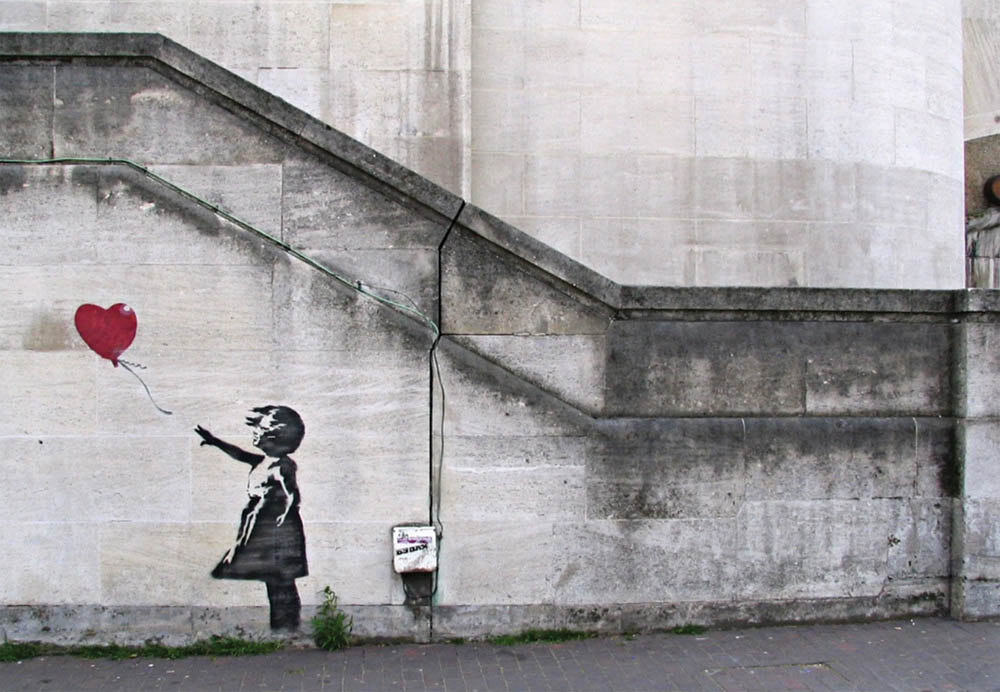
Girl with Balloon first appeared on walls in London in the early 2000s. Banksy, already known for his politically charged and satirical stencils, placed the image in public space where it could be encountered by anyone passing by. Unlike traditional artworks confined to galleries or museums, this piece belonged to the street. It required no ticket, no explanation, and no prior knowledge of art history. Its message was immediate and accessible.
The stencil technique was central to its impact. Clean lines and bold contrasts allowed the image to be quickly executed and easily replicated. The composition is minimal: a young girl leaning forward, arm extended, hair and dress slightly windswept, and a heart-shaped balloon floating away. The red balloon stands out dramatically against the monochrome figure and background. That small detail carries enormous emotional weight. The heart suggests love, hope, innocence, or desire. The fact that it is drifting away introduces ambiguity. Is the girl losing something precious, or is she releasing it?
This ambiguity is key to the work’s lasting resonance. Viewers project their own experiences onto the scene. For some, it represents lost childhood or fleeting love. For others, it symbolizes resilience and the belief that even when something slips away, hope remains. The image has often been associated with the phrase There is always hope, reinforcing a reading rooted in optimism. Yet the work does not dictate a single interpretation. It captures a universal moment of longing and leaves the conclusion open.
As Banksy’s reputation grew, Girl with Balloon became one of his defining images. It was adapted and recontextualized in various political and humanitarian settings. Variations of the motif appeared in relation to issues such as conflict and displacement, demonstrating how a simple visual idea could function as a powerful vehicle for commentary. The image proved flexible enough to carry both personal and political meaning. This adaptability contributed significantly to its global recognition.

By the mid-2010s, Girl with Balloon had transcended its origins as street art. It was reproduced on posters, prints, merchandise, and widely shared online. In 2017, it was voted the United Kingdom’s favorite artwork in a public poll, surpassing many traditional masterpieces. This was a remarkable achievement for a stencil that began as an act of unsanctioned public art. The result underscored a shift in cultural values: emotional immediacy and contemporary relevance resonated more strongly with the public than classical technique or institutional endorsement.
The work’s popularity is inseparable from the digital age. Its graphic clarity makes it instantly legible, even on a small phone screen. In an era dominated by visual sharing, the image travels effortlessly. It has been used to mark personal milestones, respond to global events, and express solidarity during times of crisis. Its simplicity allows it to function almost like a universal symbol, adaptable to countless contexts without losing its core meaning.
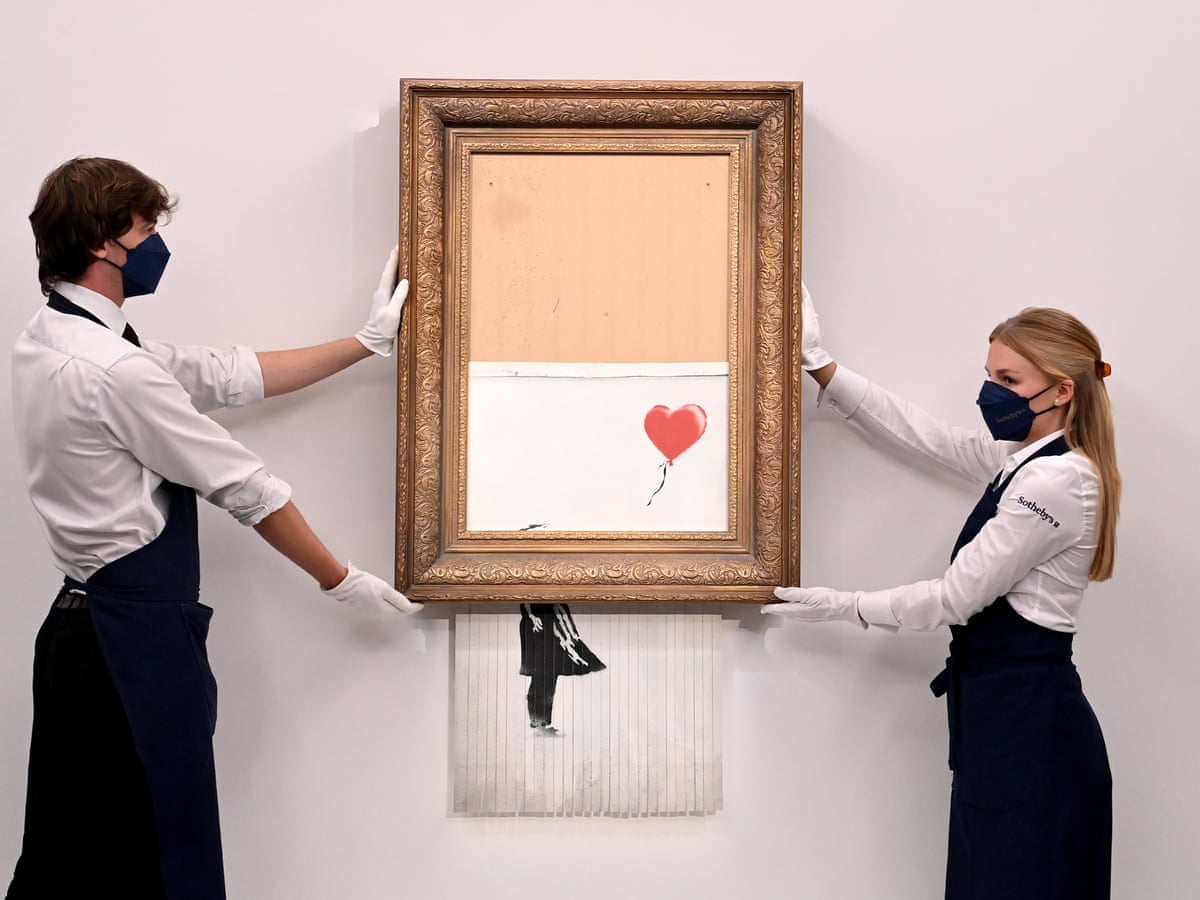
The artwork entered a new chapter in 2018 during a Sotheby’s auction in London. A framed version of Girl with Balloon was sold for just over one million pounds. Moments after the hammer fell, a hidden mechanism inside the frame activated, partially shredding the artwork before a stunned audience. The event was orchestrated by Banksy himself. The shredded piece was subsequently renamed Love Is in the Bin and authenticated as a new work.

This act instantly became one of the most talked-about moments in contemporary art history. It blurred the line between artwork and performance, turning a traditional auction into a live spectacle. On one level, the shredding appeared to critique the commercialization of street art and the art market’s appetite for commodification. On another level, it amplified the artwork’s cultural value. The partially destroyed piece later resold for a significantly higher price, demonstrating the paradox at the heart of Banksy’s practice: critique and participation in the market can coexist.
The shredding event reinforced Girl with Balloon’s status not just as an image, but as a narrative. It became part of a story about authorship, control, and the unpredictability of contemporary art. The moment expanded the work’s meaning. The act of destruction echoed the original theme of loss and release, transforming the artwork’s symbolism into lived reality. The balloon drifting away was mirrored by the artwork itself slipping beyond conventional boundaries.
Ultimately, Girl with Balloon endures because it speaks to something fundamental. It captures the tension between holding on and letting go. It reflects the fragility of love and the persistence of hope. The child’s gesture is universal; everyone has reached for something just beyond their grasp. The image freezes that instant of uncertainty, inviting viewers to decide whether it represents defeat or possibility.
Its influence extends beyond street art. It has shaped public perceptions of what contemporary art can be: immediate, emotionally direct, and socially engaged. It has demonstrated that an artwork does not need complexity of form to achieve depth of meaning. Instead, clarity and emotional truth can create a lasting icon.
In a world saturated with images, very few achieve the status of universal symbol. Girl with Balloon has done precisely that. It began as a stencil on a wall and evolved into a global emblem of hope, vulnerability, and resilience. Its journey reflects broader shifts in culture, where art can emerge from the street, dominate the digital landscape, challenge the market, and still retain its emotional core.
More than twenty years after its first appearance, the image remains as powerful as ever. The small figure reaching toward a drifting heart continues to resonate because it captures a timeless human experience. Whether seen as a story of loss, freedom, love, or optimism, Girl with Balloon invites each viewer to pause and reflect. In that quiet moment between grasping and letting go lies the reason for its enduring appeal.
Discover Banksy signed prints for sale at our New York and London galleries. Looking to sell your Banksy art? Contact our teams via info@guyhepner.com for more information.
