25 Cats Named Sam
20 works

The Skull series occupies a distinctive position within Warhol's print market—commanding serious collector attention while remaining accessible relative to his most contested series. Recent auction activity confirms sustained demand, with the complete set achieving $90,300 in October 2025. These figures represent consistency rather than volatility—exactly what institutional collectors seek when building positions in secondary market prints.
Context matters here. Warhol's market authority was definitively established when Shot Sage Blue Marilyn sold for $195,040,000 at Christie's in May 2022, setting the record for any 20th-century artwork at auction. That transaction reset collector perception of Warhol as a store of value. Mao prints each reached $4,648,000 at Christie's in May 2025, while Flowers prints commanded $4,076,000 and $3,832,000 at Sotheby's that same month. Against this backdrop, the Skull series offers serious thematic weight at acquisition prices that allow meaningful position-building.
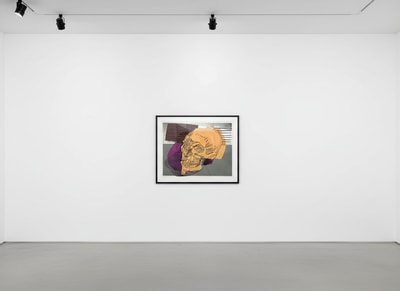
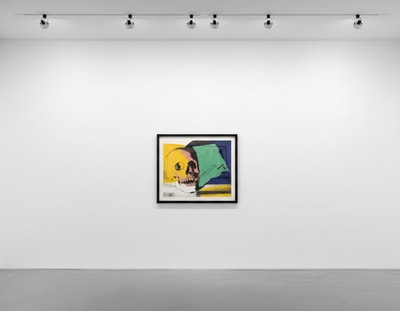
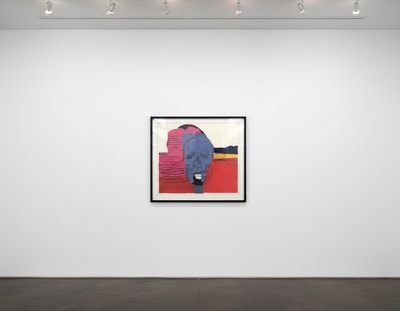
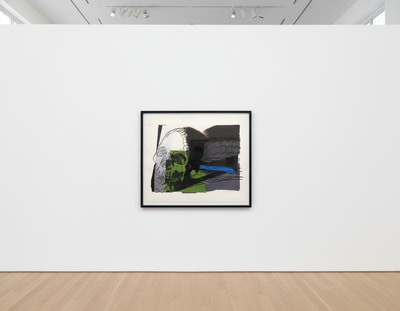
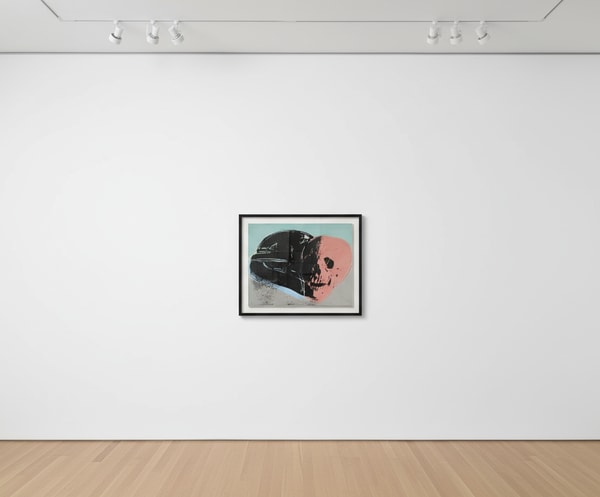
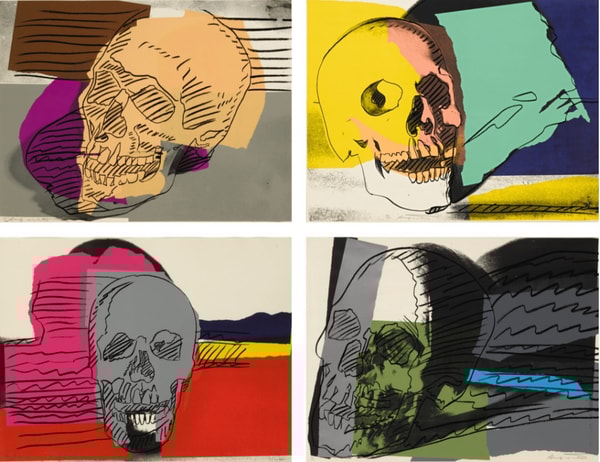
Warhol created the Skull portfolio in 1976, working from photographs of a human skull he had purchased from a Paris flea market. The source image was shot by his assistant, then translated through Warhol's signature screen printing process into four distinct colorways—each measuring 30 x 40 inches on Strathmore Bristol paper.
The series emerged during a period when Warhol was actively confronting mortality in his work, following his near-fatal shooting in 1968. Unlike the detached commercialism of the Campbell's Soup Cans or the celebrity fixation of Marilyn, the Skulls carry an introspective quality that distinguishes them within his oeuvre.
Published by Andy Warhol Enterprises and printed by Rupert Jasen Smith, the portfolio maintained Warhol's exacting production standards. The color separations across the four prints—ranging from stark black-and-white contrasts to vibrant pinks and yellows—demonstrate his mastery of chromatic variation within a single compositional framework. This technical approach would inform his subsequent memento mori works throughout the late 1970s.
The complete set represents the purest expression of Warhol's chromatic intentions, and collectors pursuing comprehensive holdings consistently prioritize these sets. From our direct experience placing these works, the complete portfolio commands a premium beyond the sum of individual sheets—collectors recognize the curatorial completeness.
One colorway generates the strongest demand. Its high-contrast composition—stark whites against deep blacks—reads as the most immediately recognizable iteration. The April 2025 result of $120,650 reflects this preference. Other colorways appeal to those building chromatic sequences across their collections.
The Skull (1976-77) acrylic and silkscreen enamel on canvas at 16 x 19 inches represents an entirely different acquisition category. Unique works on canvas from this series surface infrequently, and when they do, competition intensifies substantially. These paintings connect directly to Warhol's studio practice in ways that even pristine prints cannot replicate.
Collectors often begin with a single impression before expanding to the complete portfolio.
Authentication for the Skull prints follows established Warhol protocols. Legitimate impressions bear the artist's signature in pencil on the verso, accompanied by edition numbering. The Andy Warhol Foundation for the Visual Arts maintains authentication authority, and any acquisition should include documented provenance tracing back to original distribution channels.
Condition assessment for these works requires particular attention to several factors. The Strathmore Bristol paper, while archival quality, shows handling evidence readily—examine sheet edges carefully for soft creases or minor tears that may have been professionally stabilized.
Light exposure history should be verified whenever possible. Works that have been displayed without UV-filtering glazing may exhibit subtle shifts that only become apparent when compared against fresh impressions. At Guy Hepner, we examine every Skull print under controlled lighting conditions before presenting to clients, documenting any condition notes transparently.
Guy Hepner maintains active inventory across the Skull series, with current availability varying by colorway and condition grade. For collectors seeking specific impressions or complete portfolios, we recommend direct consultation to discuss current holdings and anticipated opportunities.
Contact our New York team to arrange a private viewing or to register acquisition interest for works not presently in inventory.
This series belongs to the vast and varied body of print and painted work Warhol produced across five decades, during which he moved fluidly between celebrity portraiture, consumer product imagery, historical appropriation, and personal or commissioned subject matter — all filtered through the same signature screenprint process that flattened the distinction between mechanical reproduction and fine art. Warhol's insistence on treating commercial printing techniques as a primary artistic medium, rather than a secondary reproductive tool, remains one of the most influential positions in postwar American art.
Warhol's work is held in the permanent collections of major museums worldwide, including the Museum of Modern Art, the Whitney Museum of American Art, Tate Modern, and the Andy Warhol Museum in Pittsburgh, which maintains the most complete public archive of his output across all periods and subjects.
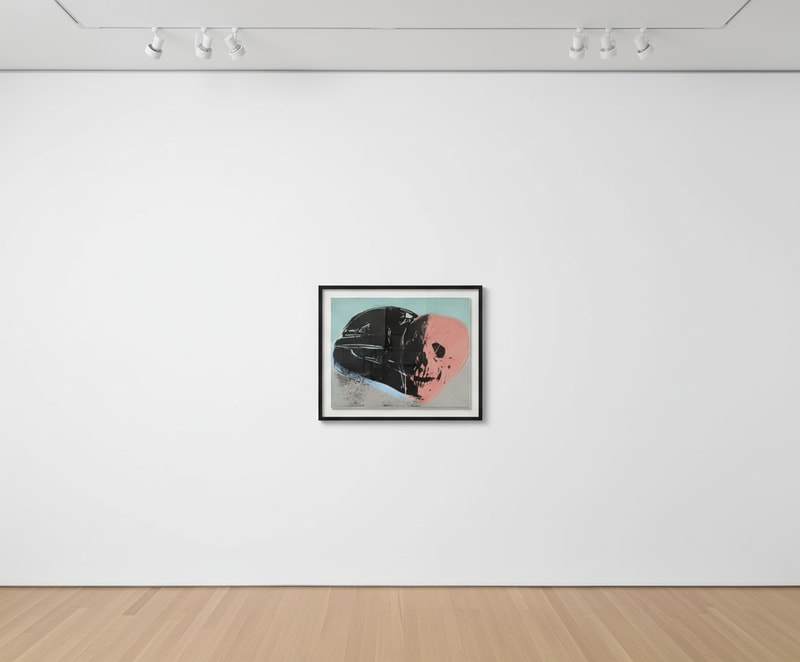
6 works available
The Colourways
Warhol bought a human skull at a Paris flea market in 1976 and had it photographed from multiple angles, reworking the images into these four prints within the centuries-old memento mori tradition.
Other Skull Works
Five Facts About Andy Warhol Skull
The Skull series originated from a real human skull Warhol purchased at a flea market in Paris in the mid-1970s.
His studio assistant Ronnie Cutrone photographed the skull with a Polaroid camera, repeatedly repositioning the light source to create different shadow effects, and those photographs became the basis for the series.
The prints and paintings date from 1976 and were produced with the help of Rupert Smith, who joined Warhol's studio specifically to assist with screen-printing at that time.
The complete print portfolio, catalogued as F&S II.157-160, comprises four screenprints in an edition of 50 with 10 artist's proofs.
Warhol reportedly conceived the subject after his business manager Fred Hughes suggested he paint a memento mori, a classical symbol of mortality, following conversations about a suitable subject for a new series.
Market Data
See real auction history, estimate ranges and price benchmarks for individual Skull prints, sourced from Christie's, Sotheby's and other major auction houses.
Frequently Asked Questions
Andy Warhol Skull prints for sale are available at Guy Hepner Gallery, 177 Tenth Avenue, New York. We offer authenticated editions with full provenance documentation sourced from the secondary market and directly from publishers.
Andy Warhol Skull works — 6 available — are typically produced as limited editions, individually signed and numbered by the artist. Contact Guy Hepner Gallery for edition details on specific works.
Pricing for Andy Warhol Skull prints varies by edition size, date, and condition. Contact Guy Hepner Gallery for current market pricing and availability.
More Andy Warhol Series
View all Andy Warhol works →