25 Cats Named Sam
20 works

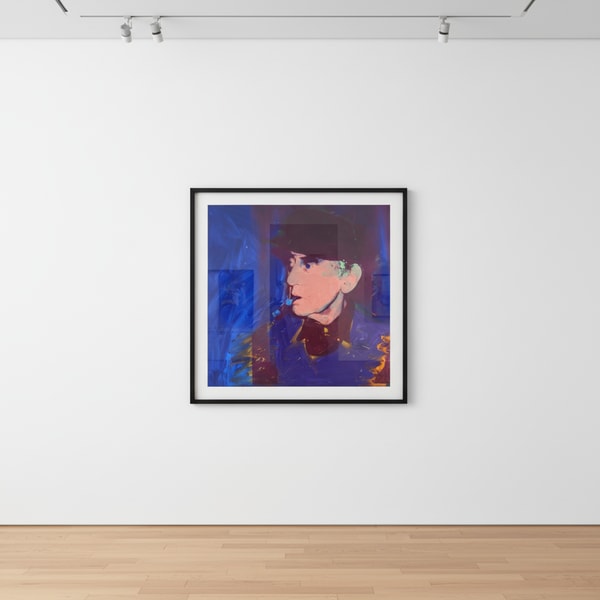
The Man Ray series represents one of Warhol's most intellectually compelling portrait suites, paying homage to the Surrealist photographer who helped define avant-garde visual culture in the twentieth century. Recent auction activity demonstrates renewed institutional and private interest in this suite. September 2025 saw a Man Ray canvas achieve GBP 797,633 at auction, signaling strong demand at the upper tier of the series. One edition realized GBP 11,970 in September 2021. These results, drawn from Guy Hepner internal records, confirm that the series operates across multiple price points—offering entry for emerging collectors while rewarding those pursuing unique canvas examples.
Context matters here. Warhol's market has never been stronger at the apex: Christie's achieved $195,040,000 for Shot Sage Blue Marilyn in May 2022, establishing the highest price ever paid for a twentieth-century artwork at auction. Mao prints sold for $4,648,000 each in May 2025, while Sotheby's moved major Flowers works at $4,076,000 and $3,832,000 that same month. A Self-Portrait brought $18,144,000 at Sotheby's in November 2023. The Man Ray series, by comparison, remains undervalued relative to these marquee categories—a gap sophisticated collectors recognize as opportunity.
Warhol created the Man Ray series in 1974, the same year he produced several of his most significant portrait suites, with printing executed by Alexander Heinrici. The edition comprises works on Strathmore Bristol paper, a surface Warhol favored for its archival quality and receptivity to his saturated color fields.
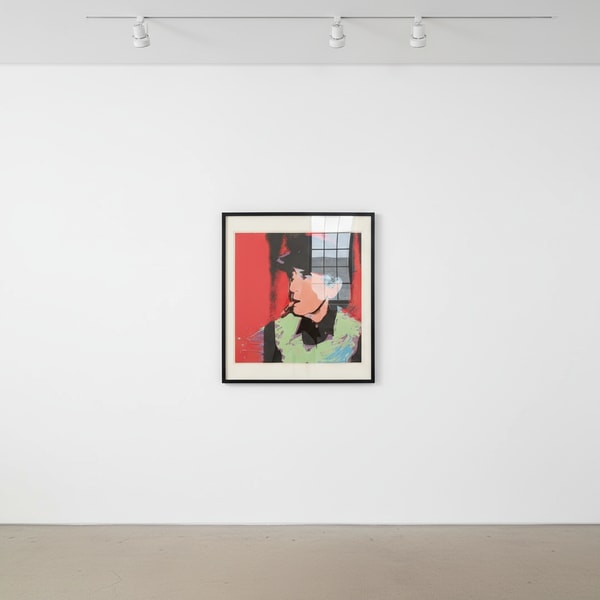
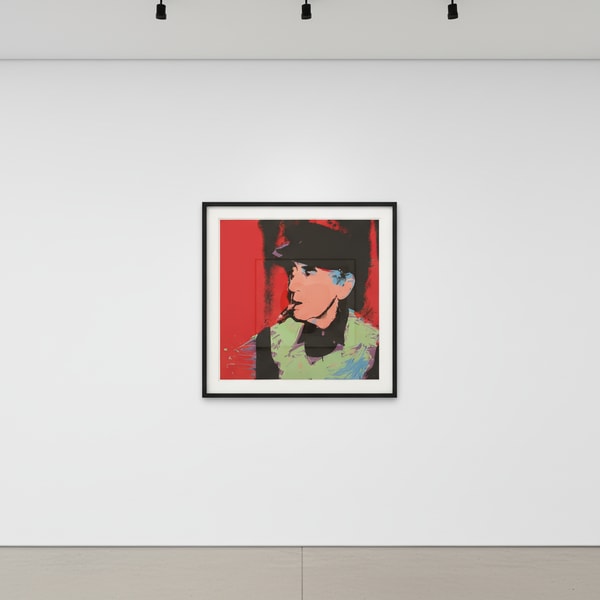
Man Ray himself embodied the cross-disciplinary experimentation Warhol admired. By selecting this subject, Warhol acknowledged his own artistic lineage while claiming a place within that tradition. The composition isolates Man Ray's face through Warhol's signature high-contrast treatment, flattening photographic source material into graphic immediacy. This wasn't mere homage—it was a conversation between two artists who understood that image-making itself had become the defining medium of modern culture.
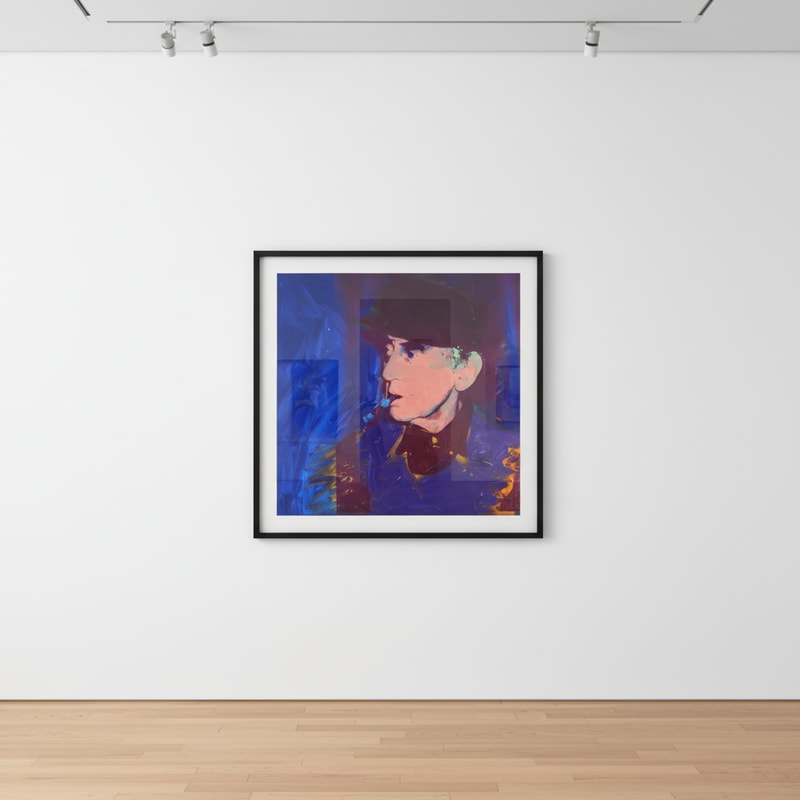
The canvas variant, measuring 40 x 40 inches in acrylic and silkscreen enamel, represents the series at its most authoritative scale. These unique works command attention that the editioned prints cannot replicate.
Man Ray (1974), Acrylic and silkscreen enamel on canvas, 40 x 40 in The canvas works stand apart. Collectors pursuing legacy holdings consistently prioritize these unique pieces, understanding that the combination of hand-applied acrylic with silkscreen enamel creates surfaces no print edition can match. The September 2025 result of GBP 797,633 came from this category, confirming the price separation between canvas and paper.
Man Ray (1974), Screen print on Paper, 13 3/4 x 13 3/4 in This smaller format edition appeals to collectors building comprehensive Warhol print holdings. We see particular interest from those who already own works from the Mao or Marilyn suites and seek intellectually adjacent examples.
Man Ray (1974), Screen print on Strathmore Bristol paper, 31 1/2 x 31 1/2 in At larger scale, this edition delivers visual presence comparable to the canvas while remaining within the editioned market. Condition becomes paramount at this size—any handling marks diminish value disproportionately.
From our experience placing hundreds of Warhols, the Man Ray buyer tends toward connoisseurship. These are collectors who appreciate subtlety alongside spectacle.
Authentication for Man Ray works follows established Warhol protocols. The Andy Warhol Foundation for the Visual Arts Authentication Board operated until 2011, and works authenticated during that period carry documentation accordingly. Current authentication relies on The Andy Warhol Catalogue Raisonné, published by Phaidon, alongside provenance research and technical analysis.
For these prints, collectors should verify stamped signatures on verso where applicable, edition numbering, and publisher blindstamps from Castelli Graphics or Multiples, Inc. Paper condition demands scrutiny: examine margins for handling creases, assess color saturation against known exemplars, and confirm no restoration to printed areas. Fading in Warhol's specific pigments indicates improper storage or light exposure.
Canvas works require assessment of silkscreen registration, surface condition of enamel layers, and structural integrity of stretcher bars. Any relined canvas should be fully documented with conservation reports.
Guy Hepner provides comprehensive condition reporting and facilitates third-party verification upon request.
Guy Hepner maintains active inventory across the Man Ray series and sources specific works for collector requirements. Our New York team brings nearly five decades of combined Warhol market experience to every acquisition.
Contact us directly to discuss available works, pricing, and acquisition strategy tailored to your collection.
This series belongs to the vast and varied body of print and painted work Warhol produced across five decades, during which he moved fluidly between celebrity portraiture, consumer product imagery, historical appropriation, and personal or commissioned subject matter — all filtered through the same signature screenprint process that flattened the distinction between mechanical reproduction and fine art. Warhol's insistence on treating commercial printing techniques as a primary artistic medium, rather than a secondary reproductive tool, remains one of the most influential positions in postwar American art.
Warhol's work is held in the permanent collections of major museums worldwide, including the Museum of Modern Art, the Whitney Museum of American Art, Tate Modern, and the Andy Warhol Museum in Pittsburgh, which maintains the most complete public archive of his output across all periods and subjects.
3 works available
Five Facts About Andy Warhol Man Ray
Man Ray (F. & S. II.148) is a 1974 screenprint portrait by Andy Warhol of American Dada and Surrealist artist Man Ray, born Emmanuel Radnitzky.
The portrait was produced for a 1974 exhibition of Warhol's work at the Galleria Il Fauno in Milan, Italy, printed by Il Fauno and published by dealer Luciano Anselmino.
Warhol was introduced to Man Ray by Anselmino and depicted him in three-quarter profile, wearing a hat and holding a pipe against a vivid red background.
The screenprint was issued in an edition of 100, hand-signed by Warhol, and printed on Strathmore Bristol paper.
The portrait was made two years before Man Ray's death in 1976, part of Warhol's practice of memorializing artists he personally admired and cited as influences on his own development.
Market Data
See real auction history, estimate ranges and price benchmarks for individual Man Ray prints, sourced from Christie's, Sotheby's and other major auction houses.
Frequently Asked Questions
Andy Warhol Man Ray prints for sale are available at Guy Hepner Gallery, 177 Tenth Avenue, New York. We offer authenticated editions with full provenance documentation sourced from the secondary market and directly from publishers.
Andy Warhol Man Ray works — 3 available — are typically produced as limited editions, individually signed and numbered by the artist. Contact Guy Hepner Gallery for edition details on specific works.
Pricing for Andy Warhol Man Ray prints varies by edition size, date, and condition. Contact Guy Hepner Gallery for current market pricing and availability.
More Andy Warhol Series
View all Andy Warhol works →