Roy Lichtenstein's Cathedral Series: History, Prints, and Collector Value
June 9, 2026 · Guy Hepner
Lichtenstein and Monet: A Dialogue Across Centuries
When Roy Lichtenstein turned to Claude Monet's Cathedrals series in the 1960s and then more extensively from the 1990s onward, he was doing something that cut directly against his public image. Lichtenstein was known — and in some quarters dismissed — as the artist who painted comic strips and consumer goods in bold outlines and Ben-Day dots. The notion that this same artist was in profound dialogue with the history of French Impressionism surprised many observers.
But Lichtenstein had always been engaged with the entire sweep of Western art history — Pop Art was never about the abandonment of that tradition but about its reimagination through the visual language of mass culture. The Cathedral series makes this explicit. By applying his signature Ben-Day dot technique to Monet's most celebrated series of atmospheric paintings, Lichtenstein stages a collision between two radically different ways of making an image, and asks the viewer to consider what gets lost and what gets gained in the translation.
The result is one of the most intellectually rich bodies of work in Lichtenstein's career, and among the most rewarding for collectors who want to engage with his practice beyond its Pop Art surface.
Monet's Rouen Cathedral Series: The Source
Monet painted the west façade of Rouen Cathedral more than thirty times between 1892 and 1894, at different times of day and in different weather conditions. The series is a foundational work of Impressionism: its subject is not the cathedral itself but the light that falls on it, the atmospheric conditions that transform its surface from hour to hour, and the painter's perception of that transformation.
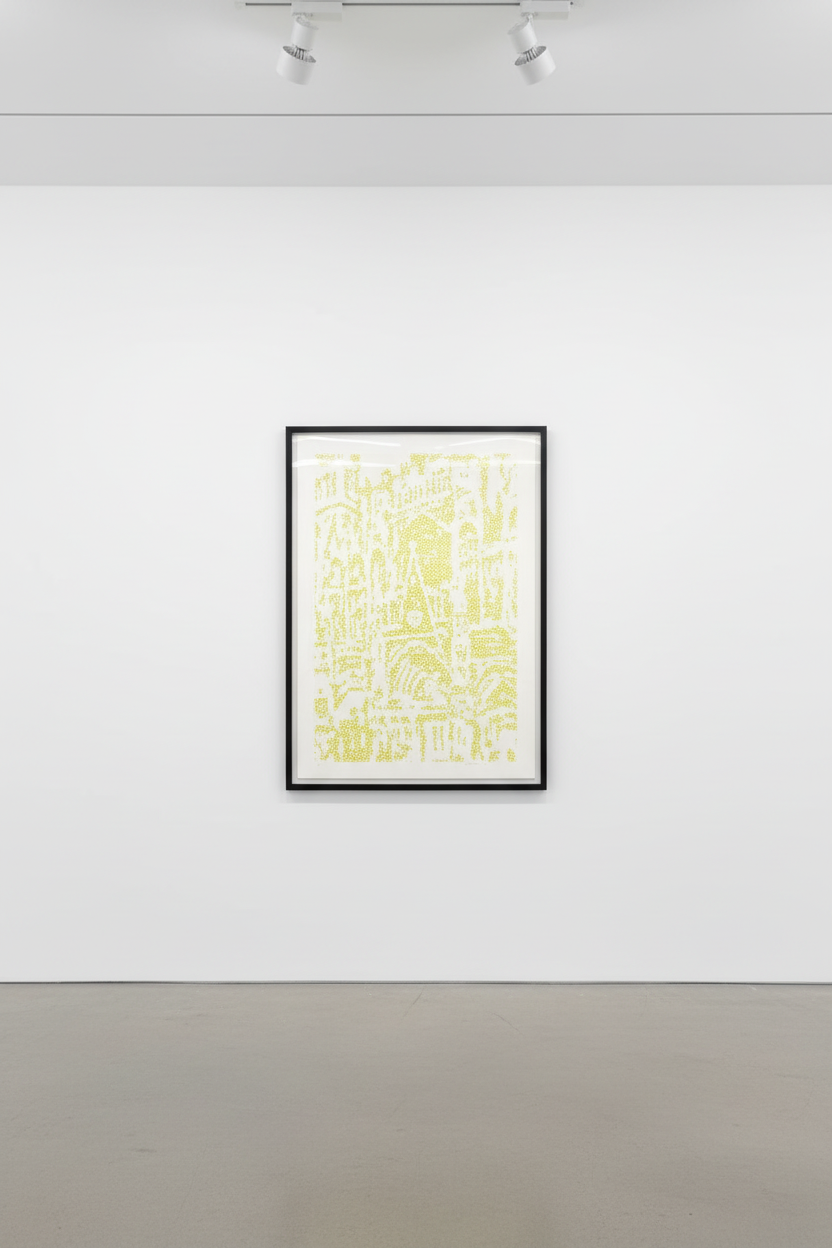
Roy Lichtenstein, Cathedral I (C-75), 1969. Available at Guy Hepner, New York.
Each painting in Monet's series is technically a portrait of the same stone surface, but the works are so varied in colour, texture, and emotional register that they read as meditations on perception, time, and the limits of representation. They were exhibited together in Paris in 1895 to considerable critical acclaim and remain among the most discussed works in the history of modern art.
Lichtenstein was drawn to precisely this quality — the series as a meditation on how images are made and what they mean — and his own Cathedral works take Monet's source material and subject it to a completely different image-making logic.
The choice of the Rouen series as a starting point was not accidental. Among Monet's bodies of work, the Cathedrals represent his most methodical and systematic exploration of atmospheric variation: the same stone surface, painted again and again under different conditions. This serial, systematic quality was something Lichtenstein recognised and shared. His own practice returned obsessively to the same motifs — comic-strip panels, consumer goods, art-historical sources — examining what changed and what remained constant across different versions of the same image. The Cathedrals series presented Monet as, unexpectedly, a kindred spirit.
The Six Cathedral Prints: C-75 Through C-82
Lichtenstein's Cathedral series comprises screenprints produced in 1969 and referred to by their catalogue numbers: C-75, C-76, C-77, C-78, C-79, and C-82. (The numbering reflects the broader catalogue of his print work rather than the sequential numbering of the Cathedral images themselves.)
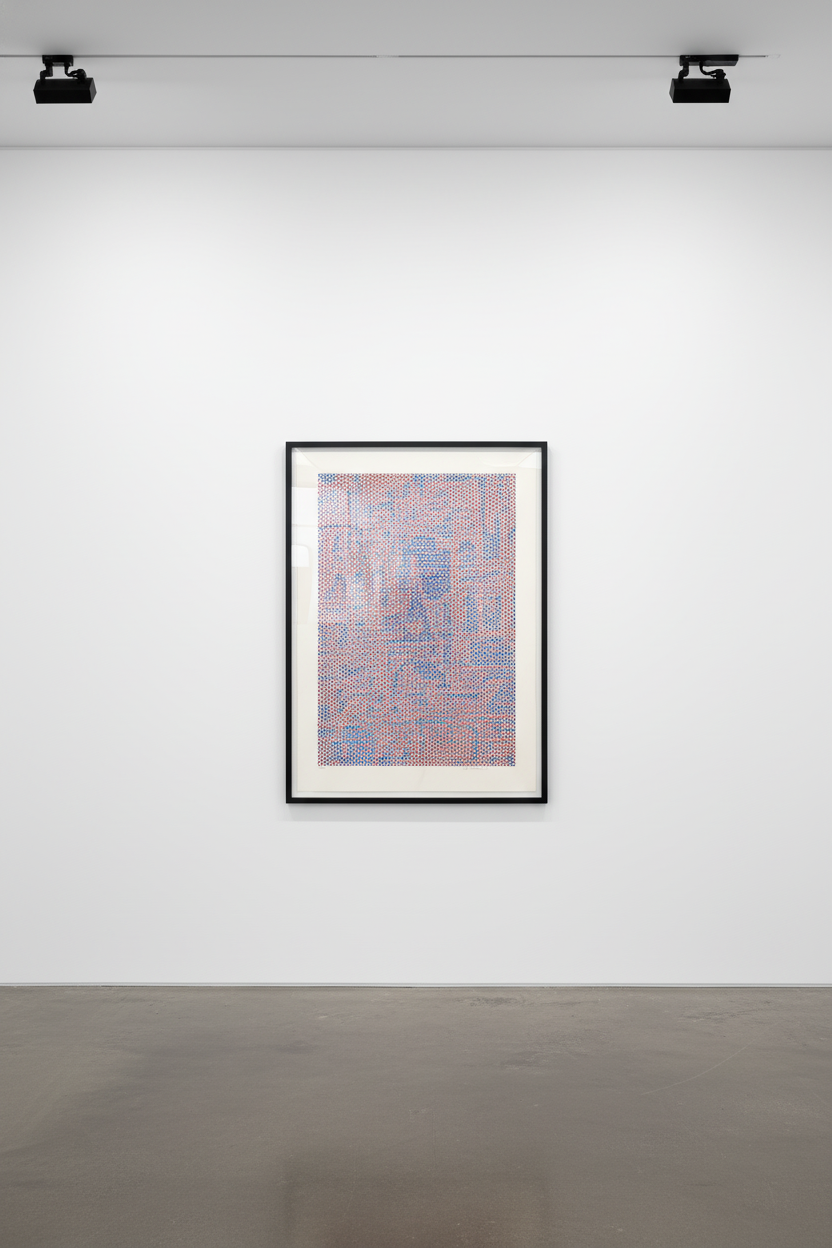
Roy Lichtenstein, Cathedral II (C-76), 1969. Guy Hepner Gallery.
Each print renders the Rouen façade through Lichtenstein's standard visual language: bold black outlines, flat areas of primary colour, and the Ben-Day dot patterns that simulate the tonal gradations of the Impressionist paintings while insisting on the mechanical, reproductive nature of the image-making process.
The dialogue with Monet operates on multiple levels simultaneously. Where Monet used gestural brushwork to capture atmospheric flicker, Lichtenstein uses mechanical dots — the fundamental unit of mass-reproduction printing — to capture something that is simultaneously a homage and a critique. The dots make Monet's shimmer systematic; they turn atmosphere into information.
The Individual Prints
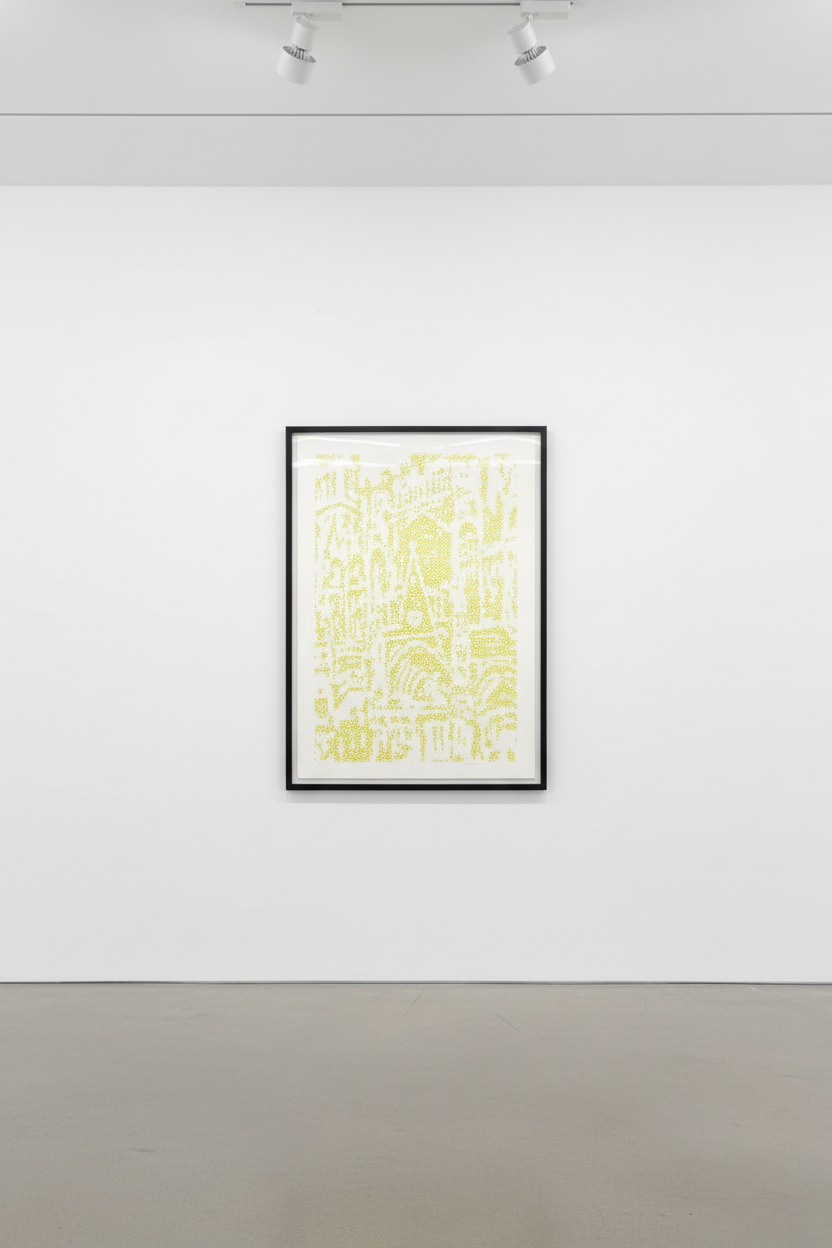
Cathedral I (C-75) introduces the series with a relatively restrained palette — the façade rendered predominantly in blue and yellow, the Ben-Day dots creating a structured tonal field that reads as stone under diffuse light. It is the most architecturally readable of the six prints, the Gothic detail of the façade still visible beneath the dot overlay.
Cathedral II (C-76) intensifies the colour and increases the density of the dot patterns, beginning the process of fragmentation that becomes more pronounced in later prints in the series. The façade is still legible but the atmospheric quality — the dissolution of stone into light — is more strongly emphasised.
Cathedral III (C-77) represents perhaps the most harmonious of the six, the dot patterns creating a visual texture that balances the competing pulls of architectural legibility and abstract dissolution. Many collectors regard C-77 as the aesthetically strongest single print in the series.
Cathedral IV (C-78) pushes the abstraction further, the dot fields beginning to dominate the architectural forms beneath them. The colour relationships become more complex and the sense of light — particularly of late-afternoon light — is more strongly evoked.
Cathedral V (C-79) continues this progression, the dots now clearly the primary visual experience rather than a secondary texture. The architectural subject is still present but it requires active reading; the surface operates increasingly as pattern.
Cathedral VI (C-82) completes the series in a state of near-abstraction, the dot patterns so dense and the colour relationships so compressed that the façade becomes almost entirely a pretext for a study in optical mixing. This print represents the logical endpoint of the series' argument: Impressionist atmosphere, subjected to the Ben-Day system, produces not the dissolution of the dot but the dissolution of the subject itself.
State I and State II Variants
Several prints in the Cathedral series were produced in both State I and State II variants. The State I versions represent an earlier stage in the printing process, while State II reflects subsequent additions or modifications. Among serious collectors, having both states of a single image offers a compelling way to study Lichtenstein's working process — the decisions made between states, the modifications introduced, the way an image evolves toward its final form.
State variants are typically rarer than standard editions and command premiums that reflect both their scarcity and their additional scholarly interest.
Ben-Day Dots Applied to Impressionism
The technical and conceptual achievement of the Cathedral series lies in what happens when Lichtenstein's Ben-Day dots meet Monet's atmosphere. The dots are the fundamental contradiction: they make systematic what Monet made fluid, they make reproducible what Monet made unique, and they make visible the mechanical substrate beneath all printed images.
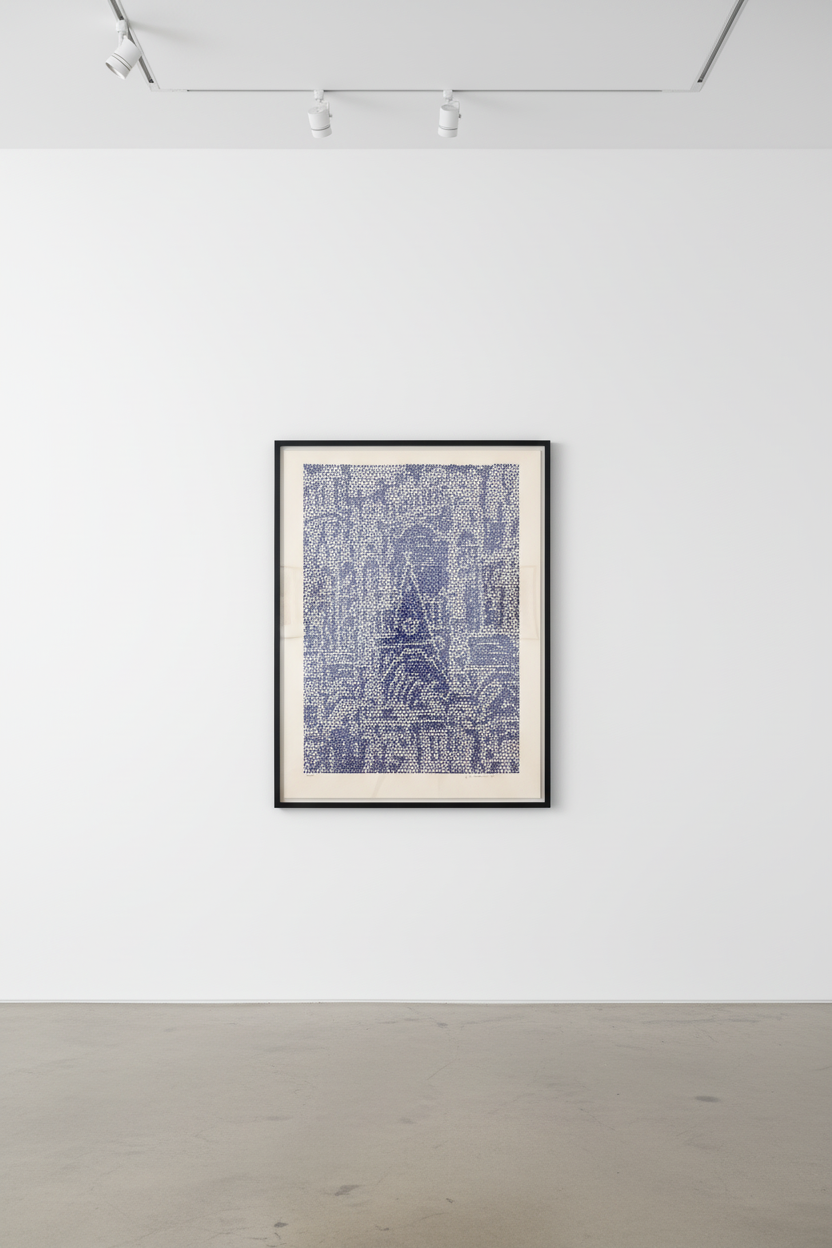
Roy Lichtenstein, Cathedral III (C-77), 1969. Guy Hepner Gallery.
But the result is not merely reductive. The Lichtenstein Cathedrals are genuinely beautiful in their own right — the organised dot patterns create a kind of structured shimmer that is different from Monet's brushwork but not simply inferior to it. Viewers accustomed to looking at Lichtenstein's work learn to see the dots as having their own visual logic, their own capacity to describe light and surface.
The Ben-Day dot originated in commercial printing as a method for creating the illusion of tonal gradation using only flat ink. Named after illustrator Benjamin Henry Day Jr., who patented the process in 1879, the technique was ubiquitous in comic-book printing and cheap newspaper reproduction by the mid-twentieth century. When Lichtenstein appropriated it in the early 1960s, he was doing something analogous to what Warhol was doing with silk-screening: elevating a mechanical reproduction process into a fine-art method, insisting on the visibility of the reproduction mechanism rather than trying to hide it.
Applied to Monet, the dots become a critique as well as a tool. Monet's whole project in the Cathedrals was to capture the ephemeral, the atmospheric, the subjective experience of perception under specific light conditions. Lichtenstein's dots are the opposite: they are systematic, mechanical, the same everywhere, incapable of capturing subtlety or nuance in the way paint can. Yet somehow, at sufficient scale and with enough care in colour selection, they do produce something that reads as atmospheric. The system generates an effect it should not be capable of generating. This paradox is the intellectual heart of the series.
For collectors, this quality means that the Cathedral prints work as both intellectual objects — documents of an important conceptual argument — and as purely visual ones. They reward living with.
The Cathedral Series in Lichtenstein's Development
The 1969 Cathedral prints were not Lichtenstein's only engagement with Monet. He returned to this dialogue throughout his career, most extensively in the 1990s when he produced the Cathedrals paintings that significantly expanded and developed the arguments first made in the 1969 prints.
This sustained engagement across three decades tells us something important about what the Monet dialogue meant to Lichtenstein. These were not opportunistic quotations — a single work that referenced a famous source for pop effect — but a genuine ongoing investigation. The questions the 1969 Cathedral prints asked about representation, mechanical reproduction, and the relationship between system and sensation were questions Lichtenstein returned to throughout his career and never fully resolved.
For collectors, this sustained engagement supports the significance of the 1969 prints as foundational works in an important series of explorations. They are not isolated objects but the opening propositions of an argument that continued for decades.
Lichtenstein's Broader Monet Dialogue
The Cathedrals were Lichtenstein's entry point into a wider engagement with Monet's body of work. He subsequently applied the same analytical process to other Monet series, most notably the Water Lilies — Monet's late Giverny paintings, which push atmospheric dissolution even further toward abstraction than the Cathedrals do.
For collectors interested in following this thread, the Water Lilies and Japanese Bridge series form a natural companion to the Cathedral works. They represent a later phase in Lichtenstein's career and push the Ben-Day logic into more abstract territory.
Explore Roy Lichtenstein's Water Lilies series →
Why These Works Matter in Lichtenstein's Career
The Monet dialogue series hold a particular importance in understanding Lichtenstein's full achievement because they demonstrate the depth beneath the Pop Art surface. Collectors and critics who engage only with the comic-strip works or the consumer-goods paintings are seeing one register of his practice; the Cathedral series reveals a sustained engagement with the history of Western painting that shaped everything he made.
For collectors, this means that the Cathedral works occupy a position in the market that reflects their dual identity: they appeal both to Pop Art collectors drawn to Lichtenstein's canonical manner and to collectors of modern European and American art more broadly. This crossover appeal has historically supported strong secondary market performance.
The Cathedral series also represents a moment in art history that is independently significant: 1969 was a pivotal year for Pop Art, as the movement was transitioning from its early provocations toward a more settled institutional recognition. The Cathedral prints are works made at the precise moment when Lichtenstein's practice was at its most self-confident and intellectually productive.
Rarity, Condition, and What to Look For
The Cathedral series prints were produced in moderate editions — typically between 60 and 100 impressions — that are relatively accessible by the standards of major mid-century American print editions. However, works in pristine condition are increasingly difficult to find, as the prints age and the pool of unexhibited examples diminishes.
Condition priorities: Paper integrity, evenness of colour, absence of foxing or toning. The bold flat colours of Lichtenstein's screenprints are sensitive to light damage; any fading in the colour fields is a significant value detractor.
State variants: Where both states exist, State I impressions tend to command premiums given their additional rarity and scholarly interest.
Edition position: Low numbers within an edition are traditionally preferred by collectors, though for works of this age the difference in demand relative to high numbers is relatively modest.
Provenance: Works with auction histories at major houses and documented collection provenances are preferred. Works that can be traced to the original publisher or to early institutional collections carry particular credibility.
Authentication: Lichtenstein's print catalogue is well-documented by the Lichtenstein Foundation, which maintains detailed records and supports authentication queries. Collectors should verify that any acquisition is consistent with the foundation's published catalogue records.
Building a Cathedral Series Collection
For collectors drawn specifically to the Cathedral prints, the most natural approach is to begin with a single strong example — ideally in State II for accessibility, or State I if budget allows — and build from there. The six-print series has an internal logic: prints earlier in the sequence are more architecturally readable; those later in the sequence are more abstractly powerful.
Many collectors find that the series as a whole tells a more compelling story than any individual print. Acquiring all six over time, in whatever states are available, builds a document of an artistic argument as it unfolds — the progression from C-75's restrained legibility to C-82's near-abstraction is itself a subject.
Given the increasing difficulty of finding pristine examples, condition should be prioritised above edition position or price point. A high-numbered impression in excellent condition is significantly preferable to a low-numbered impression with toning or surface damage.
Market Performance
Lichtenstein's print market has been consistently strong over the past two decades, with the Cathedral series among the most actively traded of his print editions. The combination of rarity, art-historical significance, and genuine visual quality supports sustained demand from a broad collector base.
Recent years have brought a broader reappraisal of Lichtenstein's late work — including the paintings and prints that continued the Monet dialogue into the 1990s — which has brought additional scholarly and collector attention to the earlier Cathedral prints as the foundation of that extended enquiry. Works that can be positioned within this longer narrative tend to perform strongly.
The Cathedral prints also benefit from the continuing institutional attention to Lichtenstein's legacy. Major retrospectives at the Art Institute of Chicago, the Tate Modern, and the Centre Pompidou over the past decade have each been followed by periods of heightened secondary market activity, as new audiences encounter his work and convert into buyers.
Further Reading
Browse Roy Lichtenstein prints available at Guy Hepner
Sell your Lichtenstein with Guy Hepner
Roy Lichtenstein's Water Lilies series — history, prints, and collector value
Works For Sale
Available through Guy Hepner

Roy Lichtenstein
Red Lamp (C. 279)
1992
Enquire →

Roy Lichtenstein
At The Beach (C. 156) , from The Surrealist Series
1978
Enquire →

Roy Lichtenstein
Imperfect 67 (C. 223)
1988
Enquire →
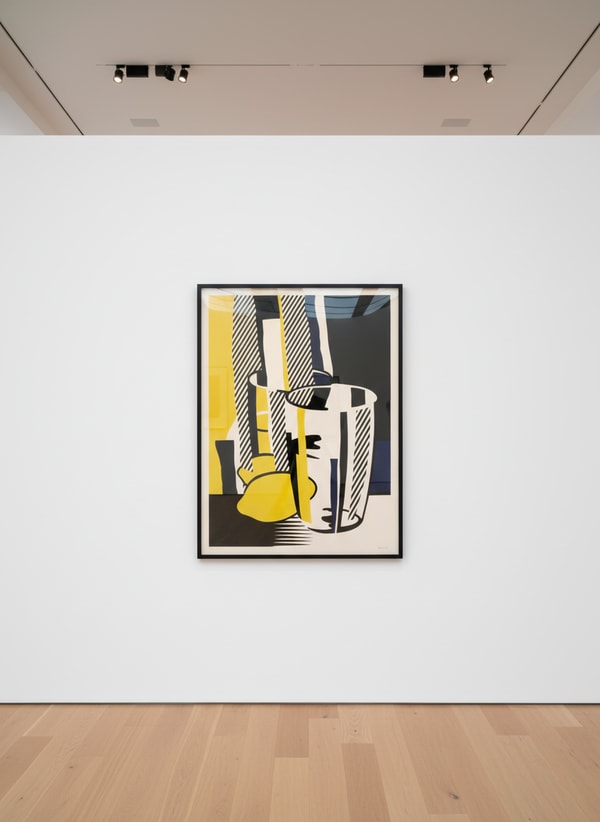
Roy Lichtenstein
Before The Mirror (C.135)
1975
Enquire →

Roy Lichtenstein
Morton A Mort (C. 178), from Expressionist Woodcut Series
1989
Enquire →

Roy Lichtenstein
Peace Through Chemistry III (C. 98)
1970
Enquire →

Roy Lichtenstein
Reflections On Crash (C.239)
1990
Enquire →

Roy Lichtenstein
Peace Through Chemistry II (C. 97)
1970
Enquire →
Thinking of selling?
Get a free Roy Lichtenstein valuation
Guy Hepner Gallery — 25+ years in the market. Same-day offers.
More from Guy Hepner

