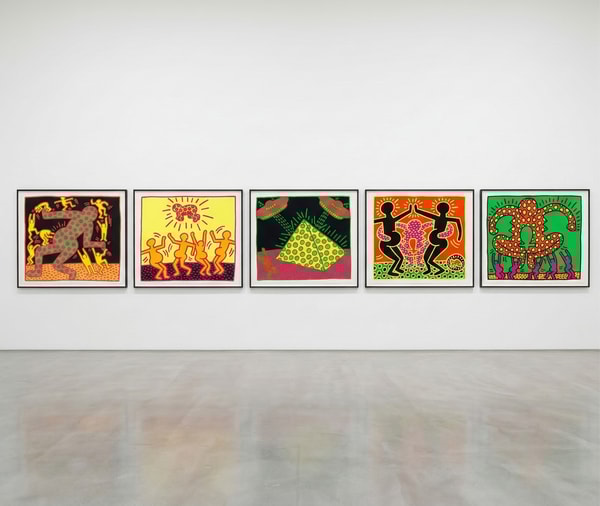
Keith Haring's Dog: The Barking Dog in His Art and Prints
June 9, 2026 · Guy Hepner
The Barking Dog: Keith Haring's Most Iconic Symbol
Few motifs in contemporary art history are as immediately recognisable — or as richly encoded — as Keith Haring's barking dog. Appearing across thousands of subway chalk drawings, major paintings, and limited-edition print portfolios, the dog is not simply a charming cartoon animal. It is one of the most carefully considered symbols in Haring's visual vocabulary: a figure of fear, authority, aggression, and the complex power dynamics that defined life in 1980s New York.
Understanding the barking dog means understanding Haring himself — his politics, his street-art origins, and the way he translated urgent social commentary into images that still feel alive decades after his death in 1990.
Origins: The Subway Drawings
Haring's dog first appeared in earnest during his famous New York City subway drawing campaign, which began in 1980. Haring had noticed the blank black advertising panels — paper coated in matte black — that lined unused subway advertising spaces throughout the city's stations. Working quickly in chalk, he began filling these panels with figures: radiant babies, dancing figures, and a particular kind of dog: four-legged, crouching, barking, with jagged lines shooting from its open mouth.
The subway drawings were ephemeral by nature — transit workers regularly removed them — but their influence was permanent. They established the vocabulary that Haring would carry into galleries, onto murals, and eventually into print editions. The dog seen in those subway drawings is essentially the same creature that appears in his most collectible print portfolios: simplified to its essence, instantly legible, but loaded with meaning.
The subway context mattered enormously. New York's transit system in the early 1980s was a contested public space — underfunded, dangerous in places, but also vibrantly alive with a diverse cross-section of the city's population. Haring's choice to work there, for free, for an audience that had not chosen to see art, was itself a political act. The barking dog addressed that audience directly: it was a figure drawn from the world they recognised, translated into a graphic language precise enough to function as communication even at speed, glimpsed from a moving train.
The Dog as Symbol: Power, Fear, and Authority
Haring was explicit about the symbolism embedded in his work, and the barking dog is among his most discussed motifs. In interviews and his journals, he described the dog in terms of aggression, threat, and the wielding of institutional power. The dog barks not out of playfulness but out of warning — it is an animal asserting dominance, demanding compliance, enforcing borders.
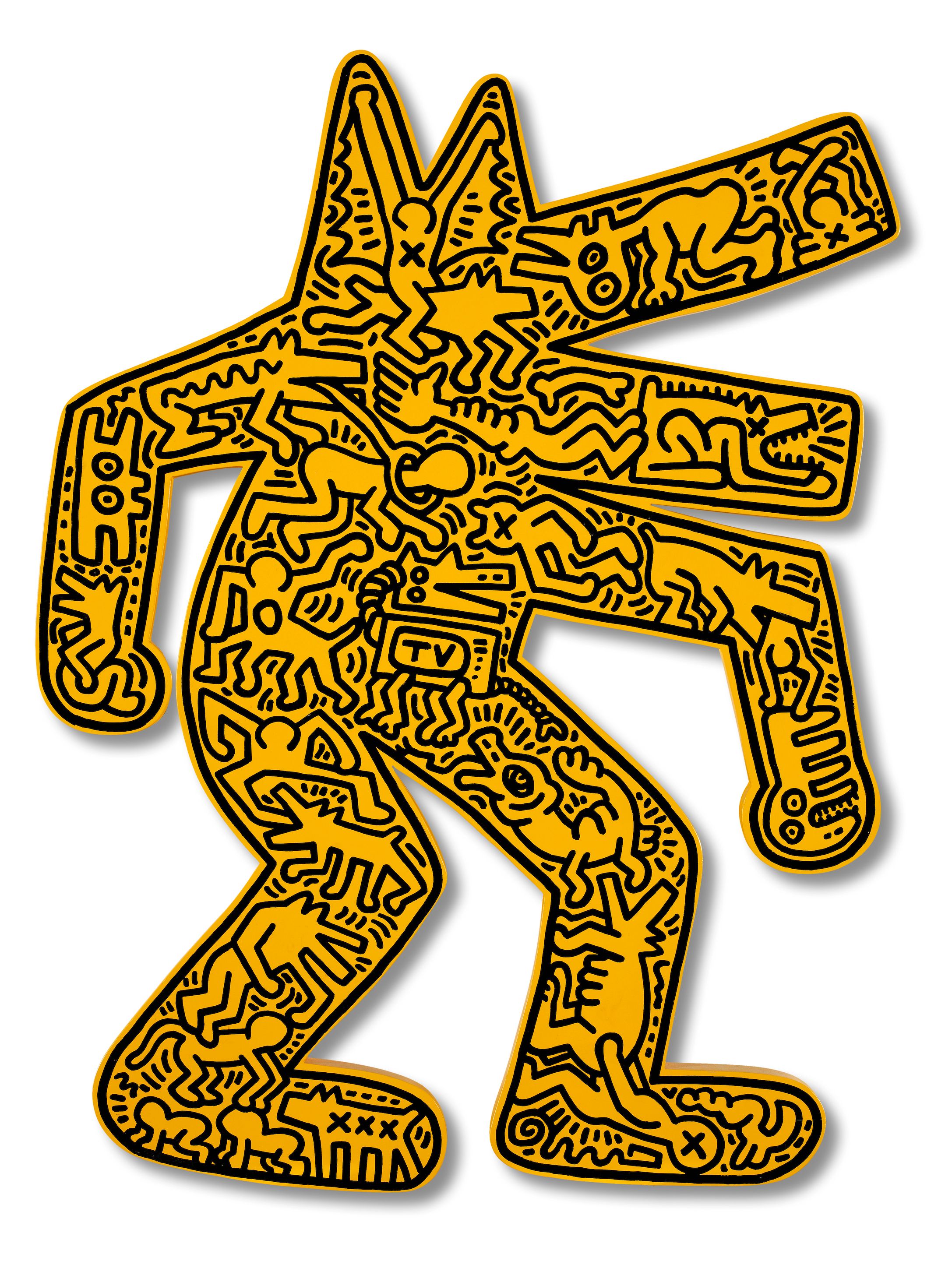
This reading was not abstract. Haring grew up during the civil rights era and came of age in a New York defined by heavy-handed policing, the AIDS crisis, and a political establishment that — in his view — used fear as a tool of control. The barking dog became his shorthand for all of it: the growl of the state, the bite of authority, the intimidation tactics of power directed at the marginalised.
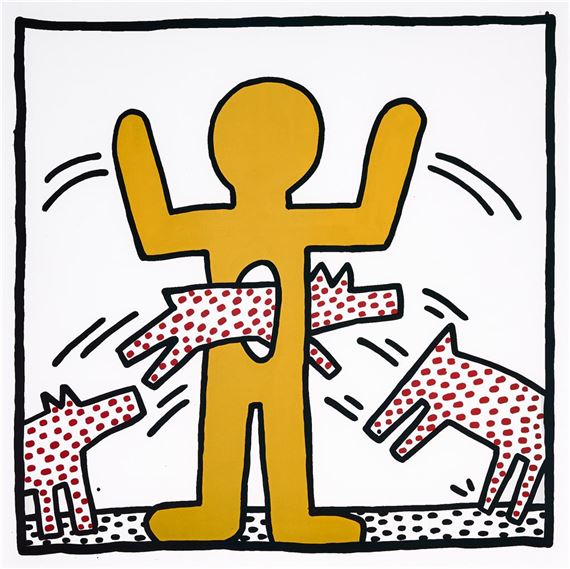
In some compositions, the dog appears alongside human figures who cower or flee. In others, it stands alone, its aggressive posture filling the frame. The jagged lines shooting from its open mouth — Haring's universal symbol for both sound and energy — transform barking into something almost violent: sound as weapon, noise as threat.
The dog also appears in tenderer contexts. Paired with figures in motion or celebration, it sometimes functions differently — as companion, as energy, as the raw animal force of life itself. This ambiguity is part of what makes the motif so enduring. Like all great symbols, the barking dog contains multitudes.
Haring's Visual Language: How the Dog Fits
To understand the barking dog fully, it helps to understand the broader system of signs Haring developed. His visual vocabulary was not a collection of arbitrary images; it was a carefully constructed language in which each motif carried specific weight and could be combined with others to generate meaning through relationship.
The radiant baby — perhaps his most famous image alongside the dog — represented innocence, the potential of human life before corruption. The dancing figures represented joy, community, and collective resistance. The UFO and alien figures spoke to Haring's fascination with science fiction and the unknown. The crawling figures, the angels, the copulating bodies: each played a role in a grammar of images that could be combined like words into sentences.
The barking dog occupied the register of threat within this system. It functioned as Haring's marker for hostile institutional force — the body of power that enforced compliance through fear. When the dog appears next to a crouching human figure, it reads as state power over the individual. When it appears alongside the radiant baby, it reads as the threat to innocence. When it stands alone, it is the pure symbol of aggression, stripped of specific target.
This systematic approach to image-making was influenced by Haring's engagement with semiotics during his time at the School of Visual Arts in New York. He read Roland Barthes and was interested in how sign systems communicated beyond linguistic channels. The subway drawings were his laboratory for testing whether his visual language could communicate across the social and demographic breadth of the city's transit population.
The AIDS Crisis and the Dog's Darkening Meaning
By the mid-1980s, the barking dog had taken on an additional layer of meaning. Haring was HIV-positive — he announced his diagnosis in 1988, though he had known for some time — and the spectre of institutional failure around the AIDS crisis charged his late work with a specific urgency.
The dog in this context becomes not just the generalised state apparatus but the specific machinery of a government and medical establishment that was, in the view of Haring and many of his contemporaries, failing catastrophically to respond to the epidemic. The barking, threatening posture is the snarl of indifference, the aggression of abandonment.
This biographical and political dimension is inseparable from the late print work, particularly the Icons and White Icons portfolios produced in 1990, the year of Haring's death. The dog in those works carries the weight of everything that Haring had lived through — and the knowledge, as he produced them, that his time to make more work was running out.
Print Series Featuring the Dog
Haring produced relatively few fine-art print editions during his lifetime, making the existing portfolios exceptionally valuable to collectors. The barking dog appears centrally in several key series.
### The Icons Series (1990)
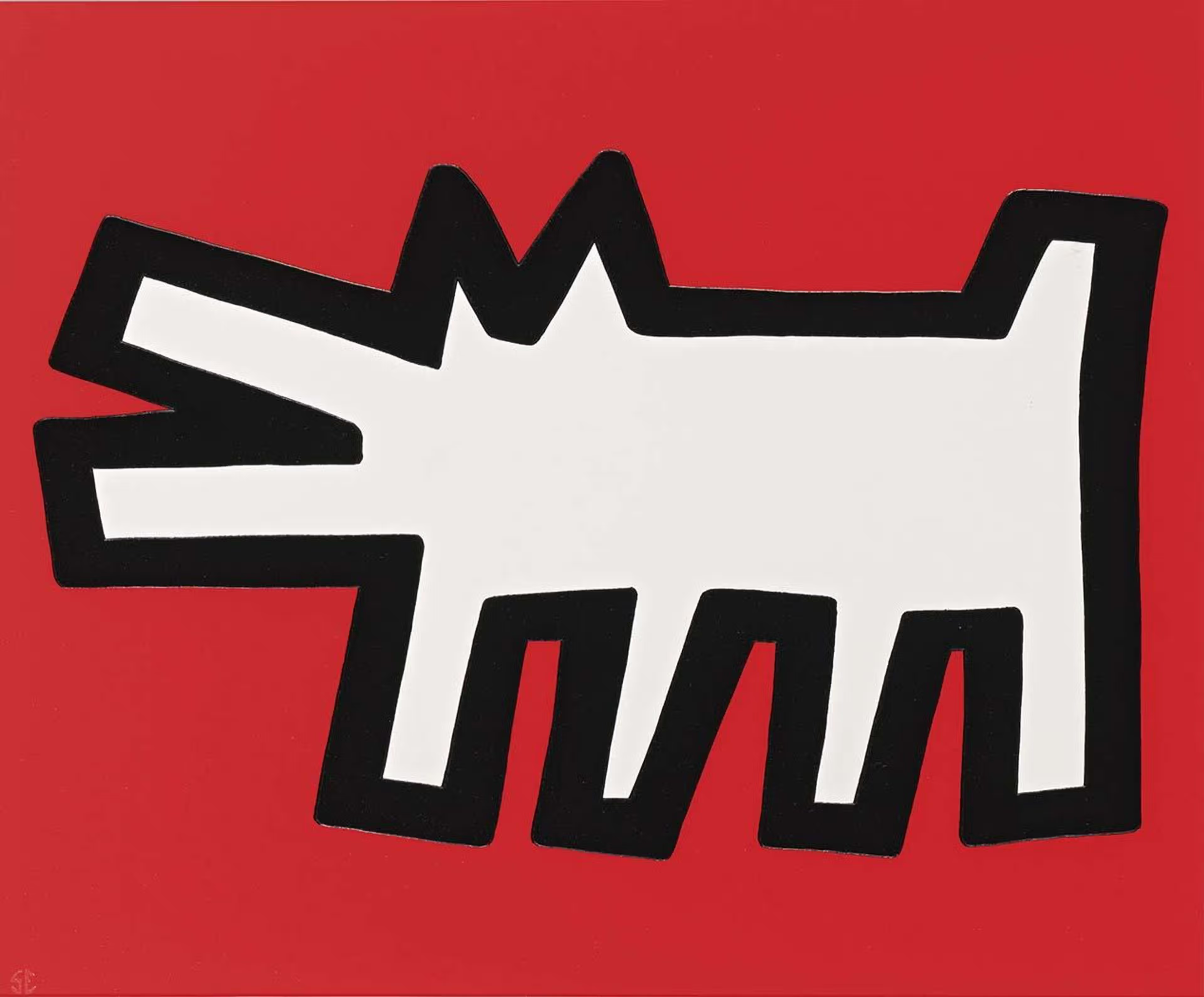
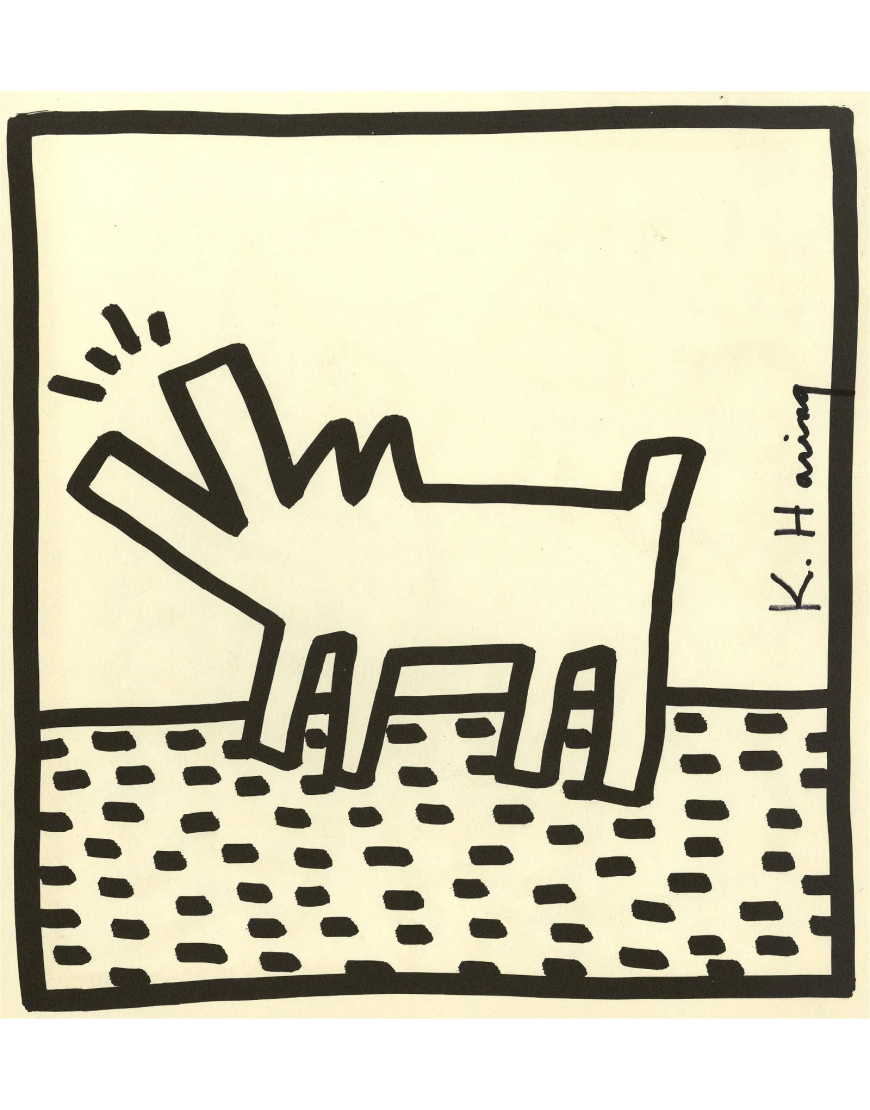
The Icons series, produced in the final months of Haring's life, is widely considered the apex of his print output. The portfolio comprises ten screenprints, each depicting a signature motif from his visual language — and the barking dog appears prominently among them.
The series was printed in 1990 and published posthumously. Each print is a large-format screenprint on Lenox Museum Board, executed in bold flat colour with the graphic precision that characterises Haring's mature work. The Icons portfolio was produced in an edition of 30, plus a small number of Artist Proofs — making it among the rarest of his print editions.
The barking dog image from Icons captures the motif at its most refined: simplified, powerful, executed with the confidence of an artist who had spent a decade perfecting this single image. Collectors regard this as the definitive print version of the dog, and auction results reflect that status.
The ten-image structure of the portfolio was itself a deliberate choice. Haring selected the motifs that he regarded as the core of his visual language — the ones that would stand as the summation of his career. The dog's inclusion confirms its centrality to his practice and his own understanding of what he had achieved.
White Icons Series (1990)
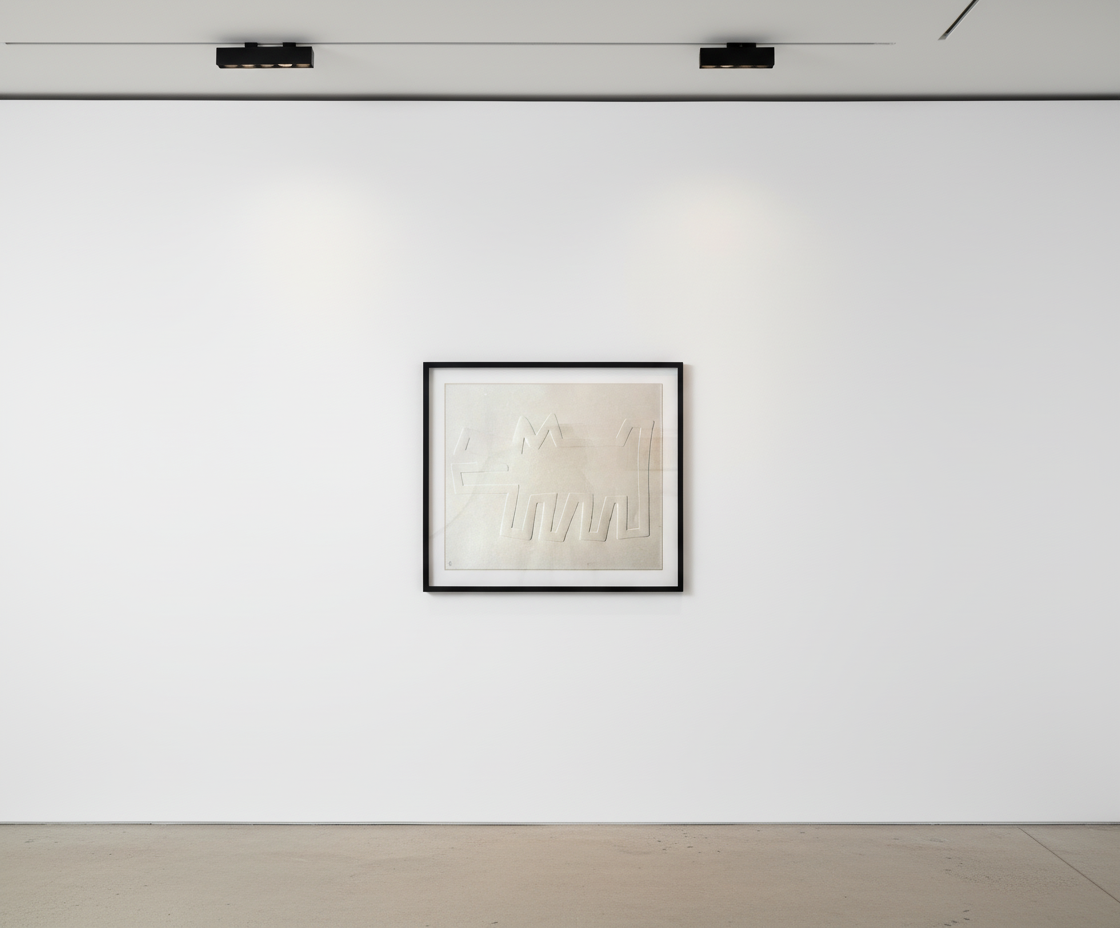
The White Icons series is a companion to Icons, presenting the same ten motifs but printed in white ink on black Lenox Museum Board. The inversion creates a dramatically different visual effect — the dog emerges from darkness rather than asserting itself against light — and gives the series a more ominous, elegiac quality that feels appropriate given it was produced as Haring faced his death from AIDS-related complications.
White Icons is produced in the same edition size as Icons: 30 editions plus APs. The black ground work is technically more demanding, and many collectors regard White Icons as the more powerful of the two portfolios. The reversed palette — white figure on black ground — recalls the original subway drawings, where the chalk-white images appeared against the matte-black advertising panels. In this sense, White Icons brings the work full circle, returning the final versions of these images to the visual conditions of their origin.
Pricing for individual prints from this series consistently outpaces even the standard Icons editions at major auction.
Stones (1987)
Earlier in his print career, Haring produced the Stones portfolio — a series of lithographs on stone that deliberately references the traditional lithographic process. The barking dog appears in Stones in a rawer, more gestural form than the later screenprints: you can feel the chalk-on-paper origins of the image in the texture of the line.
Stones was produced in a larger edition than the Icons portfolios, making individual prints more accessible to collectors entering the market. For those drawn to the historical arc of Haring's development, Stones offers a compelling counterpoint to the later, more polished print work. The roughness is not a deficiency — it is evidence of the drawing instinct beneath the refined surface of the mature work.
Other Notable Appearances
The dog appears across a broader range of Haring's print output, including the Retrospect series and various single editions produced in collaboration with publishers and galleries throughout the 1980s. Haring also worked extensively in multiples — painted and drawn objects, including Pop Shop merchandise — though these are generally regarded as collectibles rather than fine-art prints.
Collectors building serious holdings in Haring's print work typically treat the Icons and White Icons portfolios as the primary targets, with Stones and other single-image editions as supplementary acquisitions. The hierarchy is well-established in the market and reflected in auction results across the past two decades.
The Keith Haring Foundation and Authentication
Haring established his foundation in 1989, the year before his death, with a dual mission: to support arts education programmes for young people, and to maintain and disseminate his artistic legacy. The foundation is the primary authority on the authentication of Haring's work and maintains detailed records of his output.
For collectors, the foundation's involvement is crucial. Works with clear foundation provenance — those that passed through the foundation's hands at any point, or that were authenticated directly — carry a premium that reflects both their credibility and the legal protections that authenticated provenance provides in the event of future disputes.
The foundation also maintains an active programme of exhibitions, licensing, and scholarship, which supports the broader cultural presence of Haring's work and continues to introduce new audiences to his practice. This sustained institutional attention has been a significant factor in the long-term appreciation of his print market.
Collectors should be aware that the Haring market, like all markets for work by major deceased artists, attracts fakes and misattributed works. Prints offered without clear provenance, works that do not match the known specifications of documented editions, or works where the edition numbers are inconsistent with known edition sizes should all be investigated carefully before acquisition.
What Drives Value: Key Factors for Collectors
When assessing a Haring print featuring the barking dog, several factors determine value:
Edition and Series: Prints from Icons and White Icons command the highest prices by considerable margin, reflecting their rarity (edition of 30) and their status as the canonical versions of his most important motifs. Stones lithographs sit at a lower price point but have shown consistent appreciation.
Artist Proofs: APs from any series carry a premium over standard editions, both for their rarity and for the association with the artist's direct creative process.
Condition: Haring prints on Lenox Museum Board are sensitive to light and humidity. Fading, foxing, or handling marks significantly impact value. Prints in pristine condition with no toning command strong premiums.
Provenance: Works with clear provenance — particularly those that can be traced to the original publisher, the Keith Haring Foundation, or early collectors — are preferred by serious buyers. The foundation maintains records of authenticated works.
Authentication: The Keith Haring Foundation is the primary authentication authority. Collectors should seek works accompanied by foundation documentation or with clear auction and gallery history.
The Market Today
Haring's print market has shown remarkable resilience and consistent growth over the past two decades. Works from the Icons and White Icons portfolios regularly achieve six-figure results at major auction houses, with the barking dog among the most sought-after individual images.
The broader cultural presence of Haring's imagery — through retrospectives, collaborations, and the sustained activity of the Keith Haring Foundation — continues to introduce new collectors to his work while supporting values for established works. Major retrospectives at institutions including the Tate Liverpool, the Guggenheim Bilbao, and the Brooklyn Museum have each been followed by periods of heightened secondary market activity, as new collectors converted into buyers.
The dog specifically has benefited from growing scholarly attention to the political dimensions of Haring's work. As the AIDS crisis recedes in lived memory while gaining in historical significance, the work produced in its shadow — including the Icons portfolios — has attracted renewed critical attention that translates into sustained collector demand.
For collectors at entry level, works on paper, drawings, and prints from more accessible series offer genuine contact with Haring's visual world at more attainable price points. As with any market, condition and documentation are paramount.
Building a Collection
For collectors drawn specifically to the barking dog, the logical progression runs from accessible single editions and Stones lithographs up through the Icons and White Icons portfolios. Each level offers something different: the Stones prints connect you to Haring's process; the Icons series gives you the motif at its most resolved and historically significant.
Collectors with the means to acquire from the Icons portfolios face an interesting choice between the standard and White Icons versions. Many serious collections ultimately hold both: the complementary colourways, the different visual experiences they offer, and the complete narrative of the portfolio as a final artistic statement make a strong case for acquiring the pair.
Whatever you acquire, buy the best condition you can find, prioritise documented provenance, and engage only with dealers and auction houses that can speak credibly to the work's history. The Haring market is active, liquid, and well-documented — there is no reason to take shortcuts on due diligence.
Further Reading
Browse Keith Haring prints available at Guy Hepner
Sell your Keith Haring with Guy Hepner
Works For Sale
Available through Guy Hepner
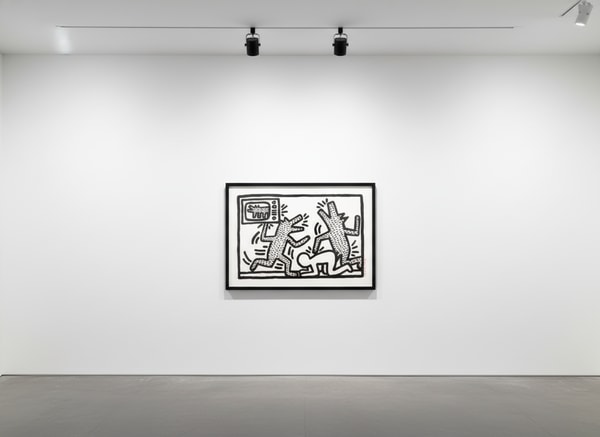
Keith Haring
Untitled III (Littmann PP. 20)
1982
Enquire →
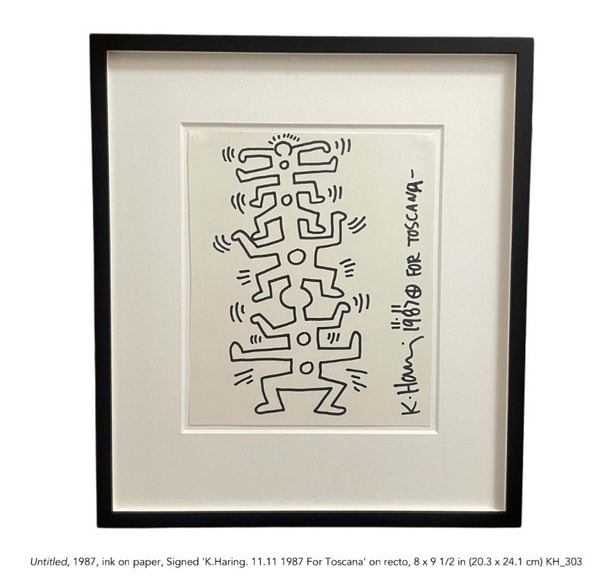
Keith Haring
Untitled (For Toscana)
1987
Enquire →

Keith Haring
Chocolate Buddha 2 (Littmann PP. 124)
1989
Enquire →

Keith Haring
Untitled (Cup Man) (Littmann PP. 116-117)
1989
Enquire →

Keith Haring
Chocolate Buddha 4 (Littmann PP. 125)
1989
Enquire →

Keith Haring
Chocolate Buddha 3 (Littmann PP. 124)
1989
Enquire →

Keith Haring
Angel, from White Icons (Littmann PP. 173)
1990
Enquire →

Keith Haring
Dog
1986
Enquire →
Thinking of selling?
Get a free Keith Haring valuation
Guy Hepner Gallery — 25+ years in the market. Same-day offers.
More from Guy Hepner